 listicle
5 Best Peptide Synthesis Methods for Purity
Last Updated: November 5, 2026
Quick Summary
Solid-phase peptide synthesis (SPPS) delivers the highest reliable purity for most sequences, reaching crude purity in the high 70s to high 80s percent and above 95% after purification. Fragment-based synthesis and chemical ligation rank second for long or complex chains, followed by liquid-phase synthesis for short peptides, tag-assisted synthesis, and chemo-enzymatic synthesis. These peptide synthesis methods are ranked by achievable purity, not popularity.
- SPPS removes excess reagents after every coupling, preventing deletion sequences from propagating.
- Fragment-based synthesis purifies each fragment before ligation, so purity is limited by the ligation step.
- Liquid-phase synthesis works best for peptides under about 10 residues, where purification is straightforward.
- Tag-assisted synthesis adds attachment and removal steps, and residual tag becomes a new impurity.
- Length is the strongest driver of achievable purity because errors accumulate across coupling cycles.
Table of Contents
- Why Peptide Purity Starts With the Synthesis Method
- The 5 Best Peptide Synthesis Methods Ranked by Achievable Purity
- 1. Solid-Phase Peptide Synthesis (SPPS), Highest Reliable Purity for Most Sequences
- 2. Fragment-Based Synthesis and Chemical Ligation, Highest Purity for Long or Complex Chains
- 3. Liquid-Phase Peptide Synthesis (LPPS), High Purity for Short Sequences
- 4. Tag-Assisted Peptide Synthesis, Purity Rescue for Poorly Soluble Sequences
- 5. Chemo-Enzymatic Peptide Synthesis (CEPS), Specialized, Method-Dependent Purity
- Comparison Table: Method, Best Use Case, and Purity Profile
- Solid-Phase Peptide Synthesis: The Purity Workhorse for Most Sequences
- Liquid-Phase Peptide Synthesis: Purity Gains for Short Sequences
- Fragment-Based and Chemical Ligation Methods for Long Peptides
- Tag-Assisted Peptide Synthesis: When Purity Needs a Handle
- Peptide Purity Analysis by HPLC: How Purity Is Actually Measured
- Purity Benchmarks by Peptide Length, Sequence Difficulty, and Intended Use
- Frequently Asked Questions
Why Peptide Purity Starts With the Synthesis Method
Purity in peptide production is decided long before the first vial reaches an HPLC instrument. The synthesis route sets a ceiling on how clean the crude peptide can be, and no amount of downstream purification fully rescues a poorly assembled chain.
Researchers often treat purity as a testing problem. It is not, testing only reports what synthesis produced.
How Synthesis Purity Differs From Post-Synthesis Purification
Synthesis purity is the proportion of full-length, correctly assembled peptide in the crude product before cleanup. Post-synthesis purification, usually preparative HPLC, removes impurities that synthesis created. A method with high coupling efficiency yields crude peptide that is already mostly target sequence, so purification is a polishing step; a method that accumulates deletion sequences forces purification to do heavy lifting, and recovery drops.
The 5 Best Peptide Synthesis Methods Ranked by Achievable Purity
Most rankings of peptide synthesis methods order them by popularity or scale. This one orders five methods by the purity a well-run laboratory can realistically achieve, first in the crude product and then after purification. Two ground rules: crude purity and final analytical purity are separate numbers, and no method wins on every sequence, the ranking reflects the median case, with notes on where the order flips.
The criteria used to rank each method:
- Coupling efficiency per cycle, how completely each amino acid is added, since incomplete coupling is the root of deletion sequences.
- Control of aggregation, whether the growing chain can fold back and shield reactive sites, the main purity killer for long or hydrophobic sequences.
- Side-reaction burden, racemization, aspartimide formation, methionine oxidation, and truncation, and how easily each is suppressed.
1. Solid-Phase Peptide Synthesis (SPPS), Highest Reliable Purity for Most Sequences
SPPS builds the chain on an insoluble resin and washes away excess reagent after every coupling, so unreacted amino acids and byproducts are removed before they can propagate. For sequences up to roughly 30-50 residues, a well-optimized Fmoc SPPS cycle routinely delivers crude purity in the high 70s to high 80s percent by RP-HPLC area, and final purity above 95% after preparative purification.
2. Fragment-Based Synthesis and Chemical Ligation, Highest Purity for Long or Complex Chains
When single-chain assembly would aggregate, fragment-based synthesis splits the sequence into shorter pieces, purifies each to high purity, then joins them by chemical ligation. Because every fragment is verified before ligation, final purity is limited by the ligation step rather than by accumulated errors of a long synthesis. The cost is procedural: more steps, more purification checkpoints, and a ligation junction that must be confirmed.
3. Liquid-Phase Peptide Synthesis (LPPS), High Purity for Short Sequences
LPPS performs coupling in homogeneous solution, allowing direct monitoring of each reaction and purification by precipitation or crystallization between steps. For short peptides, typically under about 10 residues, this can produce very clean product with straightforward purification and lower reagent cost. It ranks below SPPS and fragment methods because the advantage disappears as length grows: solubility falls, separation becomes difficult, and manual handling burden rises.
4. Tag-Assisted Peptide Synthesis, Purity Rescue for Poorly Soluble Sequences
Tag-assisted synthesis attaches a chemical handle that improves solubility, separation, or handling during synthesis and purification. The tag changes how a difficult sequence interacts with the chromatography phase, which can turn a poorly resolving peptide into a purifiable one. It ranks fourth because the tag adds reactions: attachment and removal must each go to completion, and any residual tag becomes a new impurity to detect and quantify.
5. Chemo-Enzymatic Peptide Synthesis (CEPS), Specialized, Method-Dependent Purity
CEPS uses enzymes to form peptide bonds, which can give high selectivity and reduce racemization for selected sequences. It ranks fifth because its purity performance is the most sequence-dependent of the five and its routine use is less established than SPPS. For specific targets where enzymatic selectivity solves a coupling problem chemical methods cannot, CEPS can deliver excellent purity.
Comparison Table: Method, Best Use Case, and Purity Profile
| Method | Best Use Case | Crude Purity Profile | Final Purity After Purification | Main Limitation |
|---|---|---|---|---|
| SPPS | Most research sequences up to moderate length | High for typical sequences; falls with length and hydrophobicity | Routinely above 95% | On-resin aggregation for long chains |
| Fragment-based / ligation | Long, complex, or aggregation-prone peptides | High when each fragment is verified | High, limited by ligation step | More steps and checkpoints |
| LPPS | Short peptides (roughly under 10 residues) | High for short sequences | High, easy purification | Impractical as length and scale grow |
| Tag-assisted | Poorly soluble or hard-to-purify sequences | Improved via better separation | Improved when tag removal is complete | Extra attachment and removal steps |
| CEPS | Selected specialized sequences | Method- and sequence-dependent | Method-dependent | Less established for routine work |
Watch out: the ranking assumes each method is run well. A poorly optimized SPPS cycle, incomplete coupling, insufficient washing, or a mismatched resin, will underperform a well-run LPPS on a short sequence, so treat the order as a starting hypothesis to test against your actual target.
Solid-Phase Peptide Synthesis: The Purity Workhorse for Most Sequences
Solid-phase peptide synthesis is the dominant method for research-grade peptides because it builds the chain on an insoluble resin, letting you wash away excess reagents after every coupling.
The method is not unlimited. If you are weighing whether higher-purity synthesis justifies its cost, our guide to whether high purity peptide synthesis is worth the extra cost breaks down the trade-offs.
Best for: laboratories that need reliable, automatable synthesis across many sequences. Skip if: your target peptide is exceptionally long and prone to on-resin aggregation.
Liquid-Phase Peptide Synthesis: Purity Gains for Short Sequences
Liquid-phase peptide synthesis, also called solution-phase synthesis, performs coupling in a homogeneous solution rather than on a solid support.
The catch is scale and handling. Solution-phase work demands more manual separation steps, and longer sequences become impractical as solubility and purification complexity grow.
Best for: short sequences where straightforward purification and cost control matter. Skip if: you need long chains or high-throughput automated production.
Fragment-Based and Chemical Ligation Methods for Long Peptides
When a sequence is too long or too complex for single-chain assembly, fragment-based synthesis and chemical ligation split the problem into manageable pieces.
This is the method of choice when aggregation and deletion sequences would otherwise dominate.
Best for: long or complex peptides that resist straightforward SPPS. Skip if: your sequence is short enough that a single assembly is simpler and cleaner.
Tag-Assisted Peptide Synthesis: When Purity Needs a Handle
Tag-assisted peptide synthesis attaches a chemical handle to the peptide to improve solubility, separation, or handling during synthesis and purification.
The extra steps are the cost. Adding and later removing a tag introduces additional reactions that must be controlled, and any incomplete tag removal becomes a new impurity to track.
Best for: poorly soluble or hard-to-purify sequences. Skip if: your peptide purifies cleanly without added complexity.
Peptide Purity Analysis by HPLC: How Purity Is Actually Measured
Peptide purity analysis by HPLC separates a sample's components on a chromatography column and measures the relative area of the target peak. Reversed-phase HPLC on a C18 column with a water-acetonitrile gradient is the standard approach.
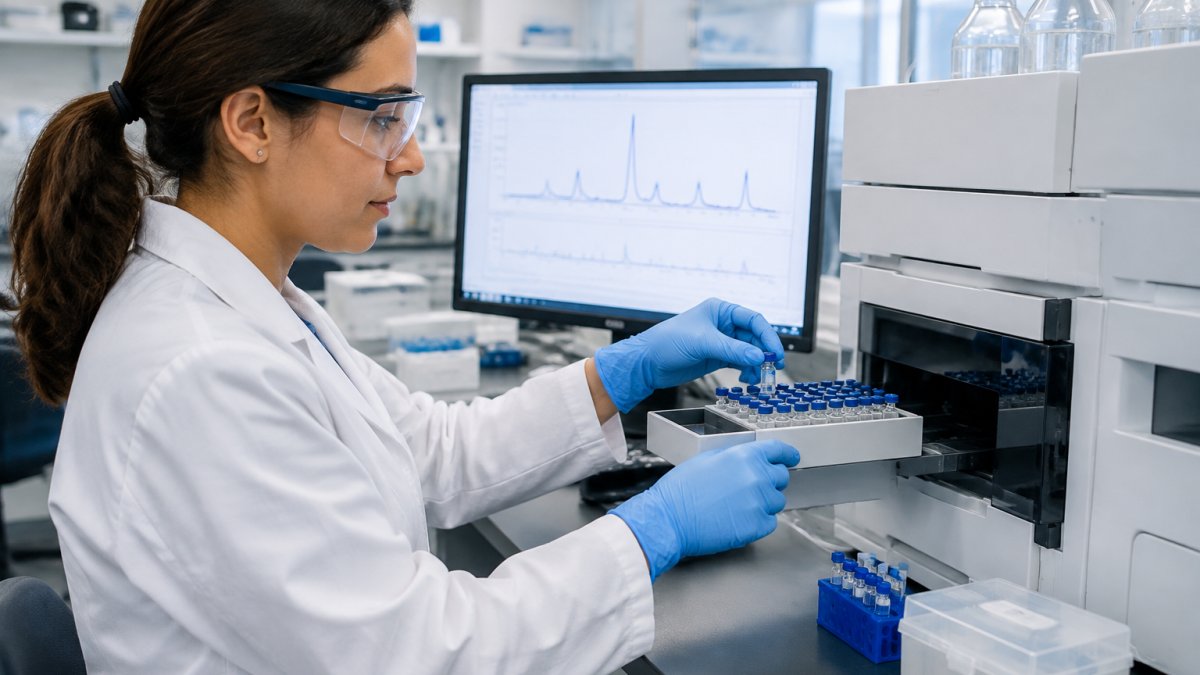
Reading that number correctly takes practice. A single peak at 98% area does not confirm identity, and co-eluting impurities can hide under the main peak. For a practical walkthrough, see our guide to understanding HPLC peptide analysis reports.
Purity Benchmarks by Peptide Length, Sequence Difficulty, and Intended Use
A purity percentage is meaningless without the context that produced it. The same 95% figure can represent an excellent result for a 40-residue hydrophobic peptide and a disappointing one for a 5-residue dipeptide. Length, sequence difficulty, and intended use all move the realistic purity target.
How Peptide Length Shifts the Purity Target
Length is the single strongest driver of achievable purity because every coupling cycle is an opportunity for an incomplete reaction, and those errors accumulate. A useful way to think about it:
- Short sequences (roughly under 10 residues): crude purity is often high enough that a single purification step reaches very high final purity. LPPS and SPPS both perform well here.
- Moderate sequences (roughly 10-30 residues): SPPS is the standard, and crude purity typically lands in a range that preparative RP-HPLC can polish to high final purity. Coupling efficiency per cycle matters most in this band.
- Long sequences (roughly 30-50 residues and beyond): aggregation and cumulative deletion sequences begin to dominate. Crude purity falls, purification recovery drops, and fragment-based or ligation strategies become worth the extra steps.
These bands are approximate and shift with sequence, but they explain why a method that is excellent for a decapeptide can disappoint for a 40-mer.
Sequence Difficulty: The Variables That Move the Number
Two peptides of identical length can differ sharply in achievable purity because of their sequence. The main difficulty factors:
- Hydrophobicity and aggregation propensity. Hydrophobic stretches promote on-resin aggregation, shielding reactive sites and lowering coupling efficiency, the most common cause of crude purity worse than length alone would predict.
- Modified and non-natural residues. Unusual building blocks couple less efficiently and can require altered coupling conditions, raising the side-reaction burden.
- Racemization-prone residues. Certain residues are more susceptible to racemization during coupling, producing a diastereomer that is difficult to separate because it closely resembles the target.
A practical pattern: when a sequence is both long and difficult, expect the crude purity ceiling to fall and budget additional purification or a fragment strategy accordingly.
Intended Use Sets the Bar
Purity requirements are not universal; they follow from what the peptide is for. Routine screening and exploratory work generally tolerate more impurity than applications where trace contaminants can distort results. Receptor binding studies, pharmacokinetic profiling, and any work where a minor impurity could produce a biological signal of its own justify a higher target and orthogonal verification.
A common mistake is treating a single purity percentage as a universal quality signal. If you are deciding whether 98% purity is enough, our researcher's guide to whether 98% purity is good for peptides explains when 98% suffices and when you need higher. Labs weighing a lower threshold can check whether 95% peptide purity is enough for research.
Matching Method to Benchmark
The benchmark and the method should be chosen together. Short, simple sequences rarely need fragment strategies; long, difficult sequences rarely succeed with a single-chain default. Use the length and difficulty bands above to narrow the method, then use the intended use to set the purity target and the analytical testing that will confirm it. If you are vetting suppliers, our buyer's guide to reliable peptide synthesis for labs covers how to verify certificates and avoid costly mistakes.
Frequently Asked Questions
Which peptide synthesis methods produce the highest purity?
Solid-phase peptide synthesis (SPPS) is generally described as providing high purity and is the most widely used approach for research-grade peptides, especially when automated. For complex or lengthy sequences, fragment-based synthesis and chemical ligation can improve purity by assembling shorter, easier-to-purify segments. Solution-phase synthesis is also cited as offering high purity and easy purification for shorter peptides. The right choice depends on sequence length, difficulty, and scale.
How is peptide purity measured after synthesis?
Peptide purity analysis by HPLC is the standard approach. Reversed-phase HPLC (RP-HPLC) with a C18 column and gradient elution separates the target peptide from impurities, and UV detection quantifies the main peak as a percentage of total peak area. Mass spectrometry is typically run alongside HPLC to confirm molecular mass and identity. Together, these methods verify both purity and that the correct peptide sequence was produced.
Is 98% purity good for peptides?
For many routine research applications, 98% purity is acceptable, but it leaves roughly 2% impurities that can matter in sensitive work such as receptor binding studies or pharmacokinetic profiling. For those applications, ≥99% purity is often preferred. Purity requirements should match the intended use, and a full Certificate of Analysis with HPLC and mass spectrometry data lets you confirm what you are actually working with.
What is the difference between solid-phase and liquid-phase peptide synthesis?
Solid-phase peptide synthesis builds the peptide on an insoluble resin support, which allows excess reagents to be washed away and makes the process easy to automate. Liquid-phase peptide synthesis, also called solution-phase synthesis, builds the peptide in solution and is cited as offering high purity, easy purification, and lower cost, though it is typically better suited to shorter sequences. SPPS is more common for longer or automated workflows.
How do peptide length and sequence affect synthesis purity?
Longer sequences accumulate more coupling and deprotection steps, which increases the chance of deletion sequences, aggregation, and racemization. Difficult sequences with hydrophobic stretches or steric hindrance can also reduce coupling efficiency. For these cases, fragment-based synthesis or chemical ligation can improve purity by assembling shorter segments. Matching the method to sequence difficulty is one of the most reliable ways to raise achievable purity.