 listicle
Reliable Peptide Synthesis for Labs: A 2026 Buyer's Guide
Table of Contents
- Why Lab-Grade Reliability Goes Beyond Purity Percentages
- How to Verify Peptide Purity Certificate of Analysis
- What Reliable Peptide Synthesis for Labs Must Include
- Custom Peptide Synthesis Cost per Amino Acid: What to Expect
- Buying Research Peptides in Bulk: Scaling Without Risk
- Vendor Vetting Checklist: 7 Questions Before You Order
- Troubleshooting Failed Syntheses and Documentation Gaps
- Conclusion: Building a Reproducible Peptide Supply Chain
- Frequently Asked Questions
Last Updated: September 9, 2026
Why Lab-Grade Reliability Goes Beyond Purity Percentages
A Certificate of Analysis that lists 98% or 99% purity can still hide problems that derail a study. The real measure of reliable peptide synthesis for labs is the consistency of the analytical data behind it, reproducibility across batches, and the completeness of the documentation trail.
Many suppliers quote a purity percentage without showing the actual chromatogram, sequence verification, or counterion content. That omission matters because a crude peptide can show high UV absorbance at 214 nm while containing significant truncation products invisible to a simple readout.
Below, we show you how to evaluate a supplier's documentation and the seven questions to ask before committing a single grant dollar.
How to Verify Peptide Purity Certificate of Analysis
The Certificate of Analysis (COA) is your primary legal and scientific evidence of product quality, but it is only as reliable as the analytical methods behind it. A superficial read of a purity percentage is insufficient; you must audit the document for internal consistency and methodological rigor.
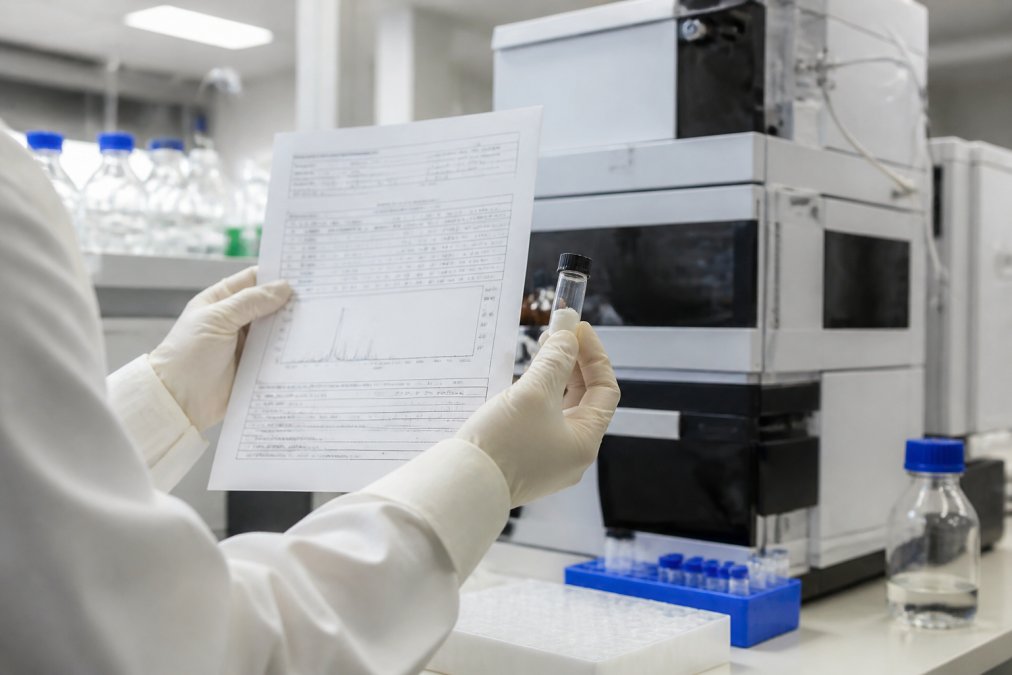
Deconstructing the Analytical Data Package
A robust COA is a data package that includes the HPLC chromatogram, the mass spectrometry (MS) report, and the synthesis record. Do not just check the final purity number. Instead, perform a three-point verification:
- HPLC Method and Trace Integrity: The chromatogram must show a UV trace at 214 nm, the standard wavelength for peptide bond absorbance. Check that the main peak is sharp and symmetrical. A broad or shouldered peak indicates heterogeneous material that may co-elute with impurities. Confirm the method states the gradient conditions (e.g., water/acetonitrile with 0.1% TFA) and the column type. If the COA only lists a purity percentage without a trace, you cannot assess the separation quality.
- Mass Spectrometry Confirmation: The COA must report the observed molecular weight (m/z) alongside the theoretical value. A mass error of greater than 0.5 Da for a standard peptide is a red flag. More importantly, check for the presence of additional peaks in the MS spectrum that correspond to common failure products like deletion sequences (missing an amino acid) or truncation products. A clean MS trace confirms sequence fidelity, not just overall purity.
- Counterion and Salt Form Specification: The COA must state whether the peptide is supplied as an acetate salt or a trifluoroacetic acid (TFA) salt. This is not a trivial detail. TFA, a common cleavage reagent, can remain bound to the peptide and interfere with cellular assays or downstream conjugation chemistry. If your assay is sensitive to TFA, you must request a counterion exchange to acetate. A COA that omits this specification is incomplete.
Spotting the 'Recycled' COA
A common failure mode is the reuse of a COA from a previous production batch. To detect this, cross-reference the batch number on the COA with the one on the vial label. The analytical date must fall within the product's stability window. If the date is older than the production date, or the batch numbers do not match, the documentation is invalid. This practice is often seen with distributors who do not perform their own QC.
The 'Gap' Competitors Miss: A Vendor Audit Rubric
Most commercial pages stop at 'we provide a COA.' To truly de-risk your sourcing, audit the vendor's analytical capabilities. Ask for their standard operating procedures (SOPs) for HPLC and MS. Inquire about their system suitability tests, do they run a standard peptide mix to calibrate their instruments daily? A vendor that cannot articulate their internal QC thresholds is unlikely to provide consistent batch-to-batch quality.
What Reliable Peptide Synthesis for Labs Must Include
Reliable peptide synthesis for labs is defined by three pillars: sequence fidelity, modification accuracy, and documentation integrity. Sequence fidelity means the final product matches the requested amino acid residues in the correct order, verified analytically rather than assumed from the synthesis log. Modification accuracy applies to custom work like phosphorylation, biotinylation, or fluorescent labeling, where a missed conjugation site can invalidate an entire assay.
Documentation integrity ties the first two together. Without a complete chain of custody from the crude peptide to the final lyophilized product, you cannot verify that what you received is what you designed. The National Institutes of Health guidelines on research reproducibility emphasize that reagent quality directly impacts experimental validity, making sourcing decisions a scientific matter, not just a purchasing one.
Analytical Methods That Matter: HPLC and Mass Spec
High-performance liquid chromatography (HPLC) and mass spectrometry are the two methods that matter most for peptide verification. HPLC separates the target peptide from impurities, reporting the purity percentage on the COA. Mass spectrometry confirms the molecular weight, proving the sequence was assembled correctly.
A reliable supplier runs both on every batch and shares the raw data. If a vendor only provides a purity number without the supporting chromatogram and mass spec trace, you are working on trust rather than evidence.
Documentation Standards for Research-Grade Peptides
Research-grade documentation should include the synthesis method, typically solid-phase peptide synthesis, the cleavage and purification profile, the final purity percentage, and the storage conditions. Look for a certificate that specifies whether the product is supplied as an acetate salt or TFA salt, since the counterion affects solubility testing and downstream assay compatibility.
Custom Peptide Synthesis Cost per Amino Acid: What to Expect
Pricing for custom peptide synthesis is typically quoted per amino acid residue, with additional charges for modifications, purification levels, and scale. Suppliers often structure pricing around a base rate per residue, then add premiums for difficult sequences, long chains, or specialized modifications.
The American Peptide Society's resources on synthesis best practices note that cost varies substantially with sequence length and difficulty. A standard 10-mer with no modifications will cost far less per residue than a 40-mer with multiple disulfide bridges requiring careful oxidation steps.
What you are paying for at the upper end of the market is the analytical verification and the guarantee that the product will work. For labs that need to know how to verify peptide purity certificate of analysis, the documentation cost is baked into the quote. Globo Research Peptides offers a special-order fulfillment program for unique products, with pricing that reflects the complexity of the synthesis and the rigor of the testing. Pricing depends on quantity, dates, and delivery. Please visit our website for current prices or a quote.
Buying Research Peptides in Bulk: Scaling Without Risk
Scaling from milligram to gram quantities is not a linear process; it introduces new failure modes invisible at the research scale. The primary risks shift from sequence fidelity to physical form consistency, solubility behavior, and long-term stability.
The Lyophilization Artifact Problem
When you order a gram of peptide, you are buying a specific physical form produced by large-scale lyophilization. At this scale, the peptide solution is often frozen in a larger vessel, which can lead to 'melt-back' or 'collapse,' where the product temperature rises above its eutectic point and the cake collapses into a dense, glassy mass. This collapsed form is often harder to reconstitute and may have reduced solubility.
Actionable Check: When you receive a bulk lot, visually inspect the lyophilized powder. It should be a loose, off-white powder or a fragile cake that easily breaks apart. A dense, hard, or glassy pellet is a sign of a poor lyophilization cycle. Request the vendor's cycle parameters (shelf temperature, vacuum pressure, time) to ensure they are using a peptide-appropriate cycle.
Solubility and Concentration Limits at Scale
A peptide that dissolves readily at 1 mg/mL may behave entirely differently at 100 mg/mL, often the concentration required for a stock solution in a bulk workflow. The issue is often not the peptide's inherent solubility but the presence of insoluble aggregates formed during large-scale cleavage and precipitation.
Actionable Check: Before committing to a full bulk order, request a 'scale-down' sample from the exact same production batch. Do not just test for purity; test for solubility at your target stock concentration in your specific buffer. If the vendor cannot provide a sample from the same batch, consider this a risk. A common pattern is that a 'scaled-up' process uses a different cleavage cocktail or precipitation solvent, which can alter the peptide's secondary structure and solubility.
Verifying Lot-to-Lot Consistency: Beyond the Purity Number
For long-term projects, you will order multiple bulk lots. The risk is that a new lot, while meeting the same ≥98% purity specification, has a different impurity profile that can affect your assay's background signal or kinetics.
Actionable Check: Do not compare just the purity percentages between lots. Overlay the HPLC chromatograms from the previous lot and the new lot. They should be nearly superimposable, with the same main peak retention time and the same minor impurity peaks at similar relative abundances. If a new lot shows a new impurity peak absent in the previous lot, even at 0.5%, it indicates a change in the synthesis or purification process.
Storage and Handling: The 'Open Vial' Degradation Trap
A bulk container is a single point of failure for moisture ingress. Peptides are hygroscopic; a gram of lyophilized powder can absorb significant moisture in a single opening, leading to hydrolysis and aggregation over time. Plan for single-use aliquots. Under an inert gas, divide the bulk powder into smaller, pre-weighed vials suitable for a week's worth of experiments. Store these at -20°C or -80°C, and keep the main stock desiccated and sealed. This is the most common cause of 'inexplicable' loss of activity in bulk supplies.
Vendor Vetting Checklist: 7 Questions Before You Order
Use this checklist to standardize how you evaluate any peptide supplier, including Globo Research Peptides. Run every potential vendor through the same criteria to keep the comparison objective.
- Do you provide a batch-specific COA with HPLC chromatogram and mass spec data? If the answer is anything other than an immediate yes, move on.
- What is your verified purity guarantee? Look for ≥99% HPLC purity with third-party confirmation, not just an in-house number.
- Can you synthesize modified peptides, including phosphorylation, biotinylation, and fluorescent labeling? Confirm the modification chemistry before you need it.
- What is your typical turnaround time for custom sequences? A vague answer suggests poor production planning.
- Do you have stock of common research peptides, or is everything made to order? In-stock inventory means faster starts for your experiments.
- What happens if the documentation does not match my specifications? A clear replacement or refund policy protects your timeline.
- Can you scale from milligram research quantities to bulk grams? You do not want to revalidate a new supplier mid-project.
| Verification Step | What to Check | Why It Matters |
|---|---|---|
| COA Batch Match | Batch number on vial matches document | Prevents recycled documentation |
| HPLC Trace | UV chromatogram at 214 nm included | Confirms purity method and profile |
| Mass Spec Data | Observed vs. theoretical molecular weight | Verifies sequence fidelity |
| Counterion Spec | Acetate salt or TFA stated | Affects solubility and assays |
| Third-Party Testing | Independent lab confirmation | Backs in-house quality claims |
Troubleshooting Failed Syntheses and Documentation Gaps
When a synthesis fails or documentation falls short, the problem usually traces to one of three causes: sequence difficulty, modification instability, or purification shortcuts. Difficult sequences, particularly those with hydrophobic stretches or aggregation-prone regions, may require specialized protocols that a generalist supplier cannot handle.
Modification instability is another common failure point. Phosphorylation and disulfide bridge formation are sensitive to cleavage conditions. If your modified peptide arrives with the modification missing or partially degraded, the issue is often in post-synthesis handling rather than initial assembly.
Documentation gaps are the easiest to spot and the most frustrating to resolve. If a supplier cannot produce a complete analytical data package, including the purification profile and sequence verification, the product is effectively unverified. The US Pharmacopeia guidance on peptide reference standards underscores that analytical characterization is essential for any material used in research or development. A vendor that cannot supply this data is asking you to trust rather than verify.
Conclusion: Building a Reproducible Peptide Supply Chain
Reliable peptide synthesis for labs is not a single purchase decision but an ongoing supply chain strategy. The suppliers you choose become partners in your research reproducibility, and their documentation quality directly affects your experimental outcomes.
The challenge is that sourcing peptides is a relationship, not a transaction. You need a vendor that understands sequence complexity, provides transparent analytical data, and can respond when your research needs shift. Globo Research Peptides combines verified ≥99% HPLC purity with full Certificate of Analysis documentation and a special-order fulfillment program, giving you a single source for both standard research compounds and unique custom sequences.
Frequently Asked Questions
How much does it cost to have a peptide synthesized?
Pricing for custom peptide synthesis varies widely based on sequence length, modification complexity, purity grade, and quantity. Most suppliers require a formal quote because difficult sequences, phosphorylation, or disulfide bridges add cost. For an accurate estimate, request quotes from multiple vendors and compare their analytical documentation and purity guarantees alongside the price.
What quality control documentation should a peptide synthesis lab provide?
A reputable synthesis lab provides a Certificate of Analysis (COA) for each batch. This document must include the HPLC purity percentage, mass spectrometry confirmation of molecular weight, sequence verification data, and the counterion form such as acetate salt or trifluoroacetic acid. The COA should also list the net peptide weight, lot number, and synthesis date. Some vendors add solubility testing results or a purification profile. If a supplier refuses to share this documentation before purchase, treat that as a red flag.
How do you verify the purity of custom synthesized peptides?
Start by reviewing the Certificate of Analysis for the reported HPLC purity percentage and the mass spectrometry trace that confirms the correct molecular weight. For critical studies, request the raw HPLC chromatogram rather than a summary. You can also submit a sample to an independent analytical lab for confirmatory testing. Reproducibility depends on consistent purity, so order from vendors that provide batch-specific documentation and retain samples for re-analysis when questions arise.
What is the typical turnaround time for custom peptide synthesis?
Standard custom synthesis typically takes 1 to 3 weeks depending on sequence length and complexity. Simple sequences under 20 amino acid residues may ship faster, while peptides requiring custom modification, disulfide bridge formation, or fluorescent labeling can extend timelines. Bulk orders or peptides above 50 residues often require additional purification passes and scale-up time. Always confirm the delivery date in writing before ordering, especially for time-sensitive studies, and ask whether partial shipments are available for large projects.