 listicle
Best Practices for Sourcing Research Peptides in 2026
Table of Contents
- Vendor Vetting: How to Find a Reliable Peptide Supplier
- How to Read a Peptide Certificate of Analysis
- Legal and Regulatory Considerations for Research Peptide Procurement
- Buying Research Peptides in Bulk: Batch Testing, Supply Chain Integrity, and Cost
- Research Peptide Storage and Handling Best Practices
- Comparing Top Sourcing Options: A Due Diligence Matrix
- Conclusion: Building a Repeatable Sourcing Workflow
- Frequently Asked Questions
Last Updated: September 22, 2026
Vendor Vetting: How to Find a Reliable Peptide Supplier
Sourcing research peptides starts with vendor vetting, and when it comes to sourcing research peptides, the strongest signal is documentation you can verify independently. At Globo Research Peptides, we see labs waste weeks re-running experiments because a supplier's paperwork didn't hold up.
The 4 checks that catch most problems:
- Confirm the supplier publishes batch-specific Certificates of Analysis, not generic sample documents
- Verify that testing was performed by an accredited third-party laboratory
- Check that the peptide sequence and molecular weight on the CoA match the catalog listing
- Ask how the supplier handles a documentation mismatch after shipment
Red Flags in Supplier Websites and Documentation
Warning signs cluster around vagueness. A supplier who won't name the testing laboratory, shows one CoA for every product, or lists purity without a method is telling you something. So is a website with no physical address, no batch numbers, and no way to request a current CoA before purchase. FDA guidance on compounded and unapproved drugs explains why unverified sourcing carries real risk.
Compounding Pharmacies vs. Research Labs: What the 503a/503b Distinction Means
These are different businesses with different rules. A 503A compounding pharmacy prepares patient-specific prescriptions under state oversight. A 503B outsourcing facility registers with the FDA and can produce larger batches without patient-specific prescriptions. Research peptide suppliers are neither, they sell materials for laboratory study, not human use, and should never blur that line.
How to Read a Peptide Certificate of Analysis
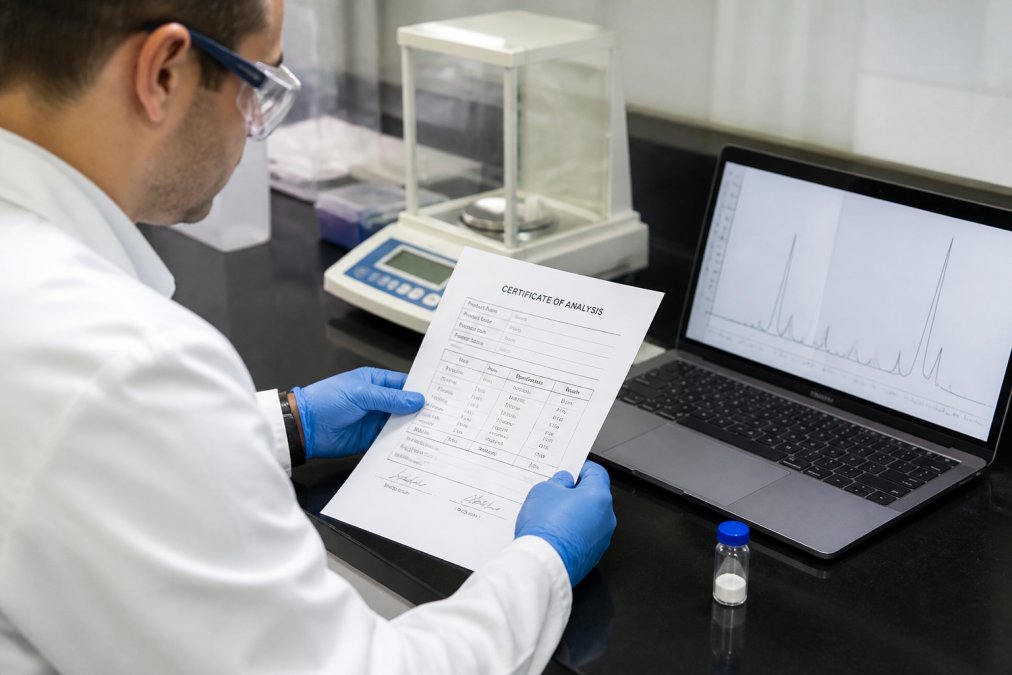
A Certificate of Analysis (CoA) is a batch-specific document reporting what analytical testing found in a specific lot. It should name the peptide, lot number, test methods, results, and the performing laboratory.
Interpreting HPLC and Mass Spectrometry Reports
HPLC separates a sample's components and reports how much is the target peptide versus everything else. Mass spectrometry confirms molecular weight, proving the compound matches the label. You want both: purity without mass confirmation doesn't prove identity, and mass confirmation without HPLC doesn't prove the sample is clean.
Purity Profile, Impurity Profile, and What ≥99% Actually Means
A purity figure of ≥99% means the target peak accounts for at least 99% of the detected HPLC area, it says nothing about the remaining fraction. Ask for the impurity profile too: deleted sequences, truncated fragments, and residual solvents all show up there. Acetate content and trifluoroacetate levels also matter, since they affect solubility and assay behavior.
Legal and Regulatory Considerations for Research Peptide Procurement
Research peptides occupy a narrow legal lane: sold and possessed as laboratory reference materials, not drugs, foods, or supplements. The moment a supplier markets them for human use, the transaction shifts into a different regulatory category, creating legal exposure for the buyer.
GMP, ISO 9001, and Third-Party Verification
GMP (Good Manufacturing Practice) is a set of FDA-enforced production and quality standards for drug manufacturing. ISO 9001 is a voluntary quality management certification covering process consistency, document control, and corrective action. Both are useful signals, but neither replaces batch-level testing data, a supplier can hold a certificate and still ship a lot with a thin CoA.
What to actually verify:
- Who issued the certificate, an accredited registrar for ISO, or the FDA for a registered facility. A logo on a website is not a certificate.
- Scope of the certificate, a facility certified for warehousing is not certified for synthesis.
- Expiration date, certificates lapse, and lapsed certificates are a common red flag.
- Per-batch analytics, the certificate covers the process; the CoA covers the lot. You need both.
FDA guidance on compounded and unapproved drugs
Buying Research Peptides in Bulk: Batch Testing, Supply Chain Integrity, and Cost
When buying research peptides in bulk, the deciding factor is batch-to-batch consistency, not the headline purity figure. Tight lot-to-lot variation saves you from re-validating assays every shipment; purity swinging between 96% and 99.5% across lots will quietly invalidate longitudinal studies.
Batch-to-Batch Consistency: The Data to Request
Most guides tell you to ask for a CoA but not what to do with a stack of them. Here's the framework.
- Purity range, the spread between the highest and lowest HPLC purity across those lots. A tight range (for example, 98.6%-99.2%) signals a controlled process. A wide range (95%-99.5%) signals either inconsistent synthesis or inconsistent testing.
- Retention time, the HPLC retention time for the target peak should be stable across lots. Drifting retention times suggest column changes, method changes, or a different synthesis route.
- Impurity profile, the same impurity peaks should appear at roughly the same relative areas. New or growing impurity peaks are the earliest warning sign of a process change.
- Mass spec confirmation, every lot should have its own mass spectrum, not a shared reference spectrum.
Supply Chain Transparency: Manufacturer vs. Reseller
The single most useful question you can ask a supplier is: who synthesized this peptide, and who tested it?
There are three common supply chain models:
- Direct manufacturer, synthesizes in-house, tests in-house or through a contracted lab, ships from its own facility. Highest traceability, usually the highest minimum order quantities.
- Contract manufacturer, synthesizes on behalf of a brand. The brand may or may not disclose the manufacturer. Traceability depends on how much the brand is willing to share.
- Reseller or middleman, buys from a manufacturer, repackages, and ships. Often cannot name the synthesis site, cannot provide raw chromatogram files, and cannot answer questions about process changes.
Cold-Chain Verification in Bulk Shipments
Bulk orders sit in transit longer than single vials, making cold-chain documentation more important. Ask for:
- Shipping method, dry ice for frozen material, gel packs for refrigerated, ambient only for lyophilized powder with documented stability data.
- Temperature excursion records, data loggers or time-temperature indicators included in the shipment.
- Packaging spec, insulated shipper type, coolant quantity, and expected transit duration.
- Receiving protocol, what to do if the shipment arrives warm, and whether the supplier will replace it.
Cost: What Actually Drives the Price Per Milligram
Price per milligram alone is the wrong comparison. The relevant figure is cost per usable milligram after accounting for purity, water content, and counterion.
- Purity, a 95% pure peptide at $X/mg contains more non-target material than a 99% pure peptide at the same price. For assay work, the effective cost per usable milligram can be higher on the cheaper product.
- Counterion, acetate and trifluoroacetate (TFA) salts have different molecular weights and different solubility behavior. TFA is common and cheap; acetate is preferred for cell-based work but often costs more.
- Water content, lyophilized powder retains some moisture. A lot with higher residual water contains less peptide per milligram of powder.
- Minimum order quantity, custom synthesis houses typically require larger minimums, which raises the effective cost for small labs even when the per-milligram price looks competitive.
| Sourcing Priority | What to Ask | Why It Matters |
|---|---|---|
| Batch consistency | Purity range and retention time across last 5-10 lots | Prevents assay re-validation and protects longitudinal data |
| Supply chain integrity | Name of synthesis site and testing lab | Separates maker from reseller; enables lot investigation |
| Documentation | Batch-specific CoA with matching lot number | Protects study timelines and audit trails |
| Storage handling | Cold-chain method and temperature excursion records | Preserves compound stability in transit |
| Cost | Cost per usable milligram after purity, counterion, and water content | Prevents false economy on cheap lots |
Custom Synthesis vs. Off-the-Shelf Compounds
Off-the-shelf compounds ship fast and cost less per milligram. Custom synthesis gets the exact sequence, modification, or label your study needs, but adds lead time and often a minimum quantity. For epitope mapping or unusual receptor work, custom is usually the only path. Globo Research Peptides runs a special-order fulfillment program for compounds outside standard inventory.
Research Peptide Storage and Handling Best Practices
Research peptide storage and handling determine whether a compound is still usable six months after arrival. Most peptides ship as a lyophilized powder because the dry state is far more stable than solution.
- Store lyophilized vials at -20°C for routine work, -80°C for long-term archiving
- Let vials reach room temperature before opening to avoid condensation
- Reconstitute with the solvent specified on the CoA, typically sterile water or a dilute acetic acid solution
- Aliquot before freezing; repeated freeze-thaw cycles degrade material
- Keep a log of reconstitution dates and solvent lots
Lyophilized Powder, Reconstitution, and Cold-Chain Logistics
Reconstitution is dissolving lyophilized powder in a suitable solvent to create a working stock. Get the concentration right the first time: dilute further rather than re-dissolving. Cold-chain logistics covers temperature-controlled shipping that keeps material stable in transit, ask whether the supplier ships with dry ice or gel packs and whether temperature excursions are documented.
Comparing Top Sourcing Options: A Due Diligence Matrix
Different sourcing routes fit different labs. Here's how the main options compare on the criteria that actually matter.
| Option | Best For | Documentation Depth | Custom Capability |
|---|---|---|---|
| Globo Research Peptides | Labs needing verified ≥99% purity and full CoA per batch | Batch-specific CoA, third-party tested | Special-order program |
| Custom synthesis houses | Novel sequences and modified peptides | Project-specific analytical reports | Full custom synthesis |
| Vendor comparison platforms | Early-stage market research | Aggregated vendor data | None |
| Educational resource sites | Protocol and handling guidance | Reference material only | None |
Conclusion: Building a Repeatable Sourcing Workflow
The hard part isn't finding a supplier once, it's building a sourcing workflow that holds up across every order. Write down your CoA requirements, storage protocol, and acceptance criteria, then hold every vendor to the same checklist. Globo Research Peptides supports that discipline with verified ≥99% HPLC purity, full batch documentation, rigorous third-party testing, and in-stock inventory ready for immediate dispatch.
Frequently Asked Questions
What is the most reputable source for research peptides?
Reputable sources provide a full Certificate of Analysis for every batch, including HPLC and mass spectrometry data, and use third-party testing by accredited labs. They also maintain transparent supply chain documentation and follow GMP or ISO 9001 standards. When sourcing research peptides, prioritize vendors that publish purity profiles and batch testing results publicly, and avoid those that only offer generic COAs without batch-specific data.
How do I verify the purity of research peptides?
Request the batch-specific Certificate of Analysis and check the HPLC chromatogram for a single sharp peak at the expected retention time. The mass spectrometry data should match the theoretical molecular weight of the peptide sequence. Look for a purity profile of ≥99% and an impurity profile that lists any residual solvents, acetate content, or trifluoroacetate levels. Third-party verification from an accredited lab adds another layer of confidence.
What documentation should accompany a research peptide order?
Every order should include a batch-specific Certificate of Analysis with HPLC and mass spectrometry results, a purity profile, and an impurity profile. For bulk orders, request batch testing records and contaminant screening results, including endotoxin levels. If the peptide is custom-synthesized, ask for a certificate of composition and stability data. Complete documentation ensures your research meets regulatory compliance and quality assurance standards.
Are research peptides intended for human consumption?
No. Research peptides are sold strictly for laboratory research and are not intended for human consumption. They are not FDA-approved for therapeutic use, and vendors that market them for human use may be operating outside regulatory compliance. Always source from suppliers that clearly label products as research-grade and provide documentation supporting their intended use in scientific studies.
How should I store research peptides to maintain stability?
Store lyophilized powder at -20°C or lower, protected from light and moisture. Once reconstituted, keep peptides at 2-8°C for short-term use or aliquot and freeze at -80°C for longer storage. Avoid repeated freeze-thaw cycles, which degrade peptide integrity. Use sterile technique during reconstitution and follow cold-chain logistics recommendations from your supplier to maintain batch-to-batch consistency.