 ultimate-guide
Is 98% Purity Good for Peptides? A Researcher's Guide
Table of Contents
- What 98% Purity Actually Means for Peptide Research
- Peptide Certificate of Analysis Interpretation: Reading Between the Lines
- HPLC vs MS Peptide Testing: What Each Method Reveals
- Common Peptide Impurities That Purity Percentages Hide
- When 98% Purity Is Sufficient vs When You Need 99% or Higher
- Storage and Degradation: How Purity Changes After You Receive the Vial
- Conclusion
- Frequently Asked Questions
Last Updated: October 2, 2026
What 98% Purity Actually Means for Peptide Research
A peptide labeled at 98% purity contains 98% of the target sequence by mass, with the remaining 2% made up of related impurities, truncated sequences, and residual synthesis byproducts. That sounds precise. It rarely is. Peptide purity is a measurement, not a guarantee, and the number on the vial only tells you what a specific analytical method detected on a specific day.
The question, "Is 98% purity good for peptides?", comes up constantly in research labs, and the honest answer is that it depends entirely on what you're doing with the compound. For a screening assay, 98% is often more than adequate. For receptor binding studies where a 2% contaminant could occupy the same binding site, it may quietly undermine your results.
Below, we'll break down what that percentage actually represents, how to verify it independently, and when you should insist on higher.
Why the 98% Threshold Became the Industry Benchmark
The 98% figure isn't a regulatory standard. No agency enforces it. It emerged as a practical convention because it's achievable at commercial scale with standard reverse-phase HPLC purification, and it satisfies the majority of research applications. A purity threshold of 98% became the informal line between "research-grade" and "crude."
What most guides miss is that the threshold is a floor, not a target. Suppliers who advertise 98% often mean "at least 98% on our in-house run," which may not be the same as 98% on an independent instrument. The gap between those two claims is where problems start.
Peptide Certificate of Analysis Interpretation: Reading Between the Lines
A Certificate of Analysis (CoA) is the document that ties a specific batch to its analytical results, and it is the single most important artifact you receive with any peptide order.
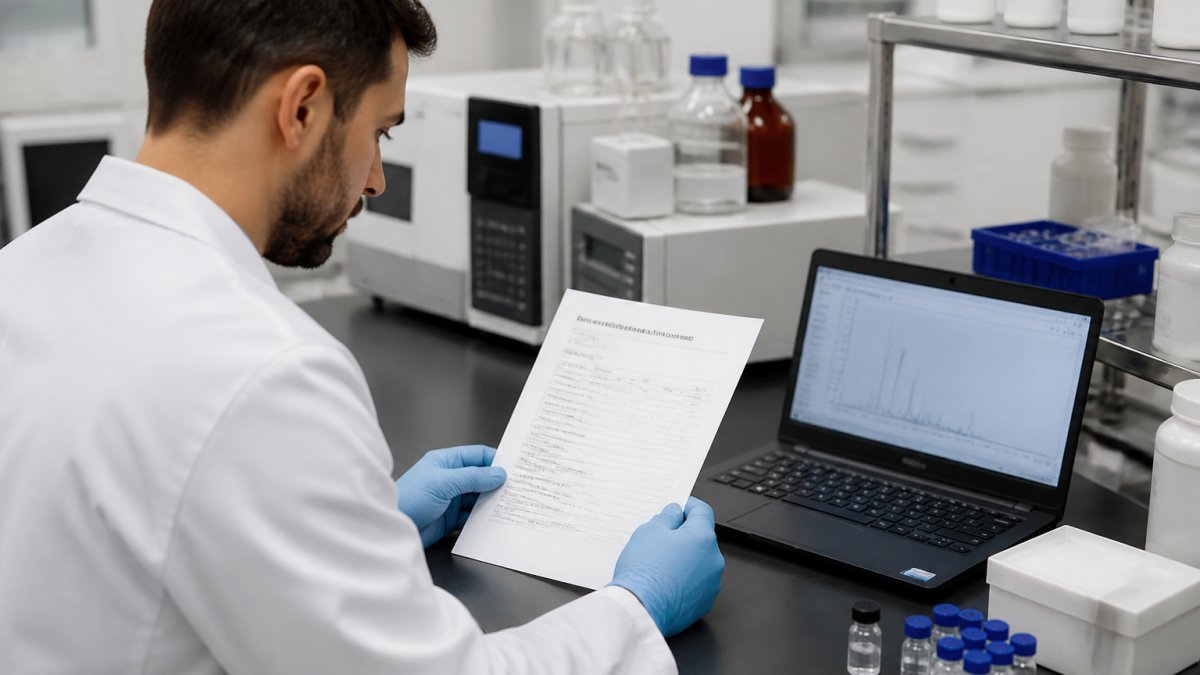
Start with the batch number and the date of analysis. If the CoA doesn't match the vial in your hand, stop there. Next, check the method: was purity determined by HPLC, and if so, at what wavelength?
Then look for the mass spectrometry confirmation. The observed molecular weight should match the theoretical molecular weight of your peptide sequence within a tight tolerance, typically under 1 Dalton for small peptides.
According to guidance from the U.S. Pharmacopeia on analytical validation, method validation and documented retention time are essential for reproducible quality control. A CoA without method details is a claim, not evidence.
| CoA Element | What to Check | Why It Matters |
|---|---|---|
| Batch number | Matches your vial | Confirms traceability |
| HPLC method | Wavelength, column, gradient | Determines what purity means |
| MS confirmation | Observed vs. theoretical mass | Detects wrong sequence |
| Purity figure | Peak integration method | Reveals how the number was calculated |
| Storage guidance | Temperature and light | Prevents degradation |
How to Independently Verify a CoA
A CoA is a supplier's claim until you confirm it. A practical verification protocol has four steps.
First, request the raw analytical data. Ask for the full chromatogram image, the integration table showing each peak's retention time and area percentage, and the mass spectrum with labeled peaks.
Second, cross-check the math. The integration table should show individual peak areas that sum to 100%. If the target peak is listed at 98% but the integration table shows several unlabeled peaks, ask what they are.
Third, confirm the method details. The CoA should specify the column type (typically C18 reverse-phase), the gradient, the flow rate, and the detection wavelength.
Fourth, consider third-party testing. For critical work, sending a sample to an independent analytical lab for HPLC and MS confirmation is the only way to fully close the loop.
HPLC vs MS Peptide Testing: What Each Method Reveals
HPLC and mass spectrometry answer two different questions, and you need both. HPLC vs MS peptide testing isn't a competition; it's a division of labor.
HPLC separates components by how they interact with a stationary phase, producing a chromatogram where each peak represents a compound. Peak integration converts those peaks into a percentage. This is where your purity number comes from. But HPLC cannot tell you what the impurities are, only that they're there.
Mass spectrometry identifies compounds by their mass-to-charge ratio. It confirms your synthetic peptides have the correct molecular weight and can flag unexpected species. What it won't do is quantify them well without careful calibration.
Common Peptide Impurities That Purity Percentages Hide
Deletion sequences arise when a coupling step fails during solid-phase synthesis and the chain continues without that residue.
Truncated sequences are the broader class: any chain that terminated early due to incomplete deprotection, steric hindrance, or reagent exhaustion. Hydrophobic stretches and sequences with adjacent bulky residues are the usual culprits.
Oxidized variants form when methionine, cysteine, or tryptophan residues are exposed to air or residual peroxides during handling. Oxidation adds 16 Da per affected residue and can shift biological activity substantially.
TFA salts deserve particular attention. Trifluoroacetate is a common counterion left over from reverse-phase purification, and it can be toxic in cell-based assays at sufficient concentration.
Byproducts from peptide synthesis also vary by sequence. Difficult sequences with hydrophobic stretches or steric hindrance generate more deletion products, which co-elute closely with the target and resist separation.
For context on how academic and industry labs approach standardization of these measurements, the National Institute of Standards and Technology maintains reference materials and analytical guidance relevant to chemical purity assessment.
When 98% Purity Is Sufficient vs When You Need 99% or Higher
For most screening and exploratory work, asking "Is 98% purity good for peptides?" usually gets a yes, since 98% purity is sufficient. If you're running a broad assay to identify whether a compound shows activity at all, a 2% impurity fraction rarely changes the outcome.
You need 99% or higher when the impurity itself could produce your signal. Receptor binding studies are the clearest case: a contaminant that binds the same receptor at low affinity can shift your curve. The same logic applies to pharmacokinetic profiling, where an impurity with different solubility or stability alters clearance measurements.
- Screening assays: 98% is typically adequate
- Receptor binding: 99%+ recommended to avoid false signal
- In vivo or PK work: 99%+ with documented amino acid analysis
- Reference standards: highest available purity with full validation
Storage and Degradation: How Purity Changes After You Receive the Vial
Lyophilized powder is stable, but it doesn't stay stable forever, and the purity you paid for can decline in storage. This is the angle competitors skip, and it's where good labs separate themselves.
Stability testing shows that most peptides degrade through oxidation, hydrolysis, or moisture uptake. Once reconstituted, the clock accelerates. A peptide stored at room temperature in solution may lose measurable purity within days, while the same compound kept frozen as a lyophilized powder holds far longer.
Vial integrity matters too. Repeated freeze-thaw cycles introduce moisture and stress the peptide. Aliquoting before freezing avoids this. Protect from light, keep the powder dry, and reconstitute only what you'll use in a short window.
Conclusion
The real challenge isn't finding a supplier who prints 98% on a label. It's finding one whose number holds up under independent scrutiny, batch after batch, with documentation that lets you verify it yourself. Globo Research Peptides addresses this directly: verified ≥99% HPLC purity, full Certificate of Analysis documentation for every batch, and rigorous third-party testing by accredited laboratories. If your research depends on compounds you can actually trust, get started with Globo Research Peptides and put verified purity behind every experiment.
Frequently Asked Questions
What is the acceptable purity for peptides?
For most research applications, 95% is the minimum acceptable peptide purity, but 98% is widely considered the practical standard for reliable results. For sensitive work like receptor binding assays or in vivo studies, 99% or higher is preferred. The right threshold depends on your specific assay, the peptide sequence, and how much interference your detection method can tolerate. Always check the Certificate of Analysis to confirm the actual purity value for your batch.
Why is 99% purity often preferred over 98% in laboratory settings?
The difference between 98% and 99% purity translates to a 50% reduction in impurities. For every milligram of peptide, a 98% pure sample contains 20 micrograms of impurities, while a 99% sample contains only 10 micrograms. In sensitive assays, those extra impurities can bind to receptors, trigger off-target effects, or interfere with analytical measurements. Labs running pharmacokinetic profiling or cell-based studies often specify 99% or higher to reduce variables they cannot control.
How do impurities in peptides affect experimental results?
Impurities can skew results in several ways. Truncated sequences may compete with the full-length peptide for binding sites. TFA salts left from synthesis can be toxic to cells in culture. Residual solvents or heavy metals can inhibit enzyme activity. Even small amounts of byproducts can produce false positives or mask real effects in dose-response curves. This is why understanding the impurity profile, not just the purity percentage, matters for reproducing your experiments.
How can researchers verify the quality of their peptide suppliers?
Start by requesting a Certificate of Analysis for the specific lot you will receive, not a generic sample. The COA should include HPLC chromatograms with retention time and peak integration, mass spectrometry data confirming molecular weight, and the method used for analysis. Look for third-party testing by accredited laboratories. Ask whether the supplier can provide batch-specific documentation and whether they offer a special-order program for custom sequences. Consistent documentation across orders is a strong signal of reliable quality control.