 ultimate-guide
How to Judge the Factors Driving Peptide Research Costs
Last Updated: October 29, 2026
Quick Summary
Peptide research costs are driven mainly by sequence length and complexity, the purity level required, batch size, and the documentation and testing included with each batch. Comparing cost per milligram, using the net peptide quantity on the certificate, gives the most reliable basis for judging whether a price is fair.
- Longer sequences and difficult residues add coupling steps, lowering yield and raising cost.
- Higher purity needs extra purification passes and longer chromatography runs, which increase price.
- Divide each quoted total by the net peptide milligrams stated on the Certificate of Analysis.
- Include cold-chain shipping, storage and any third-party testing when comparing supplier quotes.
- Buy to your consumption rate, since degraded material can erase bulk-purchase savings.
Table of Contents
- What Actually Sets the Price of a Research Peptide
- Synthesis Difficulty and Sequence Length
- Peptide Purity Standards for Research and Their Effect on Cost
- Batch Size, Bulk Purchasing and Cost Per Milligram
- How to Read a Peptide Certificate of Analysis
- Hidden Costs: Third-Party Testing, Storage and Long-Term Maintenance
- Building a Total Cost of Ownership Budget for Your Lab
- Frequently Asked Questions
What Actually Sets the Price of a Research Peptide
Most buyers assume the price on a peptide vial reflects a single thing, usually the amount of compound inside. In practice, factors influencing peptide research costs stack on top of one another, and the final number reflects how hard the molecule was to make, how pure it must be, and what documentation travels with it.
Several forces push costs up or down: synthesis complexity, purity requirements, batch size, verification testing, and the logistics of storage and shipment. Each one can shift the price per milligram substantially, and they often interact.
Synthesis Difficulty and Sequence Length
Peptides are built one amino acid at a time, and every added residue is another coupling step that can fail. Longer sequences therefore demand more reagent, more time, and more purification effort. Yield also drops with length, because small losses at each step compound across the chain.
Sequence complexity matters as much as length. Residues that resist coupling, sequences prone to aggregation, and modifications such as cyclization all add steps. A common mistake is comparing two peptides by molecular weight alone.
Peptide Purity Standards for Research and Their Effect on Cost
Purity is the most visible cost lever. Research applications generally require the target compound to dominate the sample, and the threshold you need depends on your study. Getting from a moderate purity level to a very high one usually means additional purification passes, longer chromatography runs, and more rejected material, each of which adds cost.
Purity is measured, not assumed. High-performance liquid chromatography separates the target peptide from synthesis by-products, and mass spectrometry confirms that the main peak has the expected molecular weight. A reported purity figure is only as meaningful as the method behind it, which is why the documentation discussed later matters so much.
Research-Grade Versus Clinical-Grade Compounds
Research-grade and clinical-grade compounds are not interchangeable, and the difference shows up in price. Clinical-grade material is produced under pharmaceutical quality systems with regulatory oversight, batch records, and validation that research-grade material typically does not carry. That added quality assurance is a real cost, and it is one reason clinical-grade pricing sits well above research-grade pricing. Research-grade compounds are sold for laboratory investigation, not for human use, so buyers should match the grade to the application rather than paying for documentation their study does not need. Compare research grade and analytical grade peptides to see how purity, testing, and regulatory status differ.
Batch Size, Bulk Purchasing and Cost Per Milligram
Cost per milligram is the number that matters most when comparing suppliers, and it falls as batch size rises, but not for the reason most buyers assume. The drop is driven by fixed costs being spread across more material, not by the peptide itself getting cheaper to make. Understanding which costs are fixed and which are variable is what lets you predict where a bulk discount should land and where a supplier is simply repackaging a small run.
Fixed vs. variable costs in a peptide order
Fixed costs are incurred once per production run regardless of yield: equipment setup and cleaning, column equilibration, method qualification, and the analytical testing (HPLC purity, mass spectrometry identity) that every batch must pass before release. Variable costs scale with the amount produced: crude peptide resin, coupling reagents, solvents, and the chromatography time needed to purify the target peak.
A useful mental model: if a run's fixed overhead is spread over 5 mg, each milligram carries a large slice of that overhead; spread over 50 mg, each milligram carries one-tenth as much. That is the entire mechanism behind most bulk pricing, not a volume discount on raw materials.
A worked cost-per-milligram example
Consider how cost per milligram works in general. A vial quoted at one price for a small amount and a larger vial quoted at a higher total may still carry a lower unit cost. To compare, divide each quoted total by the milligrams it contains. Pricing depends on quantity, purity specification, and delivery requirements, so request a current quote from Globo Research Peptides for exact figures. You can also compare bulk research peptide suppliers to see which offer volume orders.
Where bulk stops paying off
Bulk purchasing lowers unit price only if your study actually consumes the material before stability becomes a concern. Lyophilized powder is generally kept cold and dry, and every additional handling step, repeated freeze-thaw cycles, opening vials in humid air, reconstituting more than you need, erodes that margin. A common pattern is a lab buying 50 mg to capture the unit discount, then discarding a third of it after degradation, which wipes out the savings. The break-even question is not "what is the cheapest per milligram" but "what is the cheapest per milligram I will actually use before it degrades."
Comparing suppliers at the same batch size
When two quotes differ at the same quantity and purity, the gap usually traces to one of three things: the supplier's fixed-cost base (in-house synthesis vs. reselling a contract-manufactured batch), the documentation scope included (a full COA with measured values vs. a bare pass label), or the shipping terms (ambient vs. cold-chain). Normalize all three before treating a lower number as a better deal. A quote that excludes cold-chain shipping is not comparable to one that includes it, because the end-user absorbs that cost later.
How to Read a Peptide Certificate of Analysis
The Certificate of Analysis is the document that substantiates everything a supplier claims. For a deeper look at why this documentation matters, read why certificate of analysis documentation matters.
Look for detail. Vague certificates with no method, no batch traceability, or no measured values are a warning sign, and a study can lose weeks if a COA does not match what your protocol requires. Our recommendation is to request the COA before you order and confirm it covers the specific batch you will receive.
Hidden Costs: Third-Party Testing, Storage and Long-Term Maintenance
The sticker price rarely captures the full expense of working with a peptide. The gap between the invoice and the true cost is where most research budgets quietly break, and it is the area most pricing guides skip entirely. Three line items account for nearly all of it: independent verification, cold-chain logistics, and long-term maintenance of stored material.
Supplier COA vs. blind third-party testing
Every reputable supplier ships a Certificate of Analysis, but a COA is the supplier's own analysis of its own batch. That is not the same as independent verification. The cost difference is real and worth understanding before you budget.
A supplier COA is the supplier's own analysis of its batch and is a different thing from independent testing. To understand what this process involves, see our third-party peptide testing guide.
Researchers often weigh whether independent testing is warranted for high-stakes protocols or new supplier relationships. For routine work with a supplier whose documentation has held up across prior batches, the supplier COA is usually sufficient.
Cold-chain shipping and storage overhead
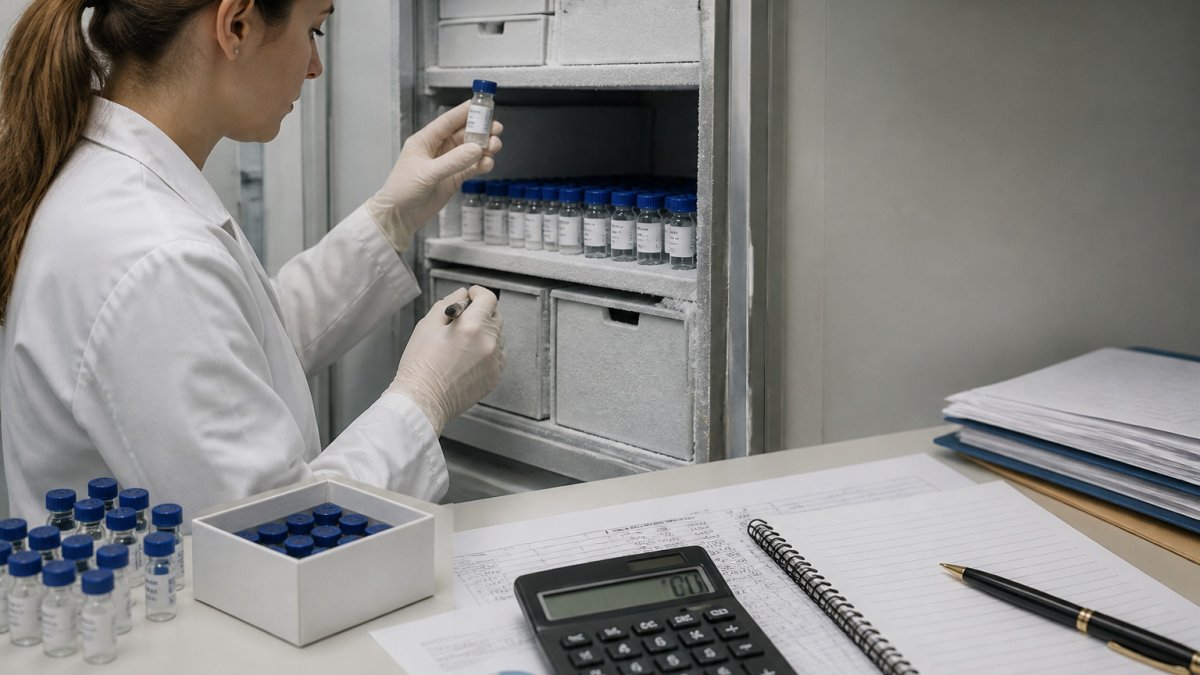
This is the cost line most guides ignore, and it is often the largest hidden expense. Lyophilized peptide powder is not shelf-stable at room temperature for long periods; it needs to be kept cold and dry, and reconstituted solutions degrade faster still. That reality creates a chain of costs the buyer absorbs after the invoice is paid:
- Shipping: Cold-chain shipment typically costs more than ambient shipping, so confirm shipping terms when comparing quotes.
- Receiving: Cold-chain deliveries require someone to be present to receive and immediately place the material in appropriate storage. A package left on a dock in summer can compromise a batch before it is ever opened.
- Storage capacity: Freezer space, temperature monitoring, and backup power for the freezer are real overhead. A lab that adds peptide work often discovers its existing freezer capacity and monitoring are inadequate.
- Handling discipline: Every freeze-thaw cycle and every moment a vial sits open in humid air accelerates degradation. Aliquotting on arrival reduces this risk but adds labor and consumables.
Long-term maintenance and re-verification
Material bought in bulk and stored for months may need re-verification before use, which shifts cost from the purchase into maintenance. A batch that sat in storage for a year is not automatically unusable, but a study that depends on it should confirm purity has not drifted, and that confirmation is another testing expense.
The practical response is to buy to your consumption rate rather than to the deepest discount, and to build re-verification into the protocol timeline rather than treating it as a surprise.
The sticker price leaves out several recurring expenses that a research budget needs to capture.
| Hidden cost | What it covers | Budget note |
|---|---|---|
| Supplier COA | Supplier's own analysis of its batch | Usually sufficient for routine work |
| Blind third-party testing | Independent HPLC purity and mass spec identity | Per-sample fee plus shipping; can delay study start |
| Cold-chain shipping | Keeping lyophilized powder cold and dry | Often costs more than ambient shipping |
| Receiving and storage | Immediate cold placement, freezer space, monitoring | Existing freezer capacity may be inadequate |
| Re-verification | Purity checks on aged stock | Adds testing cost to long-term projects |
Building a Total Cost of Ownership Budget for Your Lab
A total cost of ownership budget captures every expense from order to disposal, not just the invoice. Start with the base price per milligram at the purity and batch size you need, then add shipping, cold-chain handling, third-party testing if your protocol requires it, storage, and an allowance for re-testing or reorders.
This approach makes trade-offs visible. A cheaper vial that fails verification or degrades in storage can cost more overall than a higher-priced product with full documentation.
Frequently Asked Questions
Why is there such a wide price range for research peptides?
Prices vary because peptides differ in sequence length, synthesis difficulty and the purity grade they are produced to. A short, simple sequence sold at a basic purity grade costs far less to make than a long, modified sequence that must meet tight HPLC and mass spectrometry specifications. Documentation, batch testing and supplier overhead also add to the final price. Pricing depends on quantity, delivery timing and specifications, so request a current quote from Globo Research Peptides for the exact compound you need.
How does peptide purity affect the total cost of research?
Higher purity requires more purification steps, more analytical testing and more batches rejected for failing specification, all of which raise the unit price. Lower purity can look cheaper per milligram but may introduce impurities that confuse receptor binding results and force repeat experiments. Comparing cost per milligram of usable, verified material gives a more accurate picture than comparing sticker prices. Globo Research Peptides lists verified HPLC purity of 99% or higher with a Certificate of Analysis for every batch.
Are high-purity peptides worth the premium cost?
For most fundamental and preclinical studies, yes. Impurities can alter binding affinity, produce off-target signals and undermine reproducibility, which costs far more in wasted reagents, instrument time and delayed timelines than the price difference. Pilot work with lower-grade material may be acceptable for exploratory assays, but any study intended for publication or regulatory review should use documented, high-purity compounds.
How do bulk orders impact the cost per milligram of peptides?
Larger batches spread synthesis setup, purification and testing costs across more material, which usually lowers the cost per milligram. Bulk orders also reduce the risk of batch-to-batch variation within a long project. Confirm whether the supplier can hold a single batch number across the full order, and ask how storage and reconstitution stability will be handled before committing to a large purchase.