 ultimate-guide
Why Peptide Purity Matters in 2026: A Research Guide
Table of Contents
- Why Peptide Purity Matters More Than Ever in 2026
- What a Purity Percentage Actually Measures (and What It Doesn't)
- Where Impurities Come From: Synthesis, Side Reactions, and Degradation
- Peptide Purity Testing Methods: HPLC, Mass Spectrometry, and Beyond
- How to Read a Peptide Certificate of Analysis
- Peptide Purity vs Peptide Content: Two Numbers, Two Meanings
- Is 98% Purity Good for Peptides? Putting the Number in Context
- Frequently Asked Questions
Last Updated: October 20, 2026
Why Peptide Purity Matters More Than Ever in 2026
Peptide purity is the measure of how much of a sample consists of the intended peptide sequence, and it has become the defining quality question for research laboratories in 2026.
The stakes have risen because the research peptide market has grown crowded and unevenly regulated. Not every supplier tests to the same standard, and not every certificate tells you which method produced the number. A purity figure without method context is a claim, not evidence. Below, we'll show you exactly how to read these numbers, where impurities come from, and how to verify a certificate before a batch reaches your bench.
What a Purity Percentage Actually Measures (and What It Doesn't)
A purity percentage measures the proportion of the total peak area in a chromatogram that belongs to the target peptide. In practice, that means a high-performance liquid chromatography (HPLC) run separates the sample's components, and the software calculates what fraction of the detected signal is your compound.
What it does not measure is just as important:
- Identity. A 99% pure sample of the wrong sequence still reads as 99% pure.
- Impurity composition. The 1% could be water, salts, or a closely related analog with different biological activity.
- Sterility and endotoxin. Purity testing says nothing about microbial contamination.
- Peptide content. The percentage reflects relative peak area, not the mass of peptide per vial.
That last point trips up more labs than any other. A vial can be 98% pure by HPLC and still contain far less actual peptide than the label implies, because the remainder may be counterions, residual moisture, or manufacturing salts.
Where Impurities Come From: Synthesis, Side Reactions, and Degradation
Most research peptides are produced by solid-phase synthesis, and impurities enter at predictable points in that process. Incomplete synthesis leaves deletion sequences, peptides missing one or more amino acids. Side reactions during coupling can produce truncated or modified sequences that behave differently in assay.
The other major source is degradation after synthesis. Oxidation of susceptible residues, deamidation, and hydrolysis all accumulate during storage and handling. A peptide that tested clean at release can degrade if it is stored warm, exposed to light, or reconstituted and left too long.
Residual solvents and salts from the manufacturing process round out the list. These are usually removed during purification, but incomplete removal shows up as contamination that a purity percentage alone will not flag.
Peptide Purity Testing Methods: HPLC, Mass Spectrometry, and Beyond
No single analytical method establishes peptide quality. Each test answers a narrow question, and the strongest analytical packages combine methods that compensate for one another's blind spots. Understanding what each technique can and cannot prove is the difference between reading a certificate and verifying one.
Reversed-phase HPLC is the workhorse of peptide purity testing. It separates sample components by hydrophobicity, and the software calculates purity as the area under the target peak divided by total peak area.
Mass spectrometry answers a different question entirely. Where HPLC tells you how much of the sample is one thing, mass spectrometry confirms identity by measuring molecular weight. A peptide with the expected mass is very likely the intended sequence; a peptide with the wrong mass is not, regardless of its purity figure.
Orthogonal methods fill the remaining gaps. Karl Fischer titration measures water content, which directly affects peptide content calculations. Ion chromatography quantifies counterions such as acetate or trifluoroacetate. Amino acid analysis confirms composition. Endotoxin testing (typically the limulus amebocyte lysate method) and sterility testing address microbiological quality, which is entirely separate from chemical purity. Each method covers a dimension the others cannot see.
The FDA guidance on drug substance characterization describes the general expectation that identity, purity, and impurity profiles are established through validated methods rather than a single number, and the USP general chapter on chromatographic purity stresses that analytical results are only meaningful when the method and acceptance criteria are stated alongside them.
| Method | What It Confirms | What It Misses |
|---|---|---|
| Reversed-phase HPLC | Relative purity by peak area | Identity, co-eluting impurities, sterility, peptide content |
| Mass spectrometry (MS/MS) | Molecular identity and sequence | Purity percentage, non-peptide contaminants |
| Karl Fischer titration | Moisture level | Sequence errors, microbial contamination |
| Ion chromatography | Counterion composition | Purity, identity |
| Endotoxin testing (LAL) | Bacterial contamination risk | Purity, identity, sterility |
| Sterility testing | Microbial presence | Chemical purity, endotoxin level |
How to Read a Peptide Certificate of Analysis
A certificate of analysis (COA) is a batch-specific document reporting the results of analytical testing. A useful COA is not a marketing sheet.
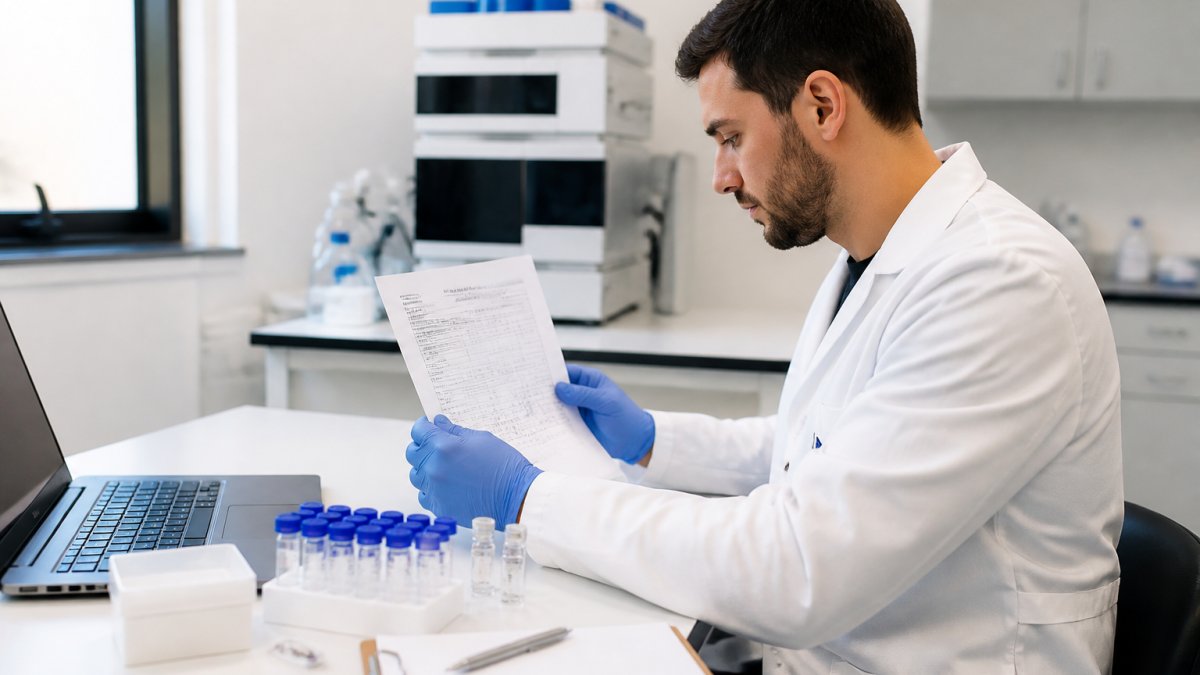
Here is the verification checklist we would use before accepting any batch:
- Batch or lot number on the COA matches the vial label exactly
- Purity figure is stated with the method used (for example, HPLC at a specified wavelength)
- The chromatogram is included, not just a percentage
- Mass spectrometry result confirms the expected molecular weight
- Testing laboratory is named, and third-party testing is documented
- Appearance, water content, and any specified counterion are reported
- Date of testing and expiry or retest date are present
- Sterility and endotoxin results appear where the application requires them
A checklist is only the starting point. The verification steps below are what separate a genuine COA from a decorative one.
Confirm batch matching. The lot number on the COA must match the vial label character for character.
Check the test date against the batch date. A COA dated before the batch was manufactured, or reused across years, is a red flag.
Verify the method is named and specific. "HPLC" alone is not enough. A credible COA states the column type, mobile-phase system, detection wavelength, and integration method. Without those details, the purity figure cannot be reproduced or compared.
Look for raw data, not just summaries. Ask for the chromatogram trace and the mass spectrum, not a table of results.
Confirm laboratory independence. Third-party testing means the laboratory is not owned by or affiliated with the supplier. The COA should name the laboratory, and the laboratory should be reachable to confirm the report.
Check reporting thresholds and sample preparation. A purity figure reported to one decimal place implies a level of precision the method may not support.
Know what to do when documentation is incomplete. If a supplier cannot provide the chromatogram, the mass spectrum, or the testing laboratory's name, treat the purity claim as unverified. Request the missing data in writing. A supplier that cannot produce it is telling you something about its quality system, and that information is more valuable than the certificate itself.
Peptide Purity vs Peptide Content: Two Numbers, Two Meanings
Peptide purity and peptide content are routinely confused, and the confusion has real consequences for dosing calculations in research protocols. Purity is the relative proportion of the target peptide among detected components. Content is the actual mass of peptide present in the vial, expressed as a percentage of total weight or as milligrams.
A vial can be 98% pure and 80% content. The gap is water, counterions, and salts. If a protocol assumes the full labeled mass is peptide, the actual amount delivered to the assay is lower than intended. That is why a proper COA reports both, and why researchers should calculate from content when preparing solutions.
The same distinction explains why "98% pure" and "98% peptide" are not interchangeable statements. One describes composition; the other describes quantity.
Is 98% Purity Good for Peptides? Putting the Number in Context
For most research applications, 98% purity is acceptable, and many suppliers treat it as a standard threshold. Whether it is good enough depends on what the study requires. Receptor binding assays, cell culture work, and analytical method development can be sensitive to impurity profiles in ways that a single percentage will not reveal.
Here is the context that matters more than the headline number:
- Method consistency. A 98% result by one laboratory's method may not be comparable to another's.
- Batch consistency. Two batches at 98% can differ in impurity composition, which affects reproducibility across a study.
- What the remaining 2% is. Trace water is benign; a closely related analog is not.
- Whether identity was confirmed. Purity without mass confirmation is half a result.
At Globo Research Peptides, every batch ships with full certificate of analysis documentation and verified ≥99% HPLC purity, tested by third-party accredited laboratories. Researchers who need compounds outside our standard catalog can use our special-order fulfillment program, and in-stock inventory dispatches immediately for labs working against a timeline.
The USP general chapter on chromatographic purity and NIH guidance on research reagent quality both stress that analytical results are only meaningful when the method and acceptance criteria are stated alongside them. A purity claim without that context is not verification. It is marketing.
Frequently Asked Questions
Is 98% purity good for a peptide?
For many routine research applications, 98% purity is workable, but it depends on what the remaining 2% contains. At 98% purity, up to 2% of the sample may be deletion sequences, oxidation products, or residual solvents, and those impurities can interfere with receptor binding assays or skew pharmacokinetic data. For sensitive work such as in vitro receptor studies or preclinical profiling, a verified ≥99% purity result with a full certificate of analysis gives you a tighter margin. Always read the chromatogram and test method, not just the headline percentage.
How is peptide purity measured in a laboratory?
The standard method is reverse-phase high-performance liquid chromatography (HPLC), which separates the target peptide from impurities and reports the area percentage of the main peak. HPLC tells you how much of the sample is the intended molecule, but it does not confirm identity on its own. Mass spectrometry is paired with HPLC to verify molecular weight and confirm the peptide is what the label says. Together, HPLC and mass spectrometry give both purity and identity verification. Some labs also run sterility, endotoxin, and residual solvent testing depending on the intended use.
Can a peptide be 99% pure and still contain contaminants?
Yes. A 99% HPLC purity result means 99% of the detected chromatographic area is the target peptide, but it does not rule out contaminants that the method cannot see. Residual solvents, counterions, endotoxins, and microbial contamination require separate tests. A peptide can also be 99% pure by HPLC and still be the wrong sequence if mass spectrometry identity verification was not performed. That is why a complete certificate of analysis reports multiple assays, not a single purity percentage.
What is the difference between peptide purity and peptide content?
Purity describes the proportion of the sample that is the target peptide relative to other peptide-related impurities, usually expressed as an HPLC area percentage. Content describes how much actual peptide is in the vial by mass, accounting for counterions, moisture, and residual salts. A vial can be 99% pure but only 80% peptide content by weight, which matters when you calculate molar concentrations for an assay. Check both figures on the certificate of analysis before you weigh out a batch.
Peptide quality is not a single number, and treating it as one is where studies quietly go wrong. If your lab needs compounds backed by full analytical documentation, verified purity, and third-party testing you can actually inspect, Globo Research Peptides is built for that standard. Every batch ships with a complete certificate of analysis, and our special-order program covers compounds outside the standard catalog. Order now and put documented quality behind your next study.