 ultimate-guide
The Importance of Certificate of Analysis Documentation
Table of Contents
- What a Certificate of Analysis Actually Proves
- Why COA Documentation Is Non-Negotiable for Research
- How to Read a Certificate of Analysis for Peptides
- Peptide Purity Testing Standards That Matter
- Red Flags of a Fraudulent or Incomplete COA
- Legal and Liability Implications of Missing Documentation
- Standardization Across Industries: Why It Still Lags
- Frequently Asked Questions
Last Updated: September 28, 2026
What a Certificate of Analysis Actually Proves
A Certificate of Analysis is a batch-specific technical document issued by a testing laboratory that records the analytical results for a defined lot of material. In the research peptide supply chain, that document is the only independent evidence a buyer has that the vial in their hand matches the specification on the label.
This guide from Globo Research Peptides covers what a COA proves, where it stops proving things, and how to read one without getting fooled. The stakes are higher than most procurement checklists suggest. A study built on an undocumented compound is a study that cannot be defended, published, or repeated.
Here's what most guides get wrong: they treat the COA as a formality attached to a shipment. It isn't.
Why COA Documentation Is Non-Negotiable for Research
Without documentation, you are not running an experiment. You are running an uncontrolled variable with a mass spec result attached to nothing.
Three practical consequences follow from missing documentation:
- Irreproducibility. A reviewer or collaborator cannot verify what you used, so the result stands alone.
- Timeline loss. Discovering a documentation gap after a study begins means restarting, not patching.
- Liability exposure. Undocumented material in a regulated workflow creates a compliance problem that outlasts the experiment.
How to Read a Certificate of Analysis for Peptides
Reading a peptide COA means checking three things in order: that the batch number matches your vial, that the analytical methods are named and appropriate, and that the reported values cover purity, contaminants, and identity. If any of those three is missing, the document is incomplete regardless of how it looks.
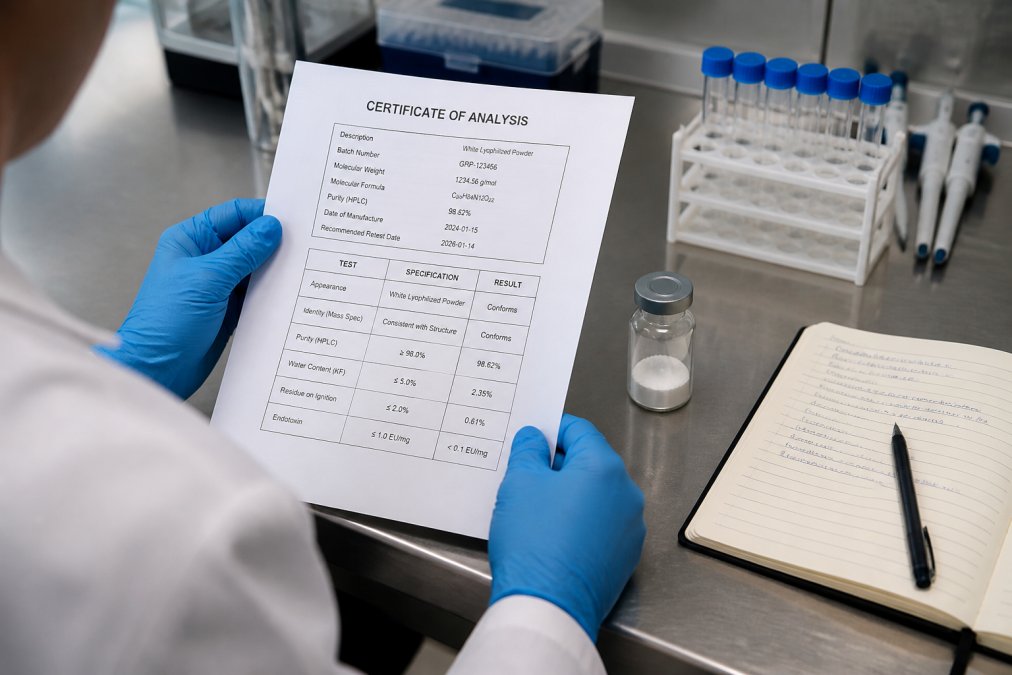
Batch Number and Chain of Custody
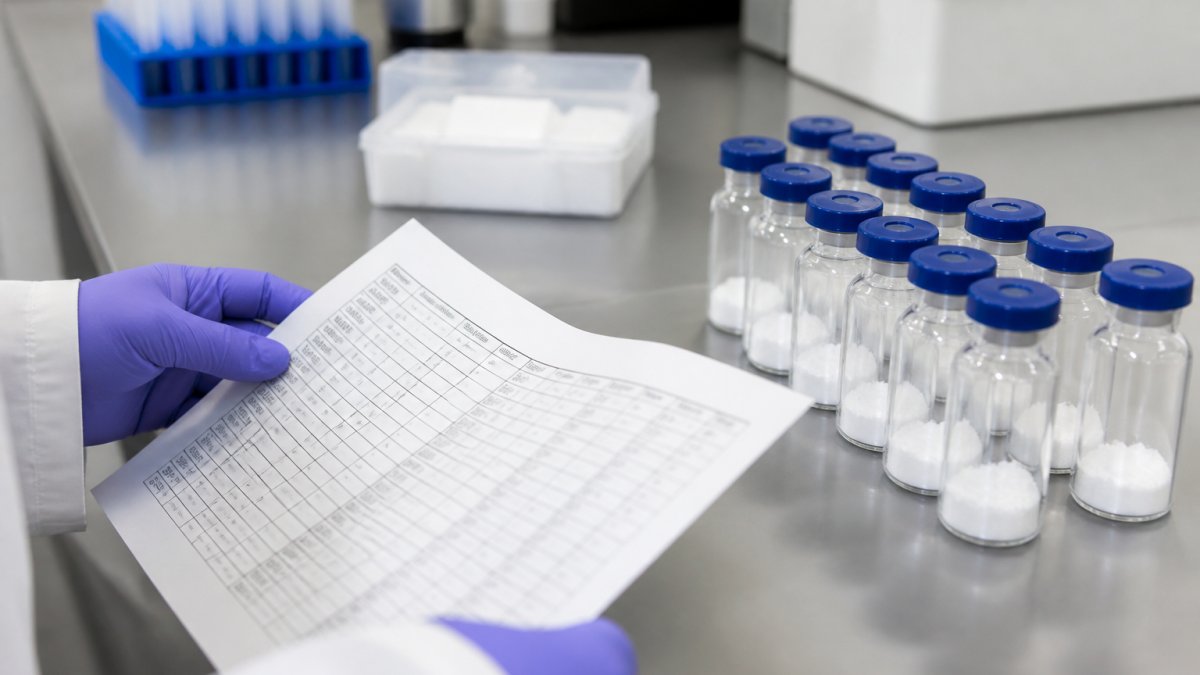
The batch number is the spine of the document. It must appear on the COA, on the vial label, and on your receiving record. When those three agree, you have a chain of custody. When they don't, you have a problem.
Analytical Methods and Instrumentation
A credible COA names the instrument and the method. For peptides, that usually means high-performance liquid chromatography for purity and mass spectrometry for identity confirmation. Each technique answers a different question, and you need both.
- HPLC separates and quantifies the components in the sample, producing the purity percentage.
- Mass spectrometry confirms the molecular weight, which is how you verify the peptide is the peptide you ordered.
- Contaminant screening looks for residual solvents, heavy metals, and microbial content where applicable.
Purity, Contaminant, and Identity Data
The results section should give you a quantitative figure for purity, a qualitative assessment of identity, and explicit contaminant limits. Vague entries like "conforms" without an accompanying value are placeholders, not data.
Peptide Purity Testing Standards That Matter
Purity standards for research peptides revolve around how the percentage is measured and what the denominator includes. A purity figure derived from HPLC area normalization describes the proportion of the main peak relative to all detected peaks. That is a useful number, but only if you know the detection wavelength and the integration method.
What matters in practice:
| COA Element | What to Check | Why It Matters |
|---|---|---|
| Purity method | HPLC with stated wavelength (commonly 214 nm) and column | Confirms how the percentage was derived and whether it is reproducible |
| Identity method | Mass spectrometry with observed vs. theoretical mass | Confirms the compound is correct, not just present |
| Batch number | Matches vial and receiving record | Establishes traceability |
| Test date | Recent relative to receipt | Rules out stale or reused data |
| Contaminant panel | Named limits (residual solvents, heavy metals, microbials), not "pass" | Quantifies what else is present |
| Chromatogram | Attached trace with baseline and integration | Lets you verify the number, not just read it |
Red Flags of a Fraudulent or Incomplete COA
Fraudulent certificates tend to fail in predictable ways, and most of them are visible on a first read. The pattern is consistent: impressive-looking formatting wrapped around data that cannot be traced to a laboratory.
Watch for these signals:
- Identical results across batches. Real analytical testing produces variation. A purity figure that reads exactly the same on every lot is copied, not measured.
- No laboratory identity. A COA without a named testing lab, address, or accreditation reference has no accountable source.
- Missing instrument details. No method, no column, no wavelength, no instrument model.
- Generic batch numbers. Sequential placeholders like "LOT-001" across unrelated products suggest a template, not a record.
- No chromatogram or spectrum. The raw data is the evidence. A summary table alone is a claim.
- Dates that don't line up. A test date after the ship date, or a certificate dated years before the batch was produced, is a contradiction.
Legal and Liability Implications of Missing Documentation
- FDA current good manufacturing practice (21 CFR Parts 210 and 211). For any material that touches a drug product, batch records and analytical testing are not optional. A COA is the analytical half of that record. Missing it is a cGMP deviation, not a paperwork inconvenience.
- FDA 21 CFR Part 11. When test results are stored or transmitted electronically, Part 11 governs electronic records and signatures, audit trails, access controls, and record retention. A PDF COA emailed from a lab is an electronic record. If the issuing lab cannot describe its Part 11 controls, the document's evidentiary value is weaker than it looks.
- DEA listed chemicals and controlled substances (21 CFR Part 1310 and Part 1300 series). The DEA regulations on listed chemicals and controlled substances show how federal oversight attaches to specific substances and how documentation requirements follow from that classification. For research compounds outside controlled schedules, the exposure is different but not absent, the record still has to show what you bought, from whom, and when.
- ISO/IEC 17025 accreditation. This is the international standard for testing and calibration laboratories. An accredited lab has been assessed on its methods, equipment, and quality system. A COA from an accredited lab carries more weight in a dispute than one from an unaccredited facility, because the accreditation is independently verifiable.
The practical exposure breaks down into three areas:
- Institutional. Universities and contract research organizations increasingly require vendor documentation as a condition of purchase approval, and institutional review boards may ask for it during protocol review.
- Contractual. Client-funded projects often specify material traceability in the statement of work. A missing COA can trigger a cure notice or a withheld payment.
- Reputational. A retraction or failed replication traced to an unverified compound damages a lab's standing permanently, and the underlying documentation gap is usually what turns a bad result into a public one.
None of these risks is exotic. They are the ordinary consequences of a documentation gap that nobody noticed until it mattered.
Standardization Across Industries: Why It Still Lags
Standardization in analytical documentation remains uneven because different sectors answer to different authorities, and research chemicals sit in a gap between them. Pharmaceutical manufacturing operates under strict current good manufacturing practice requirements. Food and cosmetics testing follows separate frameworks. Research-grade peptides, sold for laboratory use, often fall outside all of them.
Frequently Asked Questions
What is the purpose of a Certificate of Analysis?
A Certificate of Analysis documents the results of laboratory testing performed on a specific batch of material. For research peptides, it reports identity, purity level, and contaminant screening results from methods such as high-performance liquid chromatography and mass spectrometry. The COA ties those results to a batch number, giving you an audit trail you can cite in study records. Without it, you have no independent evidence that the compound in the vial matches the label.
Is a Certificate of Analysis mandatory for research-grade compounds?
No federal regulation requires a COA for research-grade peptides sold to laboratories. However, most academic institutions, CROs, and pharmaceutical R&D departments require one before a compound enters a study. Internal quality assurance programs and grant-funded projects typically demand batch-specific documentation for traceability. If your procurement process or institutional review requires verified analytical testing, a supplier that cannot provide a COA per batch fails that requirement.
How does a COA verify the purity of research peptides?
A COA reports purity as a percentage derived from analytical testing, usually high-performance liquid chromatography. The chromatogram separates the target peptide from related impurities, and the area under the main peak gives the purity figure. Mass spectrometry confirms molecular identity. For a claim of ≥99% purity to mean anything, the COA must show the method used, the batch number, and the testing laboratory. A purity number without those details cannot be verified.
What specific data points should be included in a standard COA?
A complete COA includes the product name and batch number, the testing laboratory and date, the analytical methods used, purity results with chromatogram data, molecular weight confirmation, appearance and solubility notes, and storage conditions. Contaminant screening results for heavy metals, residual solvents, and microbial content should appear when applicable. The document should also carry a lot-specific identifier so you can match the certificate to the vial you received, not just the product line.