 how-to
What Is Third Party Peptide Testing? A 2026 Guide
Table of Contents
- What Is Third Party Peptide Testing?
- How to Read a Peptide Certificate of Analysis
- HPLC vs Mass Spectrometry for Peptides
- How to Verify Peptide Sequence Accuracy
- Red Flags: Spotting Fake or Incomplete COAs
- The Cost-Benefit Analysis of Third Party Peptide Testing
- Frequently Asked Questions
Last Updated: September 15, 2026
What Is Third Party Peptide Testing?
Third party peptide testing sends a sample to a laboratory with no financial relationship to the manufacturer or seller, so an independent analyst can confirm what the compound is and how pure it is. At Globo Research Peptides, every batch undergoes rigorous third-party testing by accredited laboratories, with full Certificate of Analysis documentation provided.
A manufacturer testing its own product is grading its own homework. Independent verification removes that conflict: the lab gets paid for the analysis, not the result, which is why third party peptide testing carries weight that internal QC reports cannot match.
Below, we'll break down what a Certificate of Analysis tells you, how to read purity and identity data, and the red flags that separate a real lab report from a decorative PDF.
Why Independent Verification Matters
A supplier's internal quality control answers one question: did this batch meet our own spec? Independent verification answers a harder one: is our spec even honest?
When a batch is mislabeled or underpurified, a contaminant can occupy the same binding site and skew affinity curves in receptor binding work, while degradation products can distort clearance data in pharmacokinetic profiling. You may not see the problem until months in, when results will not replicate.
The real cost of skipping verification is not the price of the vial. It is the price of the experiment that has to be thrown out.
How to Read a Peptide Certificate of Analysis
A Certificate of Analysis (COA) is a batch-specific document reporting analytical results for one lot, including methods, measured values, and the testing laboratory. If it is not tied to a specific batch number, it is not a COA, it is a brochure.
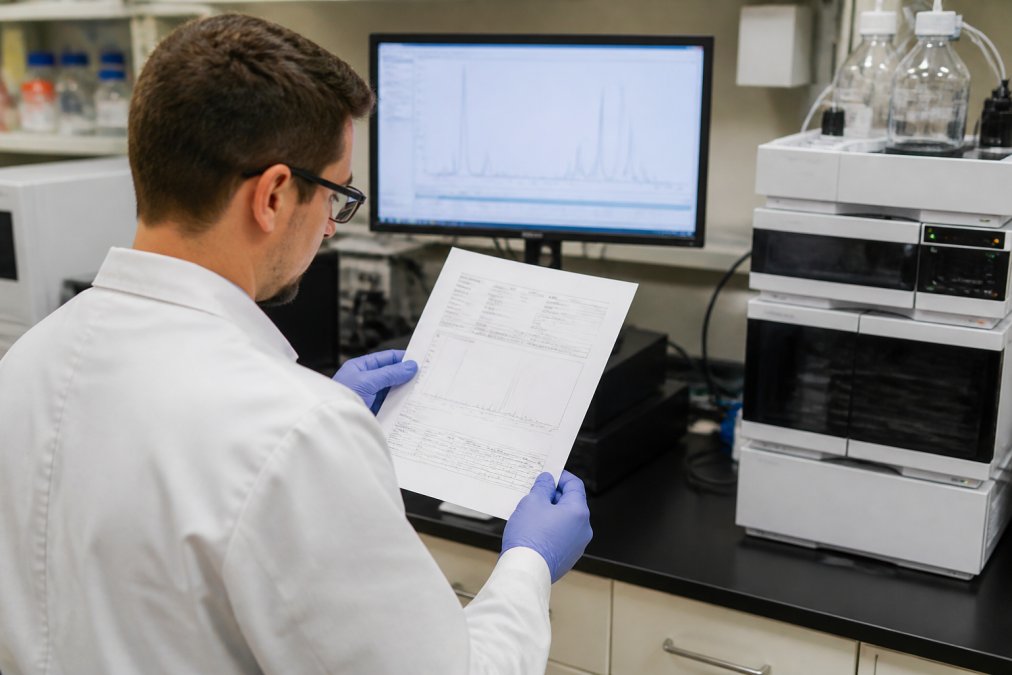
Here is what a complete document should contain:
- Batch or lot number that matches the vial label exactly
- Testing laboratory name with contact information, not just a logo
- Analytical methods named specifically (HPLC, mass spectrometry, or both)
- Measured values for purity and identity, with the actual figures shown
- Chromatogram and spectrum attached, not just summarized
- Date of analysis and the analyst's signature or authorization
- Accreditation reference for the laboratory, ideally to ISO/IEC 17025
Missing any of these makes the document an incomplete record. The batch number link matters most, because it prevents a supplier from sending a clean COA for one lot and a different lot of material.
What Makes a Testing Lab Credible
The strongest signal of a credible lab is accreditation to ISO/IEC 17025, the international standard for testing and calibration competence (iso.org). An accredited lab has its methods, equipment, and personnel assessed by an external body and operates under periodic surveillance audits, a different posture from a lab that answers only to the client paying the invoice.
When you evaluate a lab, look for:
- Scope of accreditation that actually covers peptide analysis, not just a general certificate
- Named analytical methods (for example, reverse-phase HPLC with UV detection, or electrospray ionization mass spectrometry) rather than generic "lab testing"
- Traceable reference standards used for calibration
- Documented chain of custody for samples received
- A report format that includes raw data, not just a pass/fail summary
A lab can be competent without accreditation, and an accredited lab can still make mistakes. But accreditation is the only externally audited signal available to a researcher who cannot visit the facility, making it the most useful filter when comparing suppliers.
The Chain of Custody Question
A COA only means something if the sample tested is the sample you received. That link is the chain of custody, and it is the step most suppliers never explain.
A defensible chain of custody typically includes:
- Sampling at the source, material pulled from the production batch, not from a retained reference vial
- Sealed and labeled transport, tamper-evident packaging with a batch identifier that matches the production record
- Laboratory intake log, the lab records the condition of the sample on arrival and assigns its own internal tracking number
- Analysis under the lab's own protocols, the client does not dictate the method or the acceptance criteria
- Report issued directly by the lab, not forwarded, reformatted, or rebranded by the supplier
When a supplier cannot describe this flow, the COA becomes a document of unknown provenance: the analysis may be real, but the link between report and vial is unverified. Ask the lab to confirm it received the sample directly; a lab that will not confirm receipt is a red flag.
A Practical Checklist for Spotting a Doctored COA
Falsified COAs are common enough that every report should be treated as unverified until it passes basic checks. These patterns show up most often.
- Template reuse: identical purity values, peak shapes, or retention times across different peptides and batches. Real analyses vary.
- Font and layout mismatches: a lab logo pasted onto a generic template, inconsistent fonts, or a header that does not match the lab's published report format.
- Missing or mismatched batch numbers: the number on the COA does not appear on the vial label, or the format does not match the supplier's other documentation.
- Dates that do not line up: analysis date before the batch was produced, or a report dated years before the material was sold.
- No raw data: purity percentages with no chromatogram, identity claims with no mass spectrum, or spectra that are clearly stock images.
- Unverifiable lab: no address, no phone number, no accreditation number, or a lab name that returns nothing in a search.
- Direct-from-supplier reports: the COA is issued on the supplier's letterhead rather than the lab's, which means the supplier controlled the document.
A quick verification step: contact the named lab using contact information you find independently, not the details printed on the COA, and ask them to confirm the report number and batch. A legitimate lab will confirm it performed the analysis; a fabricated report will not survive that call.
HPLC vs Mass Spectrometry for Peptides
HPLC and mass spectrometry are complementary, not competing, and a serious COA should show both. HPLC separates and quantifies; mass spectrometry identifies. Using only one leaves a gap the other would close.
High-performance liquid chromatography (HPLC) pushes the sample through a column that separates compounds by their interaction with the stationary phase.
| Method | What It Measures | Answers | Limitation |
|---|---|---|---|
| HPLC | Peak area percentage | How pure is the sample? | Cannot confirm identity alone |
| Mass spectrometry | Mass-to-charge ratio | Is this the right compound? | Not a quantitative purity measure |
| Both together | Purity plus identity | Is it pure and is it correct? | Requires an accredited lab |
How to Verify Peptide Sequence Accuracy
Here is the practical verification process:
Red Flags: Spotting Fake or Incomplete COAs
Watch for these patterns:
The Cost-Benefit Analysis of Third Party Peptide Testing
What Testing Actually Costs
What Skipping Testing Actually Costs
How to Read Testing Into a Supplier's Pricing
Questions worth asking before you buy:
Frequently Asked Questions
How much does peptide 3rd party testing cost?
Costs depend on the tests ordered, the lab's accreditation, and turnaround time. Basic purity checks cost less than full panels that include endotoxin, heavy metals, and solvent residues. For a precise quote, contact an accredited analytical laboratory directly and specify your required tests. Globo Research Peptides does not publish testing fees; pricing depends on the scope of analysis and sample volume.
How do I test if my peptides are real?
Request a Certificate of Analysis from your supplier and verify the testing lab's accreditation. Look for HPLC purity results, mass spectrometry identity confirmation, and a batch number that matches your vial. To independently confirm, submit a sample to a third-party lab for HPLC and mass spectrometry. If the COA lacks a batch number or the lab cannot be verified, treat the product as unverified.
What is a Certificate of Analysis (COA) for peptides?
A COA is a document that reports analytical test results for a specific peptide batch. It typically includes HPLC purity percentage, mass spectrometry molecular weight confirmation, and sometimes endotoxin or heavy metal results. A valid COA must reference the exact batch number and be issued by an accredited laboratory. Without a batch-specific COA, you cannot confirm the identity or purity of your peptide.
Why is HPLC testing critical for peptide purity?
HPLC separates peptide molecules from impurities based on their chemical properties. It quantifies the percentage of the target peptide in a sample, which directly affects experimental reproducibility. A peptide with 95% purity contains 5% unknown impurities that can skew receptor binding or pharmacokinetic results. For research-grade work, a purity of 99% or higher is often required, which HPLC can verify.