 how-to
How Do You Identify Contaminated Peptide Compounds?
Last Updated: October 27, 2026
Quick Summary
Contaminated peptide compounds are identified by checking the Certificate of Analysis for HPLC purity, mass spectrometry identity data, and net peptide content, then confirming the lot number matches the vial. Purity alone is not enough, because a vial can be highly pure yet contain much less actual peptide by weight.
- Confirm the COA lists the exact product name, sequence, and lot number matching your vial.
- Read the HPLC chromatogram, not just the purity percentage, and check for shoulder peaks.
- Verify identity by comparing measured mass to expected mass using MALDI-TOF or ESI.
- Calculate working amounts from net peptide content, since a 99% pure vial may hold only 75% peptide.
- Stop and contact the supplier if lot numbers, dates, or fields do not match or are missing.
Table of Contents
- Why Contamination in Peptide Compounds Matters for Research
- Step 1: Start with the Peptide Certificate of Analysis Checklist
- Step 2: Read the HPLC Peptide Purity Results Correctly
- Step 3: Confirm Identity with Mass Spectrometry Peptide Identity Testing
- Step 4: Separate Peptide Purity Versus Peptide Content
- Step 5: Check Batch Matching and Documentation Gaps
- Requesting Verified Documentation for Your Next Peptide Order
- Frequently Asked Questions
Why Contamination in Peptide Compounds Matters for Research
Globo Research Peptides supplies research-grade compounds with verified purity of ≥99% and full Certificate of Analysis documentation for every batch. This guide walks through how to identify contaminated peptide compounds before they reach your bench.
Peptide compounds are short chains of amino acids used as tools in laboratory research. Their value depends on being what the label says they are, at the purity stated, with a known identity.
Contamination takes several forms. Common examples include truncated sequences from incomplete synthesis, leftover reagents such as trifluoroacetic acid, residual solvents, and mismatched or mislabeled material. Each one can alter results in ways that are hard to trace back later.
Step 1: Start with the Peptide Certificate of Analysis Checklist
Start with the Certificate of Analysis (COA). It is the supplier's written record of what was tested and what was found, so it is the first place to look for problems.
A complete peptide COA should include:
- Product name and sequence, matching your order exactly
- Lot or batch number, so you can tie the document to the vial in hand
- HPLC purity result, with the method and wavelength stated
- Mass spectrometry identity data, showing the measured mass against the expected mass
- Net peptide content, reported separately from purity
- Date of analysis and the name of the testing laboratory
Step 2: Read the HPLC Peptide Purity Results Correctly
To read the result:
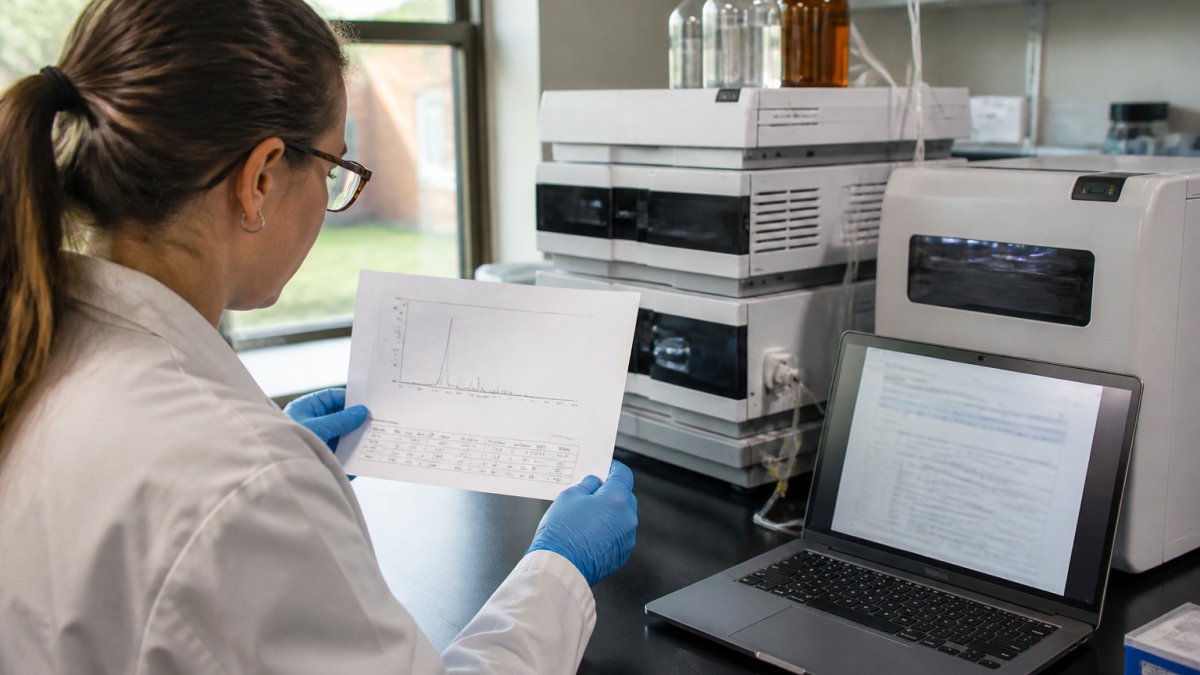
- Find the purity percentage on the COA, usually the main peak's area as a share of total peak area.
- Look at the chromatogram itself, not just the number. A clean baseline with one dominant peak is stronger evidence than a single figure.
- Check that the stated method and detection wavelength are listed. Purity numbers from different methods are not directly comparable.
- Note any shoulder peaks or peaks close to the main one. These can indicate deletion sequences or closely related impurities.
Step 3: Confirm Identity with Mass Spectrometry Peptide Identity Testing
Matrix-assisted laser desorption/ionization time-of-flight (MALDI-TOF) and electrospray ionization (ESI) are two common methods. Either is acceptable if the COA names it and reports results you can check against the expected mass.
Step 4: Separate Peptide Purity Versus Peptide Content
This step catches one of the most common misreadings. A vial labeled ≥99% purity may contain much less peptide by weight, because the rest can be water, counterions, and salts.
- Purity describes how much of the material is the target peptide relative to other peptide-related impurities.
- Net peptide content describes how much of the total weight is actual peptide.
Suppose a vial is 99% pure with 75% net peptide content. Weighing out 10 mg gives you about 7.5 mg of peptide. If your protocol assumes 10 mg of peptide, every dose will be too low.
Always check both values and calculate your working amounts from net content when your protocol depends on exact quantities.
Purity and net peptide content measure different things, and the table below shows how they differ.
| Measure | What it describes | Why it matters |
|---|---|---|
| Purity | Target peptide relative to other peptide-related impurities | Shows how much of the peptide material is the intended compound |
| Net peptide content | Actual peptide as a share of total weight | Shows how much real peptide a weighed amount contains |
| Example: 99% purity, 75% net content | 10 mg vial weight | About 7.5 mg of peptide, not 10 mg |
Step 5: Check Batch Matching and Documentation Gaps
The final check confirms that the document and the product match, and that nothing is missing.
- Match the lot number on the vial to the lot number on the COA.
- Confirm the order date falls after the analysis date. A COA dated after shipment deserves a question.
- Look for missing fields, such as no mass data, no method, or no net content.
- Flag any batch that arrives with a different appearance, color, or solubility from previous lots of the same product.
When something does not match, stop and contact the supplier before using the material. Document the discrepancy, retain the vial, and request a corrected or complete COA.
Requesting Verified Documentation for Your Next Peptide Order
Globo Research Peptides offers research-grade peptides with full COA documentation for every batch, and our shop research peptides with ≥99% HPLC purity and full COA documentation for current stock and availability. Pricing depends on quantity, dates, and delivery, so request a quote for your specific needs.
Frequently Asked Questions
How can you tell if a research peptide is contaminated?
No single test settles it. Start by reviewing the Certificate of Analysis for an HPLC purity chromatogram and a mass spectrometry identity result that name the same batch number. Look for peaks other than the main product, mass values that do not match the expected molecular weight, and missing test dates or methods. Visual inspection cannot detect contamination, so a clean-looking powder still needs documented analytical data before use in a study.
Is 98% purity good for peptides?
It depends on the application. A 98% HPLC purity value means the main peptide peak covers about 98% of the detected area at the wavelength used, which is a strong result for many in vitro work. It does not by itself confirm identity or quantity, and it does not rule out impurities that co-elute or lack UV absorbance. Pair the purity figure with mass spectrometry data and a stated peptide content value before judging suitability.
What is the difference between peptide purity and peptide content?
Purity describes the share of the detected material that is the target peptide, typically measured by HPLC. Peptide content describes how much of the total powder weight is actual peptide, with the remainder usually water, counterions such as trifluoroacetate, and residual salts. A vial can be 99% pure yet only 75% peptide by weight, so dosing calculations based on gross weight will be off unless content is known.
What should a peptide Certificate of Analysis include?
A complete Certificate of Analysis should list the product name, lot or batch number, expected molecular weight, HPLC method and column details, purity result, mass spectrometry identity data, peptide content if measured, storage conditions, and the date of testing. Check that the batch number on the document matches the vial label. Missing fields or vague wording are reasons to request clarification from the supplier before the compound enters your workflow.