 blog
Research Grade vs Analytical Grade Peptides: Key Differences
Table of Contents
- What Research-Grade and Analytical-Grade Peptides Actually Mean
- Research Grade vs Analytical Grade Peptides: Side-by-Side Comparison
- Purity, Impurities, and What a Purity Percentage Does Not Establish
- HPLC Testing for Peptides and How to Read the Results
- What a Peptide Certificate of Analysis Should Include
- How to Verify Peptide Purity Before Your Study Begins
- Is 98% Purity Good for Peptides? Matching Grade to Application
- Regulatory Status and Documentation to Check With Any Supplier
- Frequently Asked Questions
Last Updated: October 17, 2026
What Research-Grade and Analytical-Grade Peptides Actually Mean
The difference between research grade and analytical grade peptides comes down to one question: what is the material meant to prove? Research-grade peptides are sold for laboratory study; analytical-grade peptides serve as a measuring stick. That distinction shapes purity targets, testing depth, and paperwork.
Neither term is legally defined, so any supplier can print either one on a vial. Here is what the labels usually signal in practice.
Research-Grade Peptides: Defined by Intended Use
Research-grade describes a use category, not a fixed purity number. A peptide sold under this label is meant for laboratory experiments: receptor binding work, cell assays, preclinical exploration.
Suppliers set their own specs: typically a purity floor confirmed by HPLC plus a certificate of analysis per batch. Beyond that, standards vary widely.
- Purity floors vary by supplier and compound
- Testing depth varies, from basic HPLC to full mass spectrometry confirmation
- Documentation ranges from a one-page summary to a full analytical packet
- Labels should state research-use-only status clearly
The label tells you where the material may go. It does not, by itself, tell you how well the material was characterized.
Analytical-Grade Peptides: Defined by Fitness for Measurement
Analytical-grade means the material works as a reference standard. If you are calibrating an instrument, validating a method, or quantifying an unknown sample, the standard itself must be known with high confidence.
That raises the bar: identity needs confirmation by more than one method, impurity profiles need characterization rather than counting, and batch-to-batch consistency matters more, because a drifting standard corrupts every measurement built on it.
The U.S. Pharmacopeia general chapters on reference standards describe how reference materials are qualified and used.
Research Grade vs Analytical Grade Peptides: Side-by-Side Comparison
Use this comparison to match grade to application before you order.
| Criterion | Research Grade | Analytical Grade |
|---|---|---|
| Primary purpose | Laboratory experiments | Reference standard for measurement |
| Typical purity target | High, often 95%+ by HPLC | Very high, tightly specified |
| Identity confirmation | Often HPLC alone | HPLC plus mass spectrometry |
| Impurity characterization | Limited | Detailed profile |
| Documentation | Certificate of analysis per batch | Full analytical packet, method details |
| Batch consistency | Expected | Critical and monitored |
| Labeling | Research-use-only | Reference standard use |
Neither column is "better." They answer different needs. A binding assay may run perfectly well on well-documented research-grade material. A quantitative method validation will not.
Purity, Impurities, and What a Purity Percentage Does Not Establish
A purity percentage is a ratio, not a verdict. It reports the target peak area divided by total integrated peak area in one chromatographic run under one set of method conditions. Change the column, gradient, detection wavelength, or integration parameters, and the same vial can report a different number. Read it as a method-dependent measurement, not an absolute property.
What the number actually measures
In reversed-phase HPLC with UV detection, the detector responds to chromophores, not mass. Most peptide methods run at 214 nm because the peptide bond absorbs there, so the detector sees truncated sequences, deletion peptides, and oxidized variants sharing the backbone, but not residual solvents, counterions, or inorganic salts, which do not absorb at that wavelength. A 99% result means 99% of UV-absorbing peak area, not 99% of vial mass.
The impurity classes that matter
Peptide synthesis generates a predictable set of impurities, and serious characterization names them rather than counting them:
- Truncated and deletion sequences from incomplete coupling steps
- Diastereomers from racemization at cysteine or histidine residues
- Oxidized variants, especially at methionine and tryptophan
- Residual solvents such as trifluoroacetic acid, acetonitrile, and dimethylformamide from synthesis and purification
A purity number says nothing about any of these unless the certificate reports them separately.
What a purity percentage does not establish
- Identity. A clean peak can still be the wrong molecule. Only mass spectrometry or sequencing confirms the amino acid sequence and molecular weight.
- Potency. Purity measures how much target material is present, not how well it performs in a biological assay.
- Sterility and endotoxin status. These require separate microbiological and limulus amebocyte lysate testing that a standard certificate does not include.
- Residual solvent limits. Those come from gas chromatography methods, not HPLC.
Why analytical grade raises the bar
For a reference standard, the impurity profile must be characterized, not just counted. That means orthogonal methods: HPLC for separation, mass spectrometry for identity, and often nuclear magnetic resonance or amino acid analysis for structural confirmation. A drifting standard corrupts every measurement calibrated against it, in ways that are hard to trace.
HPLC Testing for Peptides and How to Read the Results
Most supplier pages stop at "we test by HPLC," which tells you almost nothing: HPLC is a separation technique, not an identity test. Reading a test report well means knowing which method answers which question, and where each method's blind spots are.
What each method can and cannot verify
HPLC with UV detection separates components and reports relative peak areas.
Mass spectrometry measures the molecular mass of the eluting species.
Peptide mapping or sequencing digests the peptide and confirms the amino acid order.
Gas chromatography detects residual solvents. Karl Fischer titration measures water content. Limulus amebocyte lysate testing measures endotoxin. None of these appear on a standard research-grade certificate unless specifically requested.
Reading the chromatogram itself
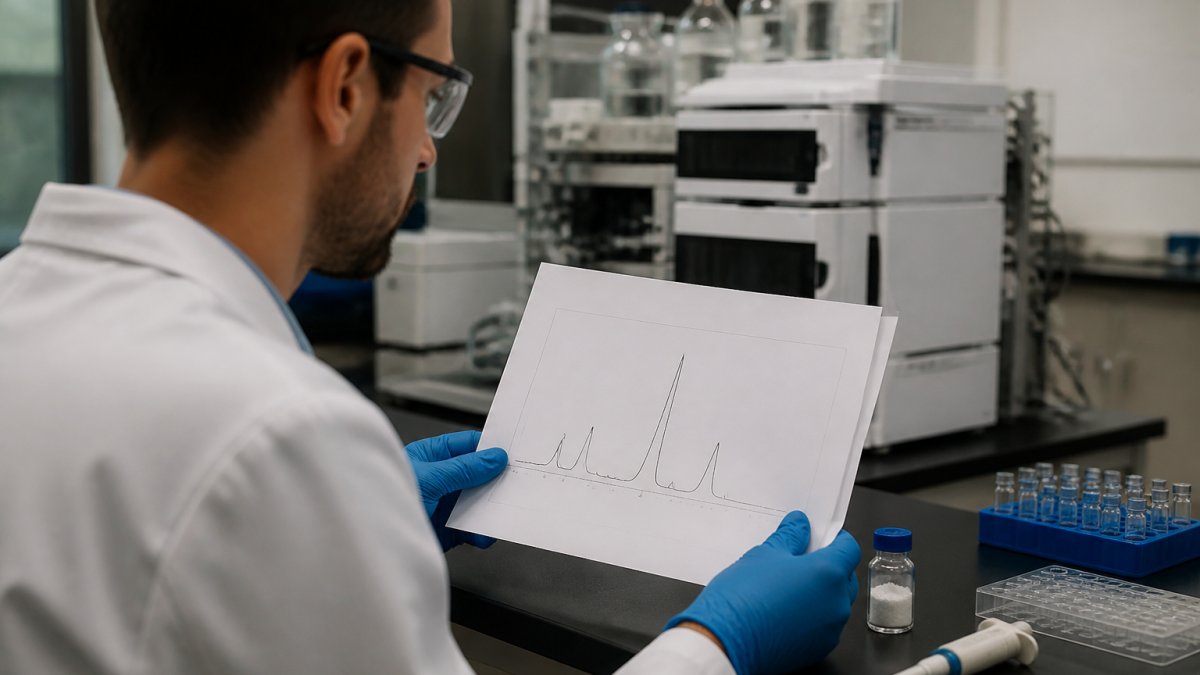
A chromatogram graphs detector response over time; the main peak's area divided by total peak area gives the purity percentage. Four checks separate a defensible report from a flattering one:
- Wavelength and method. Confirm the detection wavelength, typically 214 nm for peptides, and that the column, gradient, and run time are stated. A purity claim with no method is unverifiable.
- Peak integration. Look at how the main peak was integrated. Manual integration with a drawn baseline can absorb shoulders into the main peak and inflate the result.
- Impurity peaks. Small shoulders and early-eluting peaks matter. A 99% result with an unlabeled shoulder deserves a question about what that shoulder is.
- Scale and axis labels. A chromatogram without labeled axes or retention times cannot be checked against the method.
Ask for the raw chromatogram, not just the summary line. Reputable suppliers share it.
Reading the mass spectrometry result alongside it
A mass spectrum should report observed and expected mass for the intended sequence, with the difference stated. For a peptide of a few thousand daltons, a match within a small tolerance supports identity; a spectrum reporting only "confirmed" with no masses is not evidence. When both HPLC and mass spectrometry appear on a certificate, check they refer to the same lot and injection.
Batch-level evidence and measurement uncertainty
A certificate is only as good as its traceability. Look for the lot number, testing laboratory name, method reference, and date of analysis. Lot-specific results matter because synthesis and purification vary batch to batch; a certificate describing a representative batch rather than the lot in your hand is not batch-level evidence. Where independent testing is claimed, the report should name the laboratory.
What a Peptide Certificate of Analysis Should Include
A certificate of analysis ties test results to a specific batch. If it is vague, the batch is unverifiable.
A complete certificate should list:
- Product name and amino acid sequence
- Lot number and manufacture date
- Purity result with the analytical method named
- Identity confirmation, typically mass spectrometry
- Appearance and solubility notes
Watch for certificates with no method, no lot number, or no lab name. Those are marketing documents, not quality records.
How to Verify Peptide Purity Before Your Study Begins
Verification starts before the order ships. These steps catch most problems early.
- Request a batch-specific certificate of analysis, not a sample document
- Confirm the lot number on the certificate matches the vial label
- Check that identity was confirmed by mass spectrometry, not HPLC alone
- Review the chromatogram for unlabeled impurity peaks
- Confirm storage and shipping conditions match the compound's stability needs
That last step matters. Independent confirmation on receipt is the strongest defense against documentation errors, and it takes an afternoon.
Is 98% Purity Good for Peptides? Matching Grade to Application
For most laboratory research, 98% purity is good.
For analytical work, 98% is usually not enough. A reference standard needs a tighter specification and a characterized impurity profile, because every measurement inherits the standard's uncertainty.
Match the number to the job:
- Screening and exploratory work: 95%+ with a batch certificate is workable
- Standard research assays: 98%+ with identity confirmation
- Method validation and quantification: highest available purity plus full characterization
- Custom or specialized compounds: confirm specifications in writing before synthesis begins
Globo Research Peptides ships verified ≥99% HPLC purity with a full certificate of analysis for every batch. For specialized compounds, our special-order program confirms specifications before fulfillment.
Regulatory Status and Documentation to Check With Any Supplier
Research-grade and analytical-grade peptides sit outside drug approval pathways. They are not approved medicines, and labeling should say so plainly.
In the United States, the FDA's framework for compounding and research materials draws the line between approved drugs and materials intended for laboratory use.
Documentation to check with any supplier:
- Clear research-use-only labeling on vial and certificate
- Batch-level traceability from synthesis to shipment
- Named testing laboratory and method references
- Written specifications for custom orders
- Honest answers about what testing was and was not performed
Terminology varies by supplier and jurisdiction, so read the documents rather than the marketing copy.
Choosing between research grade and analytical grade peptides is a documentation decision as much as a chemistry one.
Frequently Asked Questions
What is the difference between research-grade and analytical-grade peptides?
Research-grade peptides are sold for laboratory investigation and labeled research-use-only; the term describes intended use, not a fixed purity standard. Analytical-grade peptides are intended for use as reference materials in measurement work, so suppliers typically document identity, purity, and impurity profiles in more detail. In practice, the two categories overlap: a research-grade peptide with a full certificate of analysis, HPLC data, and mass spectrometry confirmation can meet many analytical needs, while a product labeled analytical grade without batch-specific documentation should not be assumed fit for measurement.
Is research-grade peptide the same as analytical grade?
No, though they are often confused. Research grade signals that the material is for laboratory research only and is not for human or veterinary use. Analytical grade signals that the material is suitable for analytical measurement, which usually requires documented identity, purity, and impurity data at the batch level. A supplier can sell the same compound under both labels with different documentation. Ask for the certificate of analysis and confirm the testing methods, lot number, and specifications before treating any peptide as analytical grade.
How can you verify a peptide's purity and identity?
Start with the batch-specific certificate of analysis and check three things: the HPLC chromatogram with retention time and peak area percentage, mass spectrometry data confirming the expected molecular weight, and the lot number matching your vial. Then ask whether testing was done in-house or by an independent laboratory. For critical work, split the sample and send a portion to an outside lab for confirmatory HPLC. Purity alone does not confirm identity, so both tests matter, and neither replaces checking that storage conditions and shipping were appropriate.
Is 98% purity good for peptides?
It depends on the application. For general exploratory work, 98% HPLC purity is often acceptable. For receptor binding studies, quantitative assays, or anything used as a reference standard, the remaining 2% can matter because impurities may interfere with results. Many suppliers now offer 99% or higher with full documentation. Ask what the purity percentage measures, which method produced it, and whether impurity identity was characterized. A 98% figure without a chromatogram and lot number tells you very little on its own.