 blog
AminoVault vs Core Peptides: 2026 Comparison
Table of Contents
- AminoVault vs Core Peptides: What This Comparison Covers
- AminoVault COA and Testing Documentation
- Core Peptides COA and Batch Traceability
- How to Verify Peptide Purity: A Step-by-Step Framework
- Research Peptide Supplier Legitimacy: Scoring Both Vendors
- Matched-Product Price Comparison and Total Purchase Cost
- Where Globo Research Peptides Fits in the Comparison
- Conclusion
- Frequently Asked Questions
Last Updated: October 21, 2026
AminoVault vs Core Peptides: What This Comparison Covers
The aminovault vs core peptides comparison comes down to one question: which vendor gives you documentation you can actually verify? This guide covers COA access, batch traceability, purity verification, and matched-product pricing for both vendors, plus a transparent scoring method so you can see exactly how we reached each conclusion.
Two definitions matter here. A certificate of analysis (COA) is a batch-specific document reporting identity, purity, and test method for a specific lot number. Batch traceability is the ability to match a vial to the exact analytical record that tested it.
Below, we walk through each vendor's documentation, a verification framework you can run yourself, and where both fall short.
AminoVault COA and Testing Documentation
AminoVault publishes COAs, and the practical question is how usable they are. A COA is only worth the paper it is printed on if it names the lot number, the testing method, and the laboratory that ran the assay.
When evaluating an AminoVault COA, check three things:
- Does the COA lot number match the vial label exactly?
- Is the analytical method stated (HPLC, mass spectrometry, or both)?
- Is the testing lab named, or is it anonymized?
A common mistake is accepting a generic "99% pure" claim with no lot-specific documentation behind it. Ask for the COA before you order, not after.
Core Peptides COA and Batch Traceability
Core Peptides also provides COA documentation, and the same scrutiny applies. Batch traceability is where vendors diverge most in practice. If a supplier cannot tell you which analytical record corresponds to the vial in your hand, the documentation cannot support your study.
Ask Core Peptides two direct questions before ordering:
- Can you send the COA for the specific batch currently in stock?
- Does the COA include the testing laboratory's name and accreditation?
What most guides miss is that a COA without a lab name is close to unverifiable. You can confirm the format, but not the source.
How to Verify Peptide Purity: A Step-by-Step Framework
Purity verification is a repeatable process, not a vibe check. Run these steps on any vendor before you commit budget.
- Request the batch-specific COA for the exact lot in stock.
- Match the lot number on the COA to the vial label.
- Confirm the analytical method (HPLC and/or mass spectrometry).
- Identify the testing laboratory and check whether it holds accreditation such as ISO/IEC 17025.
- Compare reported purity against the vendor's marketing claim.
- Ask for a second batch's COA to confirm consistency.
- Document everything in your procurement file.
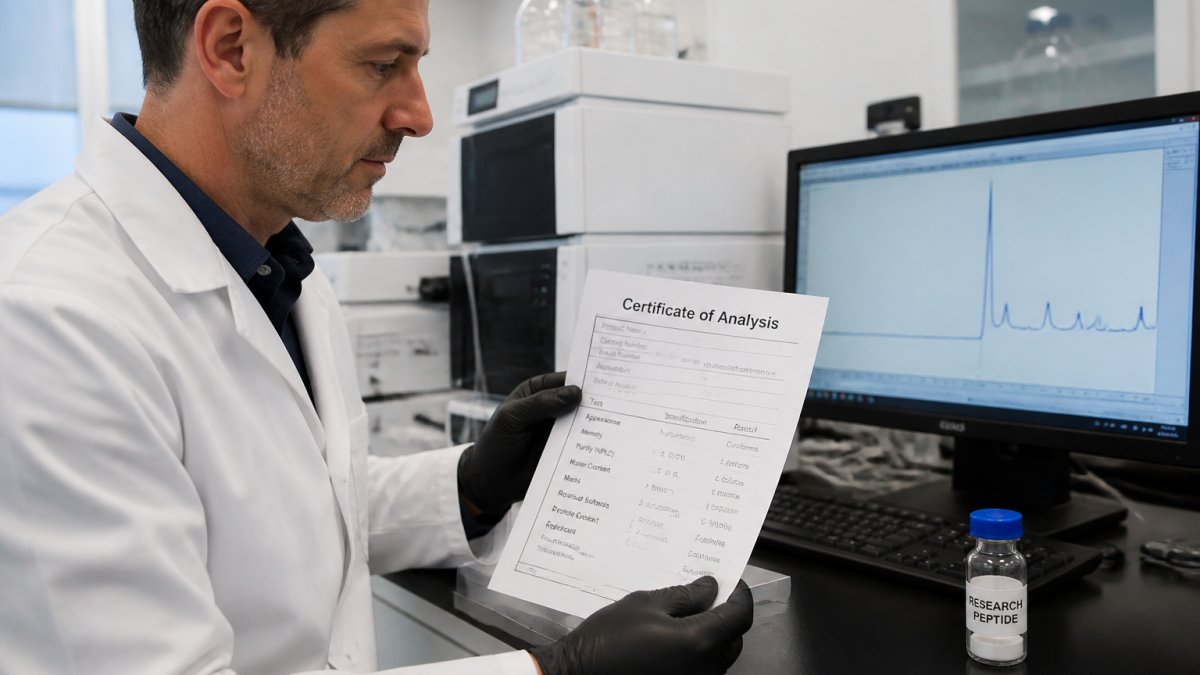
Independent verification matters because vendor claims and vendor documentation are two different things. The FDA guidance on analytical procedures and methods validation outlines what method validation should include, which gives you a checklist for reading any COA critically.
Research Peptide Supplier Legitimacy: Scoring Both Vendors
Supplier legitimacy rests on documentation quality, not marketing language. To keep this comparison honest and reproducible, we scored both vendors on six criteria, published the weights, and recorded the source and date for every data point. Where a claim could not be confirmed from public information, we scored it as unconfirmed rather than guessing, and we say so in the table.
Scoring methodology and weights
| Criterion | Weight | What Earns a High Score | What Earns a Low Score |
|---|---|---|---|
| COA accessibility | 20% | COA downloadable before purchase, no login | COA only after order or on request |
| Batch specificity | 20% | Lot number on COA matches vial label exactly | Generic or lot-agnostic COA |
| Lab identification | 15% | Testing lab named on every COA | Lab anonymized or redacted |
| Accreditation evidence | 15% | ISO/IEC 17025 certificate number verifiable | No accreditation claim, or claim without certificate |
| Catalog breadth | 15% | Matched products available in same quantity and grade | Gaps that force split orders |
| Fulfillment transparency | 15% | Published shipping terms, minimums, and return policy | Terms only disclosed at checkout |
Weights are judgment calls, not science. A lab that weights accreditation more heavily should raise that criterion to 25% and drop catalog breadth to 5%; the ranking may shift, which is why we publish the weights instead of hiding them behind a single score.
What the scoring can and cannot establish
Both vendors clear the basic bar: each publishes COAs and ties them to batches. Where neither claim can be fully confirmed from public information is independent accreditation of the testing labs. That is not a knock on either vendor. It is an honest limit of a desk comparison, and it is the limit most competitor rankings quietly ignore.
Three things this scoring does not establish:
- It does not verify that a named lab actually ran the assay. A COA can name a lab without that lab having tested the lot. Only a call or email to the lab, quoting the COA number, closes that gap.
- It does not confirm ISO/IEC 17025 scope. Accreditation is granted per test method, not per company. A lab accredited for one assay may not be accredited for the peptide assay on your COA.
- It does not measure consistency over time. A single clean COA is a snapshot. Consistency requires COAs from multiple unrelated lots, which is why we recommend requesting a batch you did not order.
How to read a COA critically
A COA is only worth the paper it is printed on if it names the lot number, the testing method, and the laboratory that ran the assay. When evaluating either vendor's COA, check three things:
- Does the COA lot number match the vial label exactly?
- Is the analytical method stated (HPLC, mass spectrometry, or both)?
- Is the testing lab named, or is it anonymized?
A common mistake is accepting a generic "99% pure" claim with no lot-specific documentation behind it. The FDA guidance on analytical procedures and methods validation outlines what method validation should include, which gives you a checklist for reading any COA critically, specificity, linearity, accuracy, precision, and range are the terms to look for, and a COA that reports only a purity percentage is reporting one number out of several.
The verification call that separates the two vendors
Most practitioners find that the difference between vendors shows up in the follow-up, not the first document. Run this test on both AminoVault and Core Peptides:
- Request the COA for the batch currently in stock.
- Reply asking for the testing lab's accreditation certificate number.
- Ask for a second COA from a lot you did not order.
- Time how long each vendor takes to answer all three.
A vendor that answers all three within one business day is operating a documentation process. A vendor that answers the first and stalls on the second and third is operating a marketing process. Record the response times in your procurement file; they are as much a part of supplier legitimacy as the COA itself.
Matched-Product Price Comparison and Total Purchase Cost
Price comparison only means something when you compare the same peptide, the same quantity, and the same purity grade. A cheaper vial at a lower purity grade is not a cheaper vial. This is the section most comparison articles skip, because it requires matched products and dated prices rather than a vague claim that one vendor is "more affordable."
Why we publish a method instead of a static price table
Peptide prices change with batch, quantity, and grade, and a price table that is not dated is worse than no table at all. Rather than print numbers that will be stale by the time you read them, we give you the exact matching protocol and the total-cost formula, so you can build a current, defensible comparison in about twenty minutes.
The like-for-like matching protocol
To compare AminoVault and Core Peptides fairly, match on all five dimensions before you look at a single price:
- Same compound, identical peptide name and sequence, not a analog or salt form.
- Same quantity, same milligram or gram amount per vial, and same number of vials.
- Same purity grade, same stated HPLC purity threshold (for example, ≥98% versus ≥99%).
- Same documentation, both quotes must include a lot-specific COA; a COA sold as an add-on changes the comparison.
- Same date, request both quotes on the same day, because batch pricing moves.
Record each quote with the date, the lot number if provided, and the sales rep's name. A quote without a date cannot be compared to anything.
Total purchase cost formula
Total purchase cost = unit price + shipping + documentation verification time + re-order risk
The last two items are where budgets quietly break, and they are the items a sticker-price comparison ignores.
- Shipping, compare published shipping terms, not just the rate. Overnight versus ground changes the effective cost per study week, and a vendor with a minimum order threshold can force you to buy more than you need.
- Documentation verification time, if a vendor takes three days to send a lot-specific COA, that is researcher hours you are paying for. Multiply the hours by your loaded labor rate and add it to the unit price.
- Re-order risk, a vendor that ships a batch with incomplete documentation forces a re-source mid-project. The cost of a stalled study week is almost always larger than the price difference between vendors.
What to ask each vendor for a matched quote
Send both AminoVault and Core Peptides the same written request so the quotes are comparable:
- Compound name, sequence, and quantity
- Required purity grade and analytical method
- Lot-specific COA included in the quote
A vendor that will not put the COA requirement in writing is telling you something about its documentation process before you spend a dollar.
Reading the result
Once both quotes are in hand, compare total purchase cost, not unit price. A vendor that is five percent cheaper per vial but takes three extra days to produce a lot-specific COA is usually the more expensive vendor once researcher time is counted. Pricing depends on quantity and specifications, so request a current quote rather than relying on a comparison article, including this one.
Where Globo Research Peptides Fits in the Comparison
Globo Research Peptides approaches the same problem from the documentation side first. Every batch ships with a full Certificate of Analysis, and purity is verified at ≥99% by HPLC.
For specialized work, our special-order fulfillment program covers compounds outside standard inventory. This matters for labs running neuropeptide receptor binding or pharmacokinetic profiling studies, where a catalog gap can stall a project for weeks.
We are not claiming AminoVault or Core Peptides are illegitimate. Documentation transparency should be the deciding factor, and that is where Globo Research Peptides competes.
Conclusion
The hardest part of sourcing research peptides is not finding a vendor. It is confirming that the documentation behind each vial is real, batch-specific, and independently verifiable.
Globo Research Peptides built its process around that gap: verified ≥99% HPLC purity, full COA documentation for every batch, rigorous third-party testing, and a special-order program for compounds you cannot find in stock.
Frequently Asked Questions
How do AminoVault and Core Peptides compare on third-party testing?
Both vendors claim third-party testing, but the comparison hinges on documentation. AminoVault COAs typically show HPLC purity results and a testing lab name, while Core Peptides COAs may include mass spectrometry data for identity confirmation. Request a sample COA from each before ordering and confirm the testing lab is independent. Look for batch-specific results, not generic certificates. If a COA lacks a batch number or lab signature, treat the testing claim as unverified and ask for a replacement document.
How can you verify a peptide supplier's Certificate of Analysis?
Start by checking that the COA includes a batch number, test date, and the name of the testing laboratory. Cross-reference the lab's accreditation, such as ISO/IEC 17025, on its website. Then compare the COA's HPLC chromatogram and purity percentage against the product listing. Call or email the supplier to confirm the COA matches the batch you will receive. If the supplier cannot provide a batch-specific document or the lab is not independent, the COA is not reliable for research use.
What should a peptide Certificate of Analysis include?
A complete COA should list the product name, batch number, manufacturing date, and expiry date. It must include the testing method (HPLC, mass spectrometry), purity percentage, and the testing laboratory's name and signature. Look for chromatogram and spectrum images, not just a number. The document should also state storage conditions and any observed impurities. If any of these elements are missing, the COA is incomplete and should not be used to support research documentation.
How do research peptide prices compare between suppliers?
Pricing varies by peptide, quantity, and batch size, so a direct comparison requires matching the same product and milligram amount. Request quotes from various suppliers for identical specifications. Factor in shipping, handling, and any minimum order fees. A lower list price can be offset by higher shipping or smaller batch sizes. Always confirm the total delivered cost per milligram before deciding, and ask whether bulk discounts apply to your order volume.