 blog
How to Choose Between Core Peptides and Simple Peptides
Last Updated: October 24, 2026
Quick Summary
Core peptides simple peptides differ primarily in transparency, documentation, and testing rigor rather than catalog size. Core peptides typically offer moderate inventory with standard documentation, while simple peptides provide limited availability and inconsistent certificates of analysis. The key distinction lies in third-party testing verification and batch-specific COA availability.
- Request lot-specific Certificates of Analysis with HPLC chromatogram data, not just summary percentages, before placing orders.
- Compare vendors using a like-for-like basket of three compounds at identical quantities and purity grades to get accurate pricing.
- Separate handling time from transit time when evaluating shipping claims, and confirm packaging includes desiccant and tamper-evident seals.
- Send all vendors the same pre-sale documentation request and score replies on completeness, speed, and whether they provide actual documents.
- Bimodal review distributions with many 5s and 1s signal fulfillment inconsistency more reliably than aggregate star ratings.
Table of Contents
- Core Peptides vs Simple Peptides: Overview
- Comparison Table: Key Features and Specifications
- Understanding Peptide Certificate of Analysis Documentation
- Research Peptide Purity Testing and Quality Standards
- How to Verify Peptide Supplier Quality and Transparency
- Pricing, Shipping, and Minimum Order Requirements
- Selecting the Right Vendor for Your Research Needs
- Frequently Asked Questions
Core Peptides vs Simple Peptides: Overview
When you're sourcing research-grade peptides, the vendor you choose determines whether your study moves forward or stalls.
Many researchers assume all peptide suppliers operate the same way. They don't.
This guide walks you through the real differences between core peptides simple peptides so you can evaluate which vendor matches your research requirements. We'll cover purity standards, documentation practices, catalog depth, and the specific questions to ask before you place your first order.
Comparison Table: Key Features and Specifications
| Feature | Core Peptides | Simple Peptides | Globo Research Peptides |
|---|---|---|---|
| HPLC Purity Verification | Varies by product | Varies by product | ≥99% verified |
| Certificate of Analysis | Provided | Limited availability | Full COA every batch |
| Third-Party Testing | Selective | Minimal | Rigorous, accredited labs |
| In-Stock Inventory | Moderate | Limited | Immediate dispatch ready |
| Custom Synthesis Program | Available | Available | Special-order fulfillment |
| Catalog Size | 50+ compounds | 20-30 compounds | 28+ HPLC-verified peptides |
| Documentation Transparency | Standard | Inconsistent | Complete batch traceability |
This table reflects typical vendor profiles based on common industry practices. Actual specifications vary, always request current documentation directly from your supplier.
Understanding Peptide Certificate of Analysis Documentation
A Certificate of Analysis is your proof of purity. It's not optional, and it's not a formality.
The COA should tell you four things clearly: what compound you received, what purity level it achieved, which testing method was used, and when the test was performed. If any of these are missing or unclear, you're working with incomplete information. Vendors that bury this data in hard-to-read formats or provide COAs weeks after shipment are telling you something about their quality control process.
Understanding what you should expect makes it much easier to spot vendors who are cutting corners. Learn what Certificate of Analysis documentation is and why it matters before evaluating suppliers.
The best vendors provide batch-specific COAs that include the actual HPLC chromatogram data, not just a summary line. This level of detail takes time to prepare, which is why some suppliers avoid it. It's also why it matters.
Research Peptide Purity Testing and Quality Standards
Purity isn't a marketing number, it's a measurable outcome of rigorous testing.
The standard test for peptide purity is HPLC (high-performance liquid chromatography).
Not all vendors use the same testing rigor. Some test selectively, meaning they test a few batches and assume the rest are fine. Others rely on in-house testing without third-party verification.
For preclinical studies, receptor binding assays, and pharmacokinetic profiling, you need to know your purity baseline. Understand industry purity standards and testing methods to evaluate Core vs Simple peptides.
How to Verify Peptide Supplier Quality and Transparency
Start by asking for three things: a complete product catalog, a sample COA, and their testing protocol. How a vendor responds tells you everything.
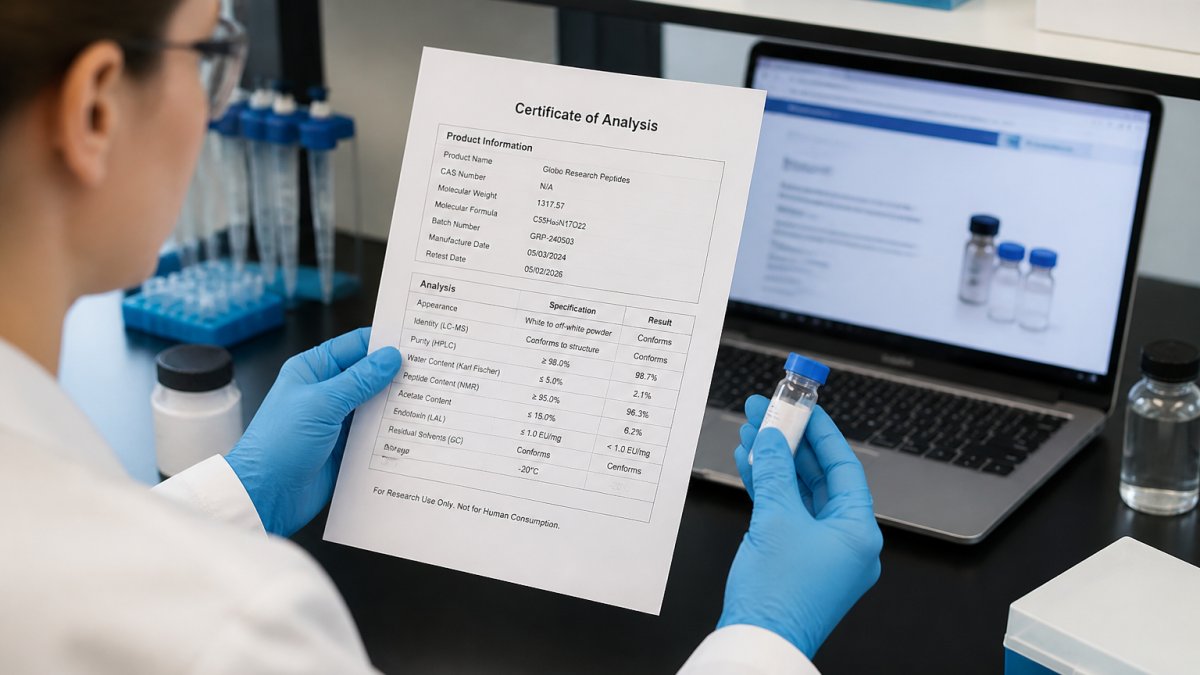
A vendor that provides these immediately, with clear documentation, is signaling that transparency is built into their process.
When you're evaluating a vendor, look for these markers of quality:
- Full batch-specific COAs provided with every order, not upon request
- Third-party testing from accredited laboratories
- Clear HPLC chromatogram data in the COA, not just summary percentages
- Consistent purity results across multiple batches
- Documented chain of custody and storage conditions
- Response time to questions, do they answer within hours or days?
The vendors worth working with treat documentation as a competitive advantage, not a burden. Learn how to assess peptide supplier transparency with batch COAs, third-party testing, and red flag checks.
Browse verified research peptides from a supplier that prioritizes transparency. You can see real COAs, catalog depth, and quality standards in action before you commit to an order.
Pricing, Shipping, and Minimum Order Requirements
Pricing for research peptides is not a single number, it is a function of four variables: compound identity, quantity, purity grade, and whether the lot is in stock or made to order. A short, common sequence sold in a 5 mg vial and a longer, modified sequence sold in a 50 mg vial can differ by an order of magnitude in cost per milligram, and that spread exists at every vendor, not just the two being compared.
The practical way to compare vendors on price is to build a like-for-like basket. Pick three compounds you actually use, request the same quantity and the same stated purity for each, and ask both vendors for a written quote with the lot number and COA attached. A quote without a lot number is a list price, not a price.
What drives the number up or down:
- Quantity breaks. Nearly every vendor tiers pricing by vial size, and the per-milligram cost typically drops as you move from 5 mg to 10 mg to 50 mg. Ask for the full tier sheet, not just the price at your current order size.
- In-stock versus custom synthesis. In-stock inventory is priced and shipped from a finished lot. Custom synthesis carries setup costs, a longer lead time, and usually a higher minimum.
- Purity grade and testing level. A lot verified by an independent laboratory with a full chromatogram costs more to produce than one with an in-house summary. That premium is real and should be visible in the quote, if it is not, ask why.
- Minimum order quantities. Minimums are common. Typical structures are a per-line minimum (a floor on milligrams per compound) or a per-order minimum (a dollar floor across the cart). A per-line minimum is the one that bites when you are screening many compounds at small scale, so confirm which structure applies before you plan a multi-compound order.
Shipping and fulfillment, compared on evidence rather than promises. Shipping speed claims are easy to make and hard to verify, so compare the mechanics instead of the marketing:
- Handling time versus transit time. Ask each vendor to separate the two. A '2-day shipping' claim often means 2 days in transit after a 3-5 business day handling window.
- Packaging and cold chain. Peptides are typically shipped lyophilized at ambient temperature, but confirm whether the vendor uses insulated packaging, desiccant, and tamper-evident seals, and whether temperature-sensitive compounds ship with cold packs.
- Order accuracy and damage policy. Ask what happens when a vial arrives cracked, short, or with a COA that does not match the lot. A written replacement policy is a better signal than a satisfaction statement.
- Returns. Research peptides are frequently sold as non-returnable once the seal is broken, which is reasonable, but the policy should be stated up front, not discovered after a problem.
- Support response time. Send both vendors the same pre-sale question (for example, 'Can you send the COA for lot X?') and time the reply. Response time on a pre-sale question is the closest proxy you have for post-sale support.
FDA guidance on compounding and research-use-only materials
Keep a simple comparison log: vendor, compound, quantity, quoted price, lot number, COA received (yes/no), handling time, transit time, and support response time. Two or three orders will tell you more about a vendor's fulfillment reliability than any review page.
Selecting the Right Vendor for Your Research Needs
The selection problem is not 'which vendor is better,' it is 'which vendor's claims can I verify before I spend money.' Use a comprehensive vetting guide to identify high-quality peptide suppliers matching your research requirements.
Step 1: Separate the three kinds of evidence. Every claim you encounter about a vendor falls into one of three buckets, and they are not equal:
- Independently verifiable. A lot-specific Certificate of Analysis with a chromatogram, a testing laboratory name, a test date, and a method. This is the strongest evidence you can get pre-purchase.
- Vendor-asserted. A purity percentage on a product page, a 'third-party tested' badge, or a quality statement with no lot number. Useful as a starting point, not as proof.
- Anecdotal. Forum posts, review-site scores, and testimonials. These can flag a pattern worth investigating but cannot establish purity or fulfillment reliability on their own.
A vendor that supplies bucket-one evidence on request is telling you something concrete.
Step 2: Audit the reviews instead of counting them. Aggregate star ratings are the weakest signal in this category because they are easy to solicit, easy to select, and rarely tied to a lot number. When you look at reviews for a vendor, check:
- Dates. A cluster of five-star reviews posted within a few days of each other is a pattern worth discounting.
- Distribution. A bimodal distribution (many 5s and many 1s, few 3s) often signals a mix of genuine satisfaction and fulfillment failures rather than uniform quality.
- Specificity. A review that names a compound, a lot, a ship date, and an outcome carries more weight than 'great product, fast shipping.'
- Selection bias. Reviews hosted on the vendor's own site are curated by definition. Cross-check against independent forums and note where the two disagree.
Step 3: Run a documentation request as a test. Before ordering, send vendors the same three questions and score the answers:
- Can you send the lot-specific COA, including the chromatogram, for the compound I am considering?
- Which laboratory performed the test, and what method was used?
- What is your handling time, and what is your policy if the COA does not match the lot I receive?
Score each reply on completeness, speed, and whether it contains a document versus a promise. This single test separates vendors more reliably than any catalog comparison.
Step 4: Match the vendor to the study, not the other way around. A small pilot screening common compounds has different requirements than a multi-month program using specialized sequences.
FTC guidance on endorsements and testimonials
Browse verified research peptides to see what lot-specific documentation looks like in practice before you run the same test on any vendor you are considering.
Frequently Asked Questions
What should a peptide Certificate of Analysis include?
A complete Certificate of Analysis must include batch-specific HPLC purity results, molecular weight confirmation, identity testing data, and storage stability information. It should be dated, signed by the testing laboratory, and reference the exact batch number on your order. Incomplete or generic COAs, those lacking batch-specific data or third-party lab credentials, indicate inadequate quality control and should be a red flag when evaluating any peptide vendor.
How can researchers verify a peptide supplier's purity claims?
Request the batch-specific Certificate of Analysis before purchase and verify it comes from an accredited third-party laboratory, not the supplier itself. Check that HPLC purity data is reported at the exact wavelength relevant to your compound. Contact the testing laboratory directly to confirm they performed the analysis. Compare multiple batches from the same vendor to identify batch-to-batch variation. Suppliers offering ≥99% purity with full documentation and third-party testing are more likely to deliver reliable results.
What is the difference between Core Peptides and Simple Peptides?
Core Peptides and Simple Peptides are distinct vendors serving the research peptide market. Both operate online catalogs of research chemicals, but they may differ in product selection, documentation practices, pricing models, and shipping speed. Researchers should compare their specific peptide needs, required purity levels, and documentation standards against each vendor's actual offerings and third-party testing practices.
How do I know if a peptide vendor is transparent about quality control?
Transparent vendors publicly document their testing protocols, name their third-party laboratories, provide batch-specific Certificates of Analysis without requiring special requests, and clearly state purity guarantees with supporting evidence. They answer technical questions about synthesis methods, batch consistency, and quality assurance procedures. Vendors that withhold testing details, offer only generic COAs, or refuse to disclose their laboratory partners are signaling weak quality control. Established suppliers maintain detailed vendor transparency by publishing their standards and testing results openly.