 how-to
How to Assess Peptide Supplier Transparency in 2026
Table of Contents
- Why Peptide Supplier Transparency Decides Your Research Outcomes
- Third-Party Peptide Testing Standards: What Accreditation Actually Means
- How to Read a Peptide Certificate of Analysis Line by Line
- Batch-Specific COAs vs. Generic Certificates: The Transparency Test
- Peptide Supplier Red Flags in Marketing and Documentation
- Cold Chain, Shipping Integrity, and Supply Chain Traceability
- A Due Diligence Checklist for Vetting a New Peptide Vendor
- Frequently Asked Questions
Last Updated: September 20, 2026
Why Peptide Supplier Transparency Decides Your Research Outcomes
Peptide supplier transparency means a vendor openly documents how each batch was made, tested, and handled, then shares that proof with you. When it is missing, a single mislabeled vial can waste months of work.
Third-Party Peptide Testing Standards: What Accreditation Actually Means
Third-party peptide testing standards define who runs the test, how, and whether results can be trusted. A vendor's own lab report proves little; an independent report proves a lot, but only if the lab is credible.
ISO/IEC 17025 and Why the Testing Lab's Credentials Matter
ISO/IEC 17025 is the international standard for testing and calibration labs. Accreditation means the lab was audited for equipment calibration, staff competency, method validation, sample handling, and record-keeping, the single most useful signal of lab credibility.
Two details most buyers miss:
- Accreditation is scope-specific. A lab can be accredited for one type of analysis and not another. Ask whether the lab's accreditation scope covers the specific method on your COA, for example, reversed-phase HPLC-UV for purity and electrospray ionization mass spectrometry for identity.
- Accreditation is verifiable. Accredited labs are listed by their accreditation body, and the body publishes the lab's scope. You can look up the lab name and confirm the accreditation is current, not expired or suspended.
HPLC vs. Mass Spectrometry: Reading Purity and Identity Separately
Purity and identity are two different questions requiring two different tests, the technical gap most supplier guides skip.
- High-Performance Liquid Chromatography (HPLC) measures purity. Compounds separate in a packed column based on their interaction with the stationary versus mobile phase, each eluting at a characteristic retention time. The target peak area divided by total peak area gives the purity percentage. One dominant peak with small shoulders is good; multiple large peaks mean a mixture.
- Mass Spectrometry (MS) confirms identity. The instrument ionizes the sample and measures mass-to-charge ratio. The observed mass should match the calculated monoisotopic or average mass of the intended sequence within a tight tolerance; if it is off, the molecule is not what the label claims.
Practical reading notes:
- Method column. It should name the column type, mobile phase, and detector for HPLC, plus ionization mode and instrument type for MS.
- Chromatogram image. A purity number without the trace is an assertion, not evidence.
- Mass spectrum. Expected and observed mass should both appear, ideally with the difference stated.
- "HPLC only" COAs. Common from resellers who never re-test.
What a Strong Testing Package Looks Like
Score each vendor's testing package on four points:
- Independent lab, not the vendor's own facility.
- ISO/IEC 17025 accreditation, with a scope covering the methods used.
- Both HPLC and MS, purity and identity, not one or the other.
- Raw data attached, chromatogram and mass spectrum, not just summary numbers.
A vendor meeting all four is doing the work; one or two means taking their word for it.
How to Read a Peptide Certificate of Analysis Line by Line
A Certificate of Analysis (COA) is the formal record of a batch's test results. Reading a peptide certificate of analysis is the fastest way to separate real vendors from resellers.
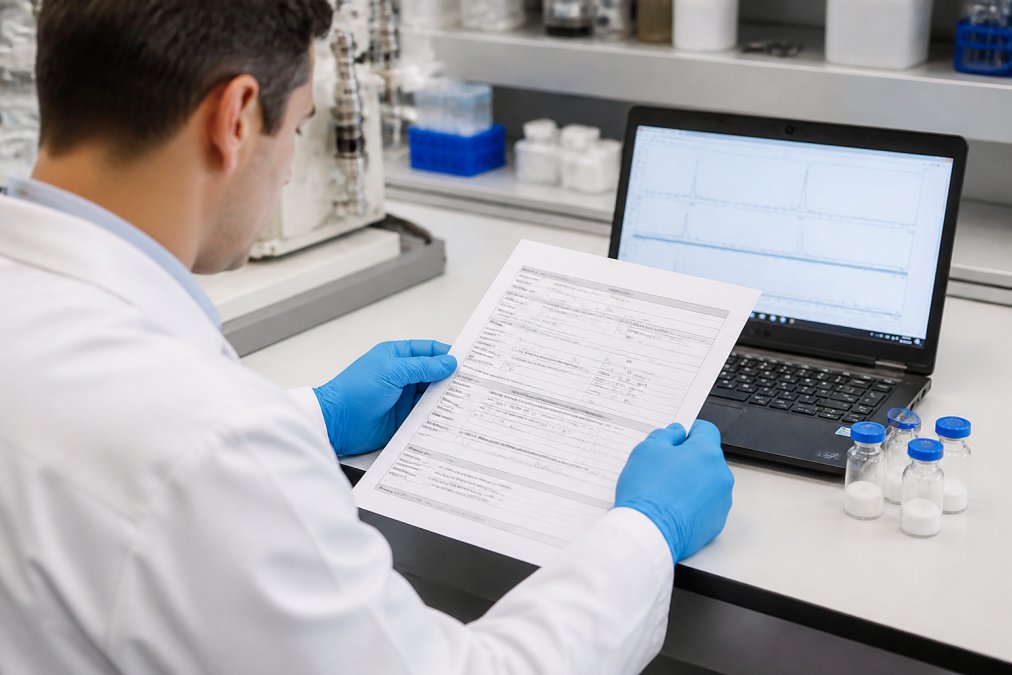
Every COA should contain these fields:
- Batch number that matches the vial label
- Test date within the last 12 months
- Method column naming HPLC and MS
- Purity percentage with the chromatogram attached
- Lab name and contact you can verify
Batch Numbers, Test Dates, and Method Columns
The batch number is your anchor: it must match the vial you receive. If the COA says "Batch A12" and your vial says "Batch B07," the document does not apply.
Batch-Specific COAs vs. Generic Certificates: The Transparency Test
Batch-specific COAs describe the exact lot you receive; generic certificates describe "typical" results and apply to nothing.
| COA Type | What It Proves | Red Flag Level |
|---|---|---|
| Batch-specific | Exact lot tested | Low |
| Generic template | Nothing about your vial | High |
| No COA | No verification at all | Walk away |
Peptide Supplier Red Flags in Marketing and Documentation
Peptide supplier red flags show up in language long before test results. Spot them early.
Common warning signs include:
- Purity claims with no lab name attached
- "Pharmaceutical grade" used loosely with no proof
- No physical address or contact details
- Prices far below every competitor
- Pressure to buy before you see documents
- No mention of Research Use Only (RUO) status
Cold Chain, Shipping Integrity, and Supply Chain Traceability
Cold chain logistics and supply chain traceability protect the peptide between the lab and your bench. Poor shipping can degrade a perfect batch, and a vendor who cannot trace a batch to its source cannot vouch for it.
Manufacturer vs. Reseller: The Distinction That Changes Everything
A manufacturer synthesizes the peptide, controls synthesis conditions, and tests the output. A reseller buys finished vials and labels them. Both can be legitimate, but their transparency obligations differ sharply.
A manufacturer can answer questions a reseller cannot:
- What synthesis method was used (solid-phase peptide synthesis is standard, but details matter)?
- What purification steps followed synthesis?
- What was the yield, and how does it relate to the purity claimed?
- What is the batch's full history from synthesis to shipment?
Cold Chain and Shipping Integrity
Many peptides ship as lyophilized powder, more stable than liquid form, but temperature swings and long transit times still cause problems for heat- or moisture-sensitive peptides.
What to check before ordering:
- Does the vendor ship with temperature control where needed, and can they describe the packaging (insulated liner, phase-change packs, desiccant)?
- Is there tracking from dispatch to delivery, and does the vendor monitor transit conditions?
- Does the vial arrive with an intact seal, a legible label, and a batch number that matches the COA?
- Is there a stated policy for what happens if a shipment arrives compromised?
Regulatory and Compliance Considerations
Research peptides are sold for laboratory study, not human use. The Research Use Only (RUO) designation reflects intended use and the regulatory framework the product falls under. A vendor who blurs the line between research and human use puts the risk on your lab.
A few compliance points worth confirming:
- RUO labeling appears on the vial, the COA, and the product page, not just one of the three.
- No human-use claims appear anywhere in the vendor's marketing, including testimonials and dosing discussions.
- The vendor's legal entity is disclosed, a real business name, a physical address, and a way to reach a human.
- Payment and record-keeping are consistent with a legitimate research supplier, not a pop-up storefront.
A Supply Chain Traceability Checklist
Score a vendor's supply chain transparency with these questions:
- Can they name the manufacturing source, or do they manufacture themselves?
- Can they describe the synthesis and purification steps?
- Does the vial's batch number trace back to a specific COA?
- Does the COA name the testing lab, its accreditation body, and the accreditation number?
- Can they describe shipping packaging and temperature control in specific terms?
- Is RUO labeling consistent across vial, COA, and product page?
- Is the legal entity and physical address disclosed?
Answering all seven signals real transparency; two or three means filling gaps with trust. In research, trust is not a substitute for documentation.
A Due Diligence Checklist for Vetting a New Peptide Vendor
Due diligence is a documented process, not a gut check. Work through this checklist before your first order.
- Request a batch-specific COA with HPLC and MS data
- Confirm the testing lab is ISO 17025 accredited
- Verify the batch number matches the vial label
- Check the test date is within 12 months
- Confirm RUO labeling and intended-use statements
- Ask about cold chain and shipping methods
- Request the source of manufacture for traceability
- Compare prices against the market (too cheap is a warning)
Frequently Asked Questions
What documentation should a reputable peptide supplier provide?
A transparent supplier provides a batch-specific Certificate of Analysis for every lot, listing the batch number, test date, HPLC purity percentage, mass spectrometry identity confirmation, and the name of the independent laboratory that ran the tests. You should also receive storage and handling instructions, plus a stated Research Use Only designation. If the COA is generic, undated, or missing the testing lab's identity, treat it as incomplete documentation and ask for the batch-matched version before ordering.
What are the common peptide supplier red flags when buying research peptides?
Watch for purity claims with no supporting COA, COAs that cover a different batch number than the vial you receive, and marketing language that promises therapeutic or human-use benefits on a Research Use Only product. Other warning signs include refusal to name the third-party lab, prices far below the market without explanation, and no stated cold chain or shipping protocol. Any one of these is worth a direct written question before you commit a study timeline to that vendor.
Why is third-party testing critical for peptide purity?
In-house testing gives the vendor control over both the sample and the result, which is why independent verification carries more weight. Third-party peptide testing standards require an accredited laboratory to run High-Performance Liquid Chromatography for purity and mass spectrometry for identity, then report the findings on the COA. A ≥99% HPLC purity figure means little without knowing which lab produced it and whether the sample came from the batch you actually received.
How do you verify a Certificate of Analysis for research peptides?
Match the batch number on the COA to the batch number printed on your vial label, then check the test date against your order date. Confirm the COA names the analytical method used, the purity percentage, and the identity confirmation, and that it comes from an independent laboratory rather than the vendor's own bench. If the document is vague or the batch numbers do not align, request a corrected COA in writing. Documentation that cannot be traced to your specific lot is not verification.
Transparency in peptide sourcing comes down to proof you can check. Vendors who test independently, document every batch, and ship with care earn your trust. Those who hide behind vague claims do not.
Globo Research Peptides builds that proof into every order. We provide full COA documentation, rigorous third-party testing, and a special-order program for hard-to-find compounds. Get started with Globo Research Peptides and source research materials you can actually verify.