 ultimate-guide
Peptide Purity Standards for Preclinical Studies
Table of Contents
- Why Peptide Purity Standards Determine Preclinical Study Validity
- HPLC vs Mass Spectrometry for Peptide Verification
- Certificate of Analysis Interpretation: What to Check Before Accepting a Batch
- The Impact of Peptide Purity on Preclinical Outcomes
- Peptide-Related Impurities and Acceptance Criteria
- Stability Testing and Solubility: The Overlooked Purity Variables
- How to Evaluate Peptide Suppliers for Preclinical Research
- Conclusion
- Frequently Asked Questions
Last Updated: September 23, 2026
Why Peptide Purity Standards Determine Preclinical Study Validity
Peptide purity standards for preclinical studies define the minimum analytical thresholds a synthetic peptide must meet before it can be trusted in cell-based or animal research. A peptide labeled 98% pure can still carry the wrong sequence, the wrong counter-ion, or an impurity profile that skews receptor binding data.
HPLC vs Mass Spectrometry for Peptide Verification
High performance liquid chromatography (HPLC) and mass spectrometry answer two different questions: how much of your sample is the target peptide, and whether that peptide is the molecule you ordered. You need both.
When HPLC Alone Falls Short
Reversed-phase HPLC at 214-220 nm detects the peptide backbone, so it sees most peptide-related impurities, but not anything that co-elutes with your target peak.
Common blind spots:
- Deletion sequences that differ by one residue and elute at nearly the same retention time
- Counter-ion content that varies between batches without changing the chromatogram
- Residual solvents and water content that inflate or deflate the reported purity
Mass Spectrometry Confirms What HPLC Cannot
Mass spectrometry verifies molecular weight, and tandem techniques extend that to sequence verification. Electrospray ionization coupled with HPLC (LC-MS) gives you a purity profile and identity confirmation in one run.
Certificate of Analysis Interpretation: What to Check Before Accepting a Batch
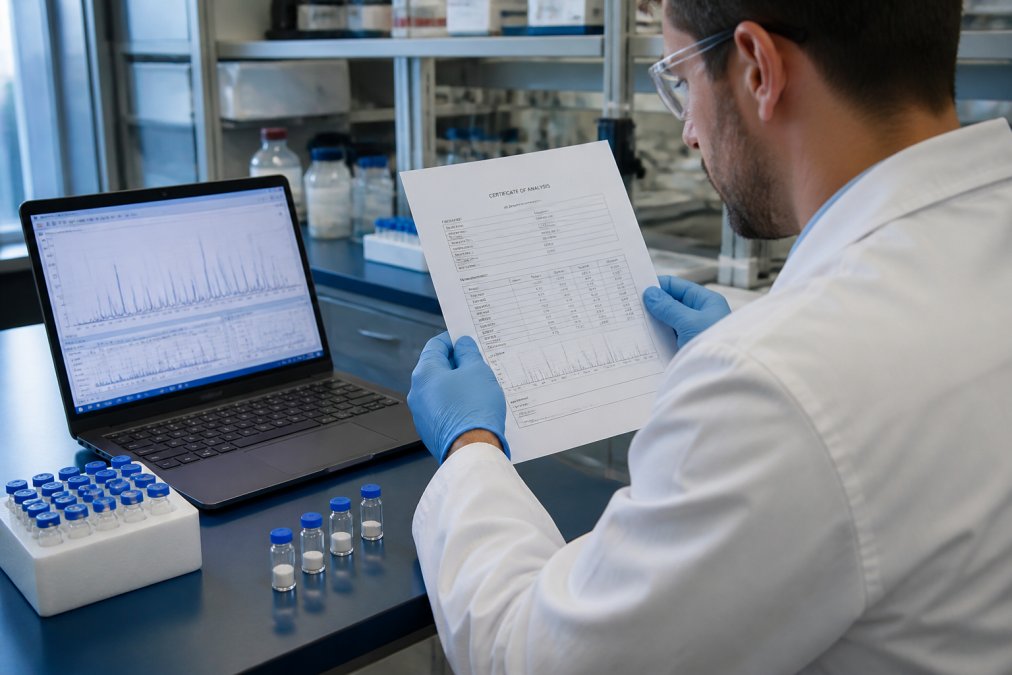
A Certificate of Analysis (COA) is a batch-specific document stating what was tested, how, and with what results. Most labs skim it; you should read it line by line.
Red Flags in a COA
The most common mistake is accepting a COA that reports a purity figure without naming the method. "Purity: 99%" means nothing without the column, mobile phase, wavelength, and gradient. Watch for:
- No lot or batch number tying the document to your specific vial
- Purity stated without the analytical method or detection wavelength
- Missing mass spectrometry data or a molecular weight that does not match the theoretical value
- No mention of counter-ion content, water content, or residual solvents
- A generic template with no testing dates or analyst sign-off
Batch-Specific Documentation Requirements
A COA that can support preclinical work should include the following on one document, tied to one lot number:
- Peptide name, sequence, and lot number
- HPLC method with column, gradient, and detection wavelength
- Chromatographic purity percentage
- Mass spectrometry result with observed and theoretical molecular weight
- Appearance and solubility notes
- Storage conditions and retest date
- Testing laboratory name and accreditation status
The Impact of Peptide Purity on Preclinical Outcomes
Impurity levels change what your data means. A peptide at 95% purity delivers roughly one part unknown material for every nineteen parts target compound, and that unknown fraction can bind receptors, trigger immune responses, or shift a dose-response curve.
Peptide-Related Impurities and Acceptance Criteria
Acceptance criteria are the pre-defined limits a batch must meet to be released, and they belong in your study protocol before you order. If you set the threshold after looking at results, you have not set a threshold, you have rationalized a number.
Common Impurity Classes in Synthetic Peptides
Synthetic peptides carry predictable impurity classes, and each one has a characteristic analytical signature:
- Deletion and truncation sequences from incomplete coupling, often the largest single impurity class in crude material
- Insertion sequences from double coupling at a single residue
- Oxidized variants, particularly methionine and cysteine residues, which shift retention time and can alter receptor binding
- Diastereomers from racemization during synthesis, which are frequently invisible on a standard single-wavelength RP-HPLC trace
- Counter-ion content (typically trifluoroacetate or acetate) from purification and salt exchange, which can account for a meaningful fraction of lyophilized mass
- Residual solvents from synthesis and chromatography, plus water content, both of which inflate or deflate a reported purity figure
Threshold of Identification and Quantification Limits
Pharmacopeial standards, the general chapters maintained by the United States Pharmacopeia, set reporting, identification, and qualification thresholds for impurities. A validated test method must quantify at the level your protocol cares about; a method whose limit of quantitation sits above your acceptance limit cannot enforce that limit.
A Practical Acceptance-Criteria Framework
Use the table below as a starting template and adjust the limits to your study's sensitivity. The right-hand column is the part most guides omit: how each attribute should be tracked across lots.
| Impurity Concern | Analytical Method | Typical Acceptance Approach | Batch-to-Batch Tracking Metric |
|---|---|---|---|
| Purity percentage | RP-HPLC | Meets protocol minimum | Mean and range across last 3-5 lots |
| Identity | Mass spectrometry | Matches theoretical mass | Pass/fail per lot, no drift allowed |
| Counter-ion content | Ion chromatography | Within specified range | Percent relative standard deviation across lots |
| Residual solvents | GC | Below protocol limits | Pass/fail per lot |
| Endotoxin levels | LAL assay | Below study threshold | Pass/fail per lot, trending chart |
| Water content | Karl Fischer titration | Within specified range | Percent relative standard deviation across lots |
Batch-to-Batch Consistency: The Metric Most Guides Skip
A single COA tells you what one lot looked like. A preclinical study that runs across multiple lots, and most do, once you scale up, depends on consistency between them. The documentation you want is not a single certificate but a lot-to-lot trend.
A workable consistency check has three parts:
- Retain a reference standard. Keep an aliquot of a well-characterized lot and run it alongside each new lot on the same HPLC method. Retention time and peak area of the reference anchor the comparison.
- Track the purity range, not just the minimum. A supplier whose lots range from 95.1% to 99.8% is less consistent than one whose lots range from 97.9% to 98.6%, even if both clear a 95% minimum.
- Document the variance. Percent relative standard deviation of purity across lots is a single number you can put in a methods section or hand to a reviewer.
When 95% Is Enough and When It Is Not
Purity thresholds are not a status symbol; they state how much uncontrolled variability your assay can tolerate.
- 95% is often sufficient for qualitative work: Western blot detection, immunogen preparation where the impurity fraction is not the immunogen of interest, and exploratory screens where you are looking for a large effect.
- 98% or higher is usually necessary for quantitative receptor binding (where a 2-5% impurity fraction can produce measurable background activity), for in vivo dose-response work (where impurity mass contributes to the delivered dose), and for any study where the impurity class is known to be biologically active, for example, oxidized methionine variants in a peptide whose target is redox-sensitive.
Stability Testing and Solubility: The Overlooked Purity Variables
Purity at release is not purity at use. Most guides stop at the COA and never address what happens between the certificate date and the last animal dosed, yet that is where most preclinical purity failures originate.
Stability-Indicating Methods
A stability-indicating method can detect degradation products separately from the parent peptide. A generic RP-HPLC method never challenged with stressed samples may co-elute a degradation product with the parent peak, reporting stable purity while the material degrades.
A Practical Stability Protocol for a Preclinical Study
Run this before the main experiment, not after:
- Baseline characterization. Reconstitute a small aliquot in your intended buffer and run HPLC and mass spectrometry on day 0. Record the peak profile.
- Storage-condition timepoints. Hold aliquots at the temperature and buffer your study will use, and re-run at day 1, day 3, day 7, and at the end of your study window. For lyophilized material, test at the storage temperature and at one accelerated condition (for example, elevated temperature) to bracket the degradation rate.
- Freeze-thaw challenge. Subject one aliquot to three freeze-thaw cycles and compare to a single-thaw control. Repeated freeze-thaw is one of the most common causes of aggregation in reconstituted peptide stocks.
- Define a failure threshold. Pre-specify the purity drop that would invalidate the batch, for example, a loss of more than 2 percentage points from baseline, or the appearance of a new peak above the reporting threshold.
- Document the result. Attach the stability data to the study file. Reviewers increasingly ask for it.
Solubility and Buffer Compatibility
Solubility is not a fixed property of a peptide; it depends on pH, ionic strength, and buffer system, and a peptide that dissolves cleanly in one buffer may aggregate in another. Aggregation reads as loss of purity on the next HPLC run, so a solubility problem can masquerade as a stability problem.
Practical guidance:
- Test in your intended buffer first. Reconstitute a small aliquot in the exact buffer your assay uses, not in water, and check for clarity and for a clean HPLC trace.
- Watch the pH relative to the peptide's isoelectric point. Peptides are least soluble near their pI. If your buffer pH sits near the pI, expect aggregation and consider a different buffer.
- Be cautious with high ionic strength. Some peptides salt out or aggregate at high salt concentrations, which is a particular problem for assays that require physiological ionic strength.
- Use a solubility-appropriate co-solvent only if your assay tolerates it. A small percentage of acetonitrile or DMSO can rescue a poorly soluble peptide, but it also changes the assay conditions and must be controlled across all arms of the study.
Reconstitution and Storage Practices That Preserve Purity
- Reconstitute lyophilized peptide at the concentration your assay requires, and avoid stock solutions so concentrated that the peptide is near its solubility limit.
- Aliquot before freezing. A single large stock that is thawed repeatedly degrades faster than single-use aliquots.
- Store lyophilized material desiccated at low temperature, and let vials equilibrate to room temperature before opening to avoid condensation.
- Record reconstitution date, buffer, and concentration on the vial. A peptide with no reconstitution record is a peptide with no provenance.
Cost-Benefit: When Stability Testing Is Worth the Effort
Stability testing costs time and material. Run it in full when your study spans more than a few days, when dosing in vivo, when your peptide contains oxidation-prone residues (methionine, cysteine, tryptophan), or when your effect size is small enough that a few percent of degradation product could explain your result.
How to Evaluate Peptide Suppliers for Preclinical Research
Ask every supplier these questions before ordering:
- Can you provide a batch-specific COA with HPLC and mass spectrometry data?
- Which third-party laboratory performs your testing, and is it accredited?
- What are your acceptance criteria for peptide-related impurities?
- How do you handle batch-to-batch consistency, and can you share historical data?
- What is your policy if a batch's documentation does not match your specification?
- Do you offer stability data or retest intervals for stored material?
Supplier selection is not a one-time decision. Batch-to-batch consistency is a moving target, and the vendor who performed well last quarter still needs to prove it this quarter.
Conclusion
The hardest part of preclinical peptide work is not the assay, it is defending the material you put into it, and that defense starts with documentation traceable to a specific lot.
ORDER NOW
Frequently Asked Questions
What is the acceptable purity level for peptides in preclinical research?
For most in vitro and in vivo preclinical studies, ≥95% chromatographic purity is the minimum, but ≥98% is strongly preferred for receptor binding assays and pharmacokinetic profiling. Studies involving sensitive cell lines or dose-response curves often require ≥99% to avoid confounding effects from peptide-related impurities. Always match the purity specification to your assay sensitivity and the intended use of the data.
Is 98% purity sufficient for all preclinical applications?
No. While 98% purity works for many exploratory in vitro studies, it may not be adequate for in vivo work where even trace impurities can trigger immune responses or off-target effects. For studies intended to support an Investigational New Drug application or preclinical safety assessment, higher purity with full analytical characterization, including mass spectrometry and counter-ion content, is typically expected.
What documentation is required to verify peptide purity?
A complete Certificate of Analysis should include the batch number, HPLC chromatogram with purity percentage, mass spectrometry data confirming molecular weight, appearance, solubility, and storage conditions. For preclinical studies, you may also need endotoxin levels, residual solvents, and counter-ion content. Request batch-specific COAs, not generic specification sheets, and verify that the testing laboratory is accredited.
How do impurities affect the reproducibility of preclinical data?
Peptide-related impurities, including deletion sequences, truncated peptides, and oxidized variants, can interact with receptors or enzymes differently than the target compound. This leads to inconsistent dose-response curves, variable results between batches, and difficulty replicating findings. Using validated test methods and setting strict acceptance criteria for impurity profiles helps ensure that each batch behaves predictably across experiments.