 how-to
What Purity Should My Retatrutide Be? A 2026 Guide
Table of Contents
- What Purity Should My Retatrutide Be? Setting the Threshold
- What an HPLC Purity Percentage Actually Measures (And What It Doesn't)
- Retatrutide HPLC Testing: Reading the Chromatogram
- Retatrutide Certificate of Analysis: What Every COA Must Show
- How to Check Peptide Purity: A Step-by-Step Verification Process
- Impurities, Byproducts, and Degradation Products: What High Purity Doesn't Rule Out
- Conclusion: Purity Thresholds in Context
- Frequently Asked Questions
Last Updated: October 5, 2026
What Purity Should My Retatrutide Be? Setting the Threshold
If you are asking what purity should my retatrutide be, the practical answer is 98% or higher by HPLC, with 99% or better for sensitive research. At Globo Research Peptides, we treat 98% as the floor, not the goal, because a single percentage point of impurity can matter in receptor binding and pharmacokinetic work.
That number is a measurement with limits. Below, we explain what it covers, how to read the paperwork behind it, and where high purity can still hide problems.
Why 98% Is the Floor, Not the Goal
A 98% figure means roughly 2% of the material is something else: synthesis byproducts, residual solvents, or degradation products formed in storage.
For early-stage or non-quantitative work, 98% may be acceptable. For anything measuring dose-response or receptor affinity, it usually is not.
- 98% to 98.9%: usable for exploratory or qualitative work
- 99% and above: the standard for quantitative assays
- Below 98%: generally unsuitable for published research
What an HPLC Purity Percentage Actually Measures (And What It Doesn't)
An HPLC purity percentage measures how much of the UV signal at a set wavelength comes from your target peak versus everything else.
A purity number answers one narrow question: how clean is this sample by one detection method?
Two things follow. First, a high percentage does not confirm identity, a sample can be 99% pure and still be the wrong peptide.
Area Percent vs. True Peptide Content
Area percent is the share of total peak area belonging to the target compound. True peptide content is the actual mass of peptide in the vial, usually lower because of counterions, water, and residual salts.
So a vial labeled 99% pure might contain meaningfully less than 99% peptide by weight. That gap matters when you calculate concentrations.
- Area percent: a ratio, not a mass
- Peptide content: the number you need for accurate dosing math
- Net peptide weight: what remains after counterions and moisture
If your protocol depends on exact molarity, ask for peptide content, not just purity.
Retatrutide HPLC Testing: Reading the Chromatogram
A chromatogram is the raw HPLC output: detector response over time.
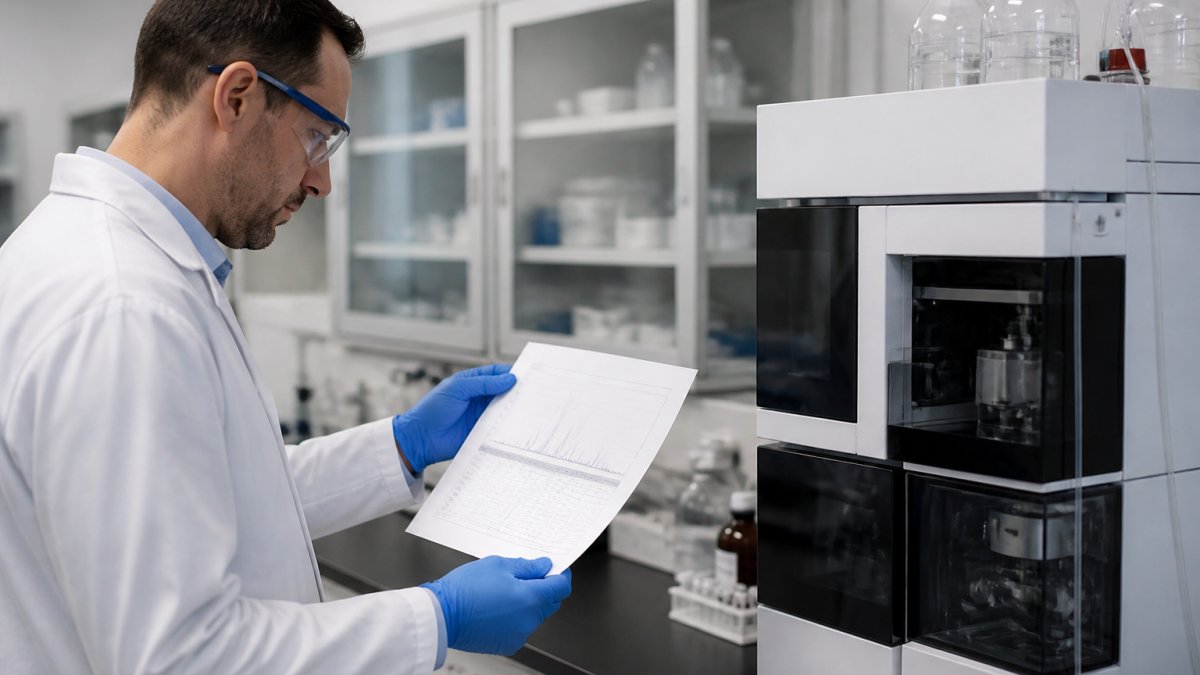
Start with the baseline: a flat, stable baseline suggests a clean run, while a drifting or noisy one can inflate or hide small peaks.
- Baseline: should be flat and stable
- Main peak: sharp and symmetrical
- Minor peaks: each one is an impurity or byproduct
Retatrutide Certificate of Analysis: What Every COA Must Show
A retatrutide certificate of analysis should show the batch number, test method, purity result, identity confirmation, and the laboratory that performed the work.
Here is what a complete COA includes:
| COA Element | What It Confirms | Why It Matters |
|---|---|---|
| Batch number | Traceability to a specific lot | Ties results to your vial |
| HPLC method | Column, gradient, wavelength | Makes results reproducible |
| Purity result | Area percent of target peak | The headline number |
| Mass spectrometry | Molecular weight match | Confirms identity |
| Testing lab | Who ran the analysis | Independent vs. in-house |
| Storage guidance | Handling conditions | Protects stability |
A COA without a batch number may describe a different lot entirely. Mass spectrometry is the piece purity alone cannot replace: it confirms the molecular weight matches retatrutide and rules out a pure sample of the wrong compound.
What the Purity Percentage Does Not Tell You
An HPLC area-percent figure answers exactly one question: of the UV signal captured at a set wavelength, what share came from the target peak? It does not measure identity, potency, concentration, sterility, or endotoxin content.
Treat the purity number as one dimension of quality, not a guarantee. Identity needs mass spectrometry; concentration needs peptide-content or net-peptide-weight data; sterility and endotoxins need separate microbiological and limulus amebocyte lysate (LAL) testing that most peptide COAs omit.
How to Independently Verify a COA
A COA is a document, and documents can be edited. Confirm a supplier's claim against something the supplier does not control.
- Match the batch number on the COA to the number on your vial label. If they differ, the report does not describe your material.
- Check the testing laboratory's credentials. Look for ISO/IEC 17025 accreditation, the standard for competent testing and calibration labs (NIST Quality System | NIST). An in-house lab run by the supplier is not independent verification.
- Contact the named lab directly. Ask whether the report reference number corresponds to a real submission. A legitimate lab will confirm it performed the test without disclosing client details.
Independent verification costs money and time. For critical studies, it is worth both.
Reading the Reporting Conventions
Two COAs can report the same 99% and mean different things: wavelength, column, gradient, flow rate, and integration settings all shift the result. A report listing only a purity percentage without method parameters is not reproducible, and one that excludes minor peaks from integration shows a higher number without the sample changing. Ask for the full chromatogram, method parameters, and detection wavelength, if a supplier cannot produce them, the purity figure is unverifiable.
How to Check Peptide Purity: A Step-by-Step Verification Process
To check peptide purity, match the COA batch number to your vial, confirm the test method, review the chromatogram, and verify the identity result. Skipping any step leaves a gap someone could exploit.
Here is the process we recommend:
- Match the batch number on the COA to the number on your vial label
- Confirm the method lists HPLC with column, gradient, and wavelength
- Inspect the chromatogram for baseline quality and peak shape
- Check the mass spectrometry result against the expected molecular weight
- Note the testing laboratory and whether it is independent
- Compare the test date to the batch date
- File the COA with your study records for traceability
Independently Verifying a Supplier's COA
A COA is a document, and documents can be edited. Confirm a supplier's claim independently by:
- Sending a sample to an accredited third-party lab for your own HPLC run
- Requesting the original instrument data file, not a reformatted PDF
- Asking the named testing lab to confirm the report reference
Independent verification costs money and time. For critical studies, it is worth both.
Impurities, Byproducts, and Degradation Products: What High Purity Doesn't Rule Out
High purity does not rule out harmful impurities.
Synthesis byproducts form during manufacturing. They are closely related to the target molecule and hard to separate, so they often co-elute near the main peak and inflate apparent purity.
Residual solvents and reagents come from synthesis and purification.
Degradation products form after manufacturing, driven by heat, light, moisture, and repeated freeze-thaw cycles.
What the Purity Number Cannot See
An HPLC area-percent figure is a ratio of UV signal, not a complete impurity profile. Several contaminant classes are effectively invisible to it:
- Non-UV-absorbing compounds such as many residual solvents and salts
- Bacterial endotoxins, which require limulus amebocyte lysate (LAL) testing
- Microbial contamination, which requires sterility testing
A COA reporting only HPLC purity and mass spectrometry has not tested for any of these. That is not necessarily a defect, but understand the limit before treating the number as a full quality profile.
Detection Limits and Reporting Conventions
Every HPLC method has a detection limit and reporting threshold. Impurities below the threshold are typically not listed, so a "99% pure" result can still contain unquantified trace impurities. This is why two labs can test the same sample and report different figures: a low reporting threshold surfaces more minor peaks and reports a lower percentage, a high threshold reports a higher one.
Stability, Storage, and the Test Date
A COA describes the batch on the day it was tested, not the day it arrives. Degradation is time- and condition-dependent, so the test date matters as much as the result.
- Store lyophilized peptide cold, dry, and protected from light
- Limit freeze-thaw cycles on reconstituted material
- Use bacteriostatic water for multi-draw vials
- Request a fresh analysis on the lot you actually receive for long studies
Safety and Legal Context
Purity is not the same as safety. Retatrutide is an investigational compound and is not an FDA-approved medicine for human use. Research-use-only peptides are not manufactured under current Good Manufacturing Practice (cGMP) conditions, are not reviewed by the FDA for safety, efficacy, or sterility, and are not intended for human consumption or injection. A 99% HPLC purity figure does not change any of that, nor establish that the material is safe, effective, sterile, or suitable for any human use.
Conclusion: Purity Thresholds in Context
Purity is a starting point, not a finish line.
That is why we build documentation around every batch rather than a single number. Globo Research Peptides provides verified ≥99% HPLC purity, full Certificate of Analysis documentation for every batch, and rigorous third-party testing through accredited laboratories.
If your study depends on material you can trace and defend, order now and get the documentation to match.
Frequently Asked Questions
What is a good purity level for retatrutide?
For research-grade retatrutide, 98% HPLC purity is generally treated as the minimum acceptable threshold, while 99% or higher is preferred for sensitive applications like receptor binding studies or pharmacokinetic profiling. The purity percentage reflects the area of the main peak relative to all peaks on the chromatogram. However, a high percentage alone does not confirm identity, sterility, or absence of non-UV-absorbing contaminants, so it should always be paired with mass spectrometry identity confirmation and a batch-specific Certificate of Analysis.
Is 98% purity good for peptides?
Yes, 98% purity is generally considered acceptable for many research applications, but it sits at the lower end of the acceptable range. For studies where trace impurities could interfere with results, such as cell-based assays or in vivo work, 99% or higher is a safer target. The key is to match the purity threshold to your specific experimental requirements. A 98% result also means up to 2% of the material is something other than the target peptide, which may include deletion sequences, truncated fragments, or residual solvents.
How do you check retatrutide purity?
Purity is checked primarily through reverse-phase high-performance liquid chromatography (HPLC), which separates components in a sample and reports each as a percentage of total peak area. Mass spectrometry is then used to confirm the molecular identity matches the expected mass of retatrutide. To verify a supplier's claim, request the batch-specific Certificate of Analysis, confirm the batch number matches your vial, and check that the testing laboratory is independent and accredited. If documentation seems incomplete, consider sending a sample to a third-party lab for independent testing.
Does a high purity percentage prove a peptide is safe or authentic?
No. A high HPLC purity percentage only tells you how much of the UV-absorbing material in the sample eluted as a single peak. It does not confirm the peptide's identity, rule out non-UV-absorbing contaminants, verify sterility, or establish safety for human use. Identity confirmation requires mass spectrometry, and authenticity requires that the measured mass matches the expected molecular weight of retatrutide. Additionally, retatrutide is not FDA-approved and is sold for research use only, so purity documentation should never be interpreted as a safety or efficacy claim.
Research peptide purity is a chain, and every link has to hold. A strong HPLC number means little without identity confirmation, a batch-specific COA, and storage you can trust. Globo Research Peptides supports that chain with verified ≥99% HPLC purity, full Certificate of Analysis documentation for every batch, and rigorous third-party testing by accredited laboratories. Get started with Globo Research Peptides and source research compounds you can document from vial to result.