 ultimate-guide
Why Peptide Purity Matters for Experiments
Table of Contents
- How Purity Affects Your Assay Results
- Peptide Synthesis Impurities: What Is Actually in Your Vial?
- Is 98% Purity Good for Peptides? Matching Grade to Application
- How to Interpret a Peptide COA Like a Reviewer
- Purity vs. Identity: Why Both Matter for Reproducibility
- Troubleshooting Failed Experiments Linked to Impurities
- Conclusion
- Frequently Asked Questions
Last Updated: September 8, 2026
Peptide purity is the single most critical variable determining whether your experimental results are real, reproducible, and publishable. When you order a synthetic peptide, the vial contains your target sequence alongside synthesis byproducts, truncated sequences, and residual solvents that can silently compromise your data. Globo Research Peptides provides research-grade compounds with verified purity of ≥99% and full Certificate of Analysis documentation for every batch, because peptide purity directly dictates experimental reproducibility and biological activity.
Below, we'll show you exactly how impurities interfere with your assays, what those impurities are, and how to verify quality beyond simply reading a label.
How Purity Affects Your Assay Results
Impurities in your peptide preparation interfere with assays through three primary mechanisms: competitive binding, off-target effects, and concentration errors. A truncated sequence that lacks a few C-terminal residues may still bind your receptor, but with different affinity and efficacy than your full-length peptide. This produces dose-response curves that are shifted, flattened, or frankly misleading.
The practical consequence is that peptide purity affects your calculated EC50 values, binding constants, and kinetic parameters. If your peptide is 95% pure, then 5% of what you weigh out is not your compound (peer-reviewed research). Your nominal concentrations are wrong, and your biological activity measurements carry an error margin that may exceed the effect you are trying to measure.
Peptide Synthesis Impurities: What Is Actually in Your Vial?
Peptide synthesis impurities are the byproducts and residual materials that accumulate during solid-phase peptide synthesis and subsequent processing. Understanding what is in your vial is the first step toward controlling experimental variability.
Truncated Sequences and Deletion Peptides
The most abundant impurities are truncated sequences and deletion peptides. When a coupling fails and the next amino acid attaches instead, you generate a deletion peptide missing one residue; when the chain terminates early, you generate a truncated sequence. These closely related impurities are nearly impossible to separate completely and can retain partial biological activity, making them dangerous for functional assays.
Counter-Ion Content vs. Peptide Content
Most synthetic peptides are purified by HPLC using mobile phases containing trifluoroacetic acid, so the final lyophilized product is a peptide salt, typically a trifluoroacetate salt. The peptide content, the actual peptide molecule, may be only 70-85% of the gross weight; the remainder is counter-ion, residual water, and residual solvents (PubMed).
This distinction matters because it affects how you calculate molar concentrations.
| Measurement | What It Tells You | Why It Matters |
|---|---|---|
| HPLC Purity | Percentage of peptide-related peaks | Indicates absence of synthetic byproducts |
| Peptide Content | Percentage of actual peptide by weight | Determines correct molar concentration |
| Counter-Ion Content | Percentage of salt (e.g., TFA) | Explains weight not accounted for by peptide |
| Residual Solvents | Water and organic solvents | Affects solubility and stability |
Is 98% Purity Good for Peptides? Matching Grade to Application
98% purity is good for some experiments and a liability for others. The real question is whether the impurity profile of your peptide can confound the specific readout you are measuring.
A Decision Matrix for Purity Grades
Use the following framework to match purity to your assay's sensitivity to impurities. The logic is simple: the more quantitative your endpoint, the more a 2-5% impurity fraction can shift your results.
| Application Type | Recommended Purity | Why This Grade | Cost Consideration |
|---|---|---|---|
| Preliminary screening / hit identification | 95-98% | You are looking for a qualitative yes/no signal; a truncated analog with partial activity rarely flips a clear hit to a miss. | Lower purity reduces synthesis cost by 20-40% per peptide; useful when testing many analogs. |
| Dose-response curves / EC50 determination | ≥98% | A 2% impurity with 10x higher potency can shift your EC50 by 0.2 log units, enough to misrank a series of analogs. | The cost of re-running a full dose-response plate exceeds the purification surcharge. |
| Quantitative binding (Kd, Ki) / enzyme kinetics | ≥99% | Impurities directly corrupt your calculated constants; a 1% high-affinity contaminant can produce a biphasic binding curve that misleads curve fitting. | This is non-negotiable; the math only works with a defined single species. |
| Structural biology (NMR, crystallography) | ≥99% with MS identity confirmation | A 1% deletion peptide can disrupt crystal packing or produce ambiguous electron density. | The cost of failed crystallization trials dwarfs any purification savings. |
| In vivo / pharmacokinetic studies | ≥99% with full COA and peptide content | Impurities can trigger off-target immune responses or alter clearance rates, invalidating your PK model. | Regulatory-grade documentation is worth the premium. |
The 'Over-Buying' Trap
Many researchers default to ≥99% purity for every experiment out of caution. For a first-pass GPCR screening campaign testing 50 analogs, paying a 30-50% premium for ≥99% purity provides no scientific advantage if your endpoint is a binary agonist/antagonist call at a single concentration. Reserve the highest purity grade for analogs that advance to quantitative characterization.
The 'under-buying' trap is more common than you think. A lab that orders 95% crude-desalted peptide for a quantitative ELISA and observes a 20% shift in signal between batches is seeing batch-to-batch impurity variation, not biology. Repeating that ELISA costs more than the initial purification upgrade.
The 98% Specific Problem
98% purity is the most common grade offered by suppliers because it is achievable with a single HPLC pass for most sequences. But 98% purity means 2% of your material is something else. If that 2% is a deletion peptide missing a single hydrophobic residue, it may aggregate differently, solubilize differently, and bind your target with altered kinetics, shifting your apparent potency by more than your experimental error bar.
The Cost-Benefit Calculation That Matters
A typical research-grade peptide at 98% purity costs $150-300 for 5 mg; the same sequence at ≥99% with full documentation runs $250-500 (the NIH). The $100-200 difference is trivial compared to a failed experiment: a week of a postdoc's time ($1,500-2,500), reagents ($200-500 per plate), and a delayed publication. The purity upgrade is the cheapest insurance you will buy in the lab.
For labs on tight budgets, a practical compromise is to order 98% for initial screening and request a re-purification to ≥99% only for the 2-3 lead compounds that advance to quantitative studies. Most peptide suppliers offer re-purification services at a fraction of the original synthesis cost.
How to Interpret a Peptide COA Like a Reviewer
A Certificate of Analysis is your primary evidence that the peptide you received matches what you ordered. Reviewing a COA like a peer reviewer means checking more than the purity percentage on the top line, that single number can hide critical issues.
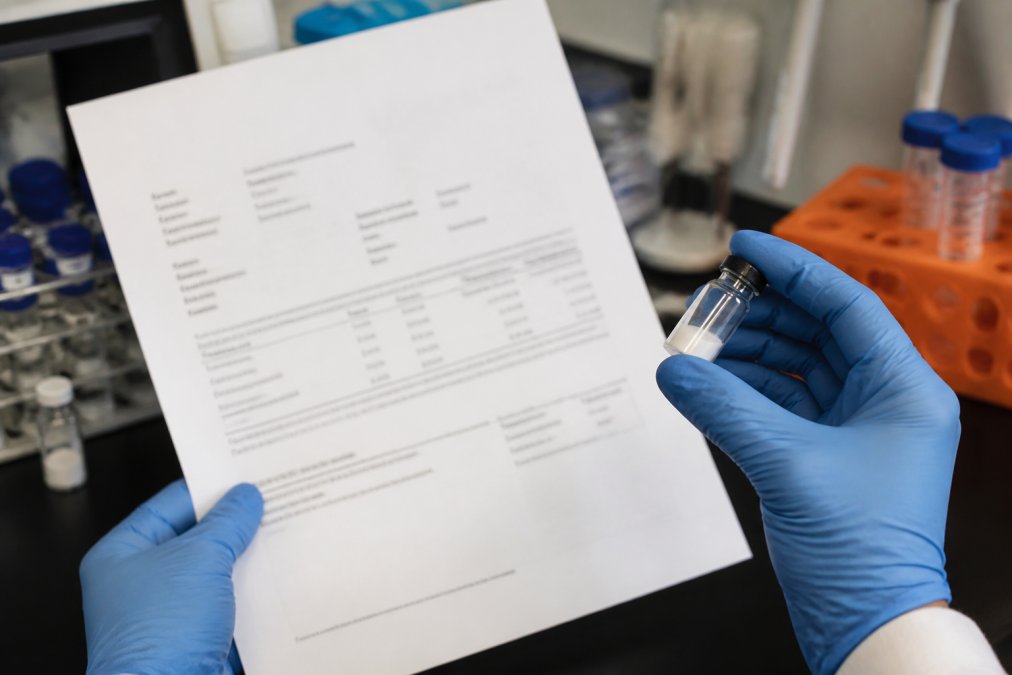
The Five Numbers That Matter on Every COA
1. HPLC Purity (Area %): This is the percentage of UV absorbance at 214 nm attributed to your target peak; ≥98% is standard for research-grade material. But area percentage is not a mole percentage, a contaminant with a high extinction coefficient can be over-represented. For quantitative work, ask if purity was determined at 214 nm (peptide bond absorbance) or 280 nm (aromatic residues only).
2. Peptide Content (%): This is the percentage of gross lyophilized weight that is actual peptide, not counter-ion or water. For TFA salts, peptide content typically runs 70-85%. If your COA reports 98% HPLC purity but only 75% peptide content, your molar concentration calculations must use the peptide content, not the gross weight.
3. Counter-Ion Specification: Most reverse-phase HPLC purification uses TFA in the mobile phase, producing a TFA salt that can be 10-20% of gross weight and interfere with cell-based assays. If your assay is TFA-sensitive, request acetate or hydrochloride salt exchange.
4. Mass Spectrometry (MS) Confirmed Molecular Weight: This is your identity check. The observed molecular weight should match the theoretical value within ±0.5 Da; a discrepancy of more than 1 Da indicates a sequence error, not a purity issue. Without MS confirmation, the supplier has not verified that the main peak is actually your peptide.
5. Date of Analysis and Batch Number: The COA should be dated within the last 6-12 months, and the batch number must match the vial label. A COA from a batch synthesized 3 years ago may not reflect current storage conditions.
Red Flags That Warrant a Call to Technical Support
- COA reports only HPLC purity, no MS data: The supplier has not confirmed identity. This is a common gap in supplier COAs.
- Peptide content is absent or listed as 'N/A': You cannot calculate accurate molar concentrations without this number.
- Purity is reported at 280 nm only: This wavelength only detects aromatic residues; a contaminant without tryptophan or tyrosine will be invisible.
- The COA shows a single HPLC trace with no method parameters: Reputable suppliers report column type, gradient conditions, and flow rate. Without these, you cannot assess whether the separation was adequate.
- Counter-ion is not specified: Assume TFA unless stated otherwise. This matters for solubility and cell-based assays.
How to Verify Beyond the COA
For critical experiments, consider independent verification. Major US academic core facilities and commercial labs offer analytical HPLC and ESI-MS services for $50-150 per sample, a 15-minute run can confirm both purity and identity before you commit a month of work.
The 'Purity vs. Identity' Trap in COA Review
The most dangerous COA error is conflating purity with identity. A COA can report 99.5% HPLC purity, and the material can still be the wrong sequence, a coupling error early in synthesis can produce a full-length peptide with a single amino acid substitution that has nearly identical chromatographic properties to your target. This is why MS confirmation is not optional; it is the only routine method that verifies the molecular weight of your assembled sequence.
For batch-to-batch consistency, compare MS spectra and HPLC retention times across multiple COAs from the same supplier. A retention time shift of more than 0.2 minutes between batches suggests a different impurity profile or sequence variant. Document these parameters to detect drift before it affects your data.
Purity vs. Identity: Why Both Matter for Reproducibility
Purity and identity answer different questions, and both are required for experimental reproducibility. Purity tells you how much material is your target peptide versus other species; identity tells you that the main peak is actually the sequence you designed and ordered.
A peptide can be 99% pure by HPLC and still be the wrong sequence if a coupling error occurred early in synthesis. Mass spectrometry provides molecular weight verification that confirms the sequence assembled correctly. Batch-to-batch consistency depends on both measurements being reproducible across independent syntheses.
Troubleshooting Failed Experiments Linked to Impurities
When an experiment fails unexpectedly, impurities are a prime suspect. If your assay shows no response where literature suggests one should exist, or if your dose-response curve is erratic, scrutinize the impurity profile of your peptide.
A systematic approach includes confirming solubility (affected by residual TFA and counter-ion content), verifying your concentration calculations account for peptide content rather than gross weight, and comparing results across batches to identify variability.
If you suspect impurity-related problems, request the full analytical data package from your supplier. Documentation from third-party testing by accredited laboratories provides independent verification that the quality control data was not generated in-house with conflicts of interest.
Conclusion
Peptide purity matters because it directly determines whether your data reflects the biology of your target peptide or the artifacts of synthesis byproducts. The distinction between purity and identity, the difference between peptide content and gross weight, and the presence of truncated sequences all influence reproducibility in ways that are costly to discover late.
Globo Research Peptides provides high-purity, research-grade peptides with verified ≥99% HPLC purity and full Certificate of Analysis documentation for every batch. Rigorous third-party testing and transparent quality standards support your in vitro receptor binding and pharmacokinetic profiling studies with materials you can trust. ORDER NOW and advance your research with compounds that meet the analytical standards your work demands.
Frequently Asked Questions
Is 98% purity good for peptides?
For many routine assays, 98% is acceptable, but it depends on your application. In cell-based assays or receptor binding studies, the remaining 2% can contain truncated sequences or other byproducts that interfere with results. For in vivo work or studies requiring high sensitivity, 99% or higher is the standard. Check the COA to see what the remaining percentage contains, not just the purity number itself.
How do impurities affect peptide synthesis results?
Impurities like truncated sequences compete with the full-length peptide for binding sites, which can skew dose-response curves and IC50 calculations. Even small amounts of hydrophobic byproducts can cause aggregation or solubility issues. When you buy from a supplier with verified purity of 99% or higher and full analytical documentation, you reduce the risk of these artifacts and improve batch-to-batch consistency.
What is a Certificate of Analysis (COA) in peptide research?
A COA is the manufacturer's report documenting the quality of a specific peptide batch. It includes the HPLC purity percentage, mass spectrometry results for sequence verification, counter-ion content, and often the net peptide weight. Always compare the COA against your order to confirm the right sequence and purity grade. A complete COA is your primary tool for confirming you are working with the correct material.
Can you test peptides for purity in your own lab?
Yes, analytical HPLC and mass spectrometry are the standard methods, but they require specialized equipment and method development. Most labs rely on the supplier's COA instead. If you need independent verification, look for a supplier that uses accredited third-party testing and provides full documentation for each batch.
Get started with Globo Research Peptides and ensure your next experiment is built on verified quality. Our in-stock inventory, special-order fulfillment program, and complete analytical documentation give you the confidence to focus on your science, not your reagents.