 how-to
How to Verify Peptide Sequence Accuracy After Purchase
Quick Summary
Verify peptide sequence accuracy by checking identity, not just purity: match the batch number on the Certificate of Analysis to your vial, then confirm the observed mass against the theoretical mass calculated from the sequence, ideally using mass spectrometry or MS/MS data. A high HPLC purity percentage alone does not prove the correct sequence was delivered.
- A peptide can show 99% HPLC purity and still be the wrong sequence.
- Check that the batch number on the vial label matches the Certificate of Analysis.
- A complete CoA should include a chromatogram, mass spectrum, testing laboratory and analysis date.
- Compare observed and theoretical mass, accounting for charge state and known adducts.
- Commission independent testing when the study depends on exact sequence or the CoA lacks raw data.
Table of Contents
- Why Purity Alone Does Not Prove Peptide Sequence Accuracy
- Step 1: Match the Batch Number on the Certificate of Analysis to Your Vial
- Step 2: Run a Peptide Certificate of Analysis Checklist Review
- Step 3: Confirm Sequence Identity with Peptide Sequence Verification by Mass Spectrometry
- Step 4: Compare Expected Versus Measured Peptide Molecular Weight
- Step 5: Decide When to Commission Independent Testing and What It Costs
- What to Do When Results Conflict or Fail to Match
- Requesting Your Batch Documentation from Globo Research Peptides
- Frequently Asked Questions
Why Purity Alone Does Not Prove Peptide Sequence Accuracy
A peptide can show 99% HPLC purity and still be the wrong sequence. HPLC separates a sample by how it interacts with a column, so it tells you how much of the main peak is present. It does not tell you what that peak is made of.
Keep two questions apart. Purity asks how much of the sample is the target compound. Identity asks whether the target compound is the right sequence. Mass spectrometry and sequence-level data answer identity. HPLC answers purity.
Many researchers assume a clean chromatogram means the right peptide was delivered. That assumption breaks down when synthesis produces deletion sequences or truncated peptides that elute close to the target. Those by-products can sit under the main peak or near it, and a purity percentage alone will not reveal them.
Verifying peptide sequence accuracy after purchase means checking evidence for identity, not just purity. The steps below walk through that process.
Step 1: Match the Batch Number on the Certificate of Analysis to Your Vial
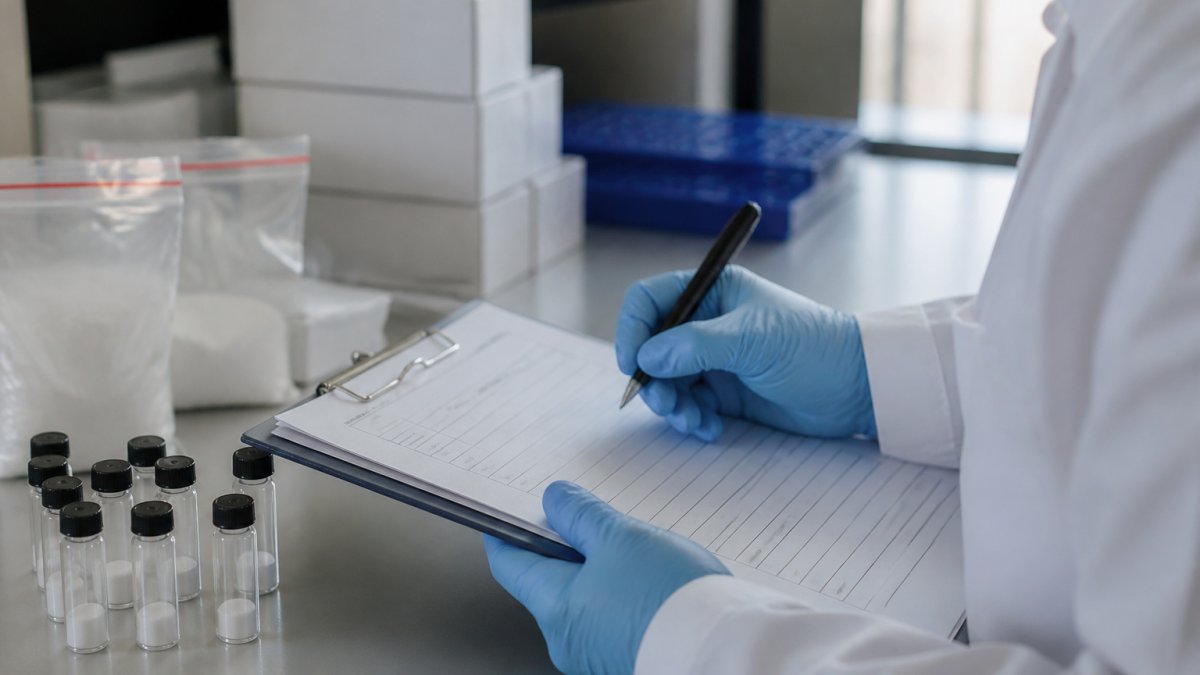
Start by confirming the vial you received matches the documentation for it. Compare the lot or batch number printed on the vial label with the batch number on the Certificate of Analysis (CoA). Understand why peptide batch documentation matters for traceability.
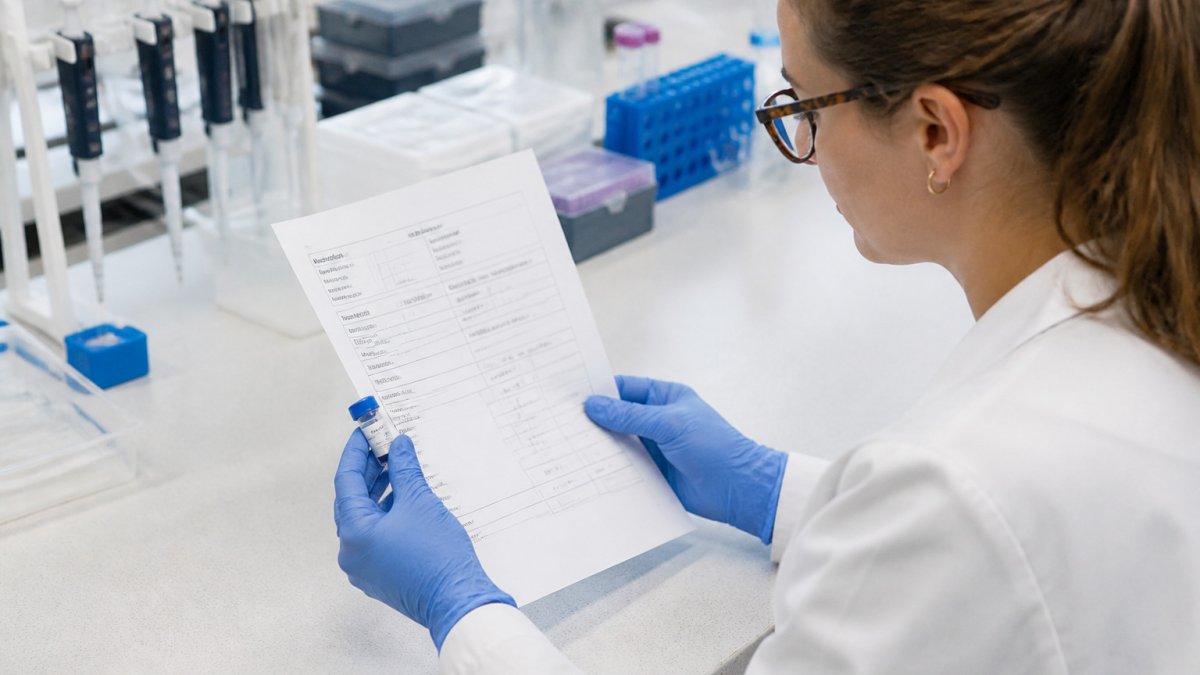
Check the sequence name, molecular formula and nominal molecular weight on the CoA against your order. A mismatch here is the simplest error to catch and should stop your review before analytical data is even considered.
Note the date of analysis and the testing laboratory named on the CoA. Results tied to a different batch cannot verify the peptide in your vial.
Step 2: Run a Peptide Certificate of Analysis Checklist Review
A complete CoA should contain more than a single purity number. Work through this checklist:
- Batch or lot number matches your vial label
- Peptide name and sequence are stated
- Molecular weight is reported (observed and theoretical)
- HPLC chromatogram is included, not just a percentage
- Mass spectrum is included with the observed mass
- Testing laboratory and method are named
- Date of analysis is listed
If the CoA has only a purity figure and no chromatogram or mass data, you cannot independently assess identity. Ask the supplier for the raw analytical data before relying on the result. Contact the Globo Research Peptides team with questions about your documentation.
Step 3: Confirm Sequence Identity with Peptide Sequence Verification by Mass Spectrometry
Mass spectrometry (MS) measures the mass-to-charge ratio of ions from your sample (Mass Spectrometry Instrument Lab | NIST). For peptide identity, the key comparison is the observed mass against the theoretical mass calculated from the sequence.
For stronger sequence-level evidence, look for tandem mass spectrometry (MS/MS) data. Learn how to read MALDI-TOF mass spectrometry data to interpret the spectra you receive. MS/MS fragments the peptide and reads the fragment masses, which can confirm the amino acid order rather than just the total mass. A single mass value can match more than one sequence, so MS/MS is the stronger test.
Be clear about the limits. Intact-mass MS confirms that a molecule of that weight is present. It does not by itself prove the order of residues. Note which method the supplier used. Review best practices for peptide mapping protocols to see how sequence verification is usually carried out.
Step 4: Compare Expected Versus Measured Peptide Molecular Weight
This is where most post-purchase reviews succeed or stall. The comparison is not simply "does the number match", it requires knowing which mass you are comparing, how the instrument reported it, and what magnitude of difference is meaningful.
Establish the theoretical mass first. Calculate the theoretical mass from the stated sequence using average masses for each residue (the sum most CoAs report) and, separately, the monoisotopic mass (the sum using the most abundant isotope of each element). The two differ by roughly 0.5-1 Da for a typical peptide, so comparing a monoisotopic observed value against an average theoretical value can create a false mismatch.
Account for the ionization state. Electrospray instruments report multiply charged ions. A peptide observed at m/z 850.4 with a +3 charge corresponds to a neutral mass near 2,548 Da, not 850 Da.
Recognize common adducts and modifications. Sodium (+22 Da) and potassium (+38 Da) adducts are routine and do not indicate a wrong sequence. Oxidation of methionine or tryptophan adds approximately +16 Da per residue; acetylation adds approximately +42 Da; a missing N-terminal protecting group or an unremoved side-chain protecting group shifts the mass in the opposite direction.
Use the residue-mass shortcut. If the observed mass differs from theoretical by approximately the mass of one amino acid residue (for example, roughly 71 Da for alanine, 57 Da for glycine, 113 Da for leucine/isoleucine, 128 Da for glutamine or lysine), suspect a deletion or addition rather than an adduct. A difference near a single residue mass is a synthesis problem worth escalating.
Set an acceptance window. Most practitioners treat a difference within about 0.1% of the theoretical mass, after accounting for charge state and known adducts, as consistent with the intended sequence. Anything larger warrants a written explanation from the supplier and, if the study depends on exact sequence, independent confirmation.
Watch out: comparing an average-mass theoretical value against a monoisotopic observed value, or ignoring charge state, produces mismatches that look like sequence errors but are purely reporting artifacts.
If the observed mass is close to target but off by a whole residue mass, the peptide may be missing or carrying an extra amino acid. That points to a synthesis problem, not a labeling detail.
The table below summarises the mass-comparison checks the article recommends before judging whether a peptide's observed mass matches its sequence.
| Check | Typical value or pattern | What it means |
|---|---|---|
| Sodium adduct | About +22 Da | Routine; not a sequence error |
| Potassium adduct | About +38 Da | Routine; not a sequence error |
| Methionine or tryptophan oxidation | About +16 Da per residue | Modification, not a sequence error |
| Acetylation | About +42 Da | Modification to check against the CoA |
| Mass difference near one residue | Roughly 57 to 128 Da | Suspect a deletion or addition from synthesis |
| Acceptance window | Within about 0.1% of theoretical | Consistent with the intended sequence |
Step 5: Decide When to Commission Independent Testing and What It Costs
Supplier documentation is useful, but an independent check gives you evidence the supplier did not produce. The decision to commission it, and how to do it well, is where most post-purchase workflows break down.
When independent testing is warranted. Commission third-party analysis when the study depends on exact sequence, when the supplier's CoA lacks raw data (chromatogram or mass spectrum), when observed and theoretical masses conflict after adduct and charge-state review, when you need documentation for publication or a compliance file, or when you are comparing multiple lots and need a consistent analytical basis.
Selecting a laboratory. Look for a lab that states its methods explicitly, reverse-phase HPLC-UV for purity, LC-MS for intact mass, and LC-MS/MS for sequence-level fragmentation, and that will report the instrument, column, gradient, and software used. Ask whether the lab will provide the raw chromatogram and spectrum files, not just a summary table, and whether it will interpret the data against your stated theoretical sequence. A lab that only returns a purity percentage cannot answer a sequence question.
Sample submission and chain of custody. Confirm the minimum sample quantity the lab requires (many methods need only a small amount of lyophilized powder or a diluted solution), the shipping conditions (typically ambient for lyophilized material, with cold chain only if the lab specifies), and whether the lab requires a sealed, labeled aliquot. Keep a photograph of the vial label and the shipping paperwork, and request a submission receipt or tracking record so the sample's identity is documented from your hands to the lab's.
What to request in the report. Ask for: the observed deconvoluted mass and charge states, the theoretical mass calculated from your sequence, the HPLC chromatogram with retention time and peak purity assessment, MS/MS fragmentation data if sequence-level confirmation is needed, the method description, and a clear statement of what the data do and do not establish. Sequence-level confirmation from MS/MS requires the lab to interpret fragment ions against the expected sequence, specify that in the request.
Cost and turnaround. Pricing depends on the method, number of samples, turnaround time, and the laboratory. Intact-mass LC-MS is generally less expensive than MS/MS sequence confirmation, and rush turnaround adds cost. Get a written quote that itemizes each test and confirms whether raw data files are included, because a low quote that excludes raw data often costs more once you need the underlying evidence.
What to Do When Results Conflict or Fail to Match
Not every discrepancy means the peptide is wrong. Work through the possibilities before drawing a conclusion:
- Recheck the batch match between vial and CoA first
- Confirm both observed and theoretical masses used the same salt or counterion basis
- Look for adducts before assuming a sequence error
- Compare the chromatogram for extra peaks that could be impurities near the main peak
If the observed mass is clearly wrong and the batch match is confirmed, document the discrepancy with screenshots of the CoA, chromatogram and mass spectrum. Do not use the material in a study until the issue is resolved. Ask the supplier for a written explanation and, if needed, a replacement or retest.
Keep all records, including the vial label photo, shipping paperwork and correspondence, so you can escalate if required.
Requesting Your Batch Documentation from Globo Research Peptides
If your CoA is missing chromatograms, mass spectra or batch details, request the full documentation from your supplier before you use the compound. Provide your order number and the batch number from your vial label.
When you ask, specify exactly what you need: the HPLC chromatogram, the mass spectrum with observed mass, the testing laboratory name and method, and the analysis date. Clear requests get faster, more useful responses.
Frequently Asked Questions
How can you verify a peptide sequence after purchase?
Start by matching the batch or lot number on the Certificate of Analysis to the label on your vial. Then confirm the sequence with mass spectrometry, ideally tandem MS/MS, which fragments the peptide and shows whether the amino acids appear in the expected order. An HPLC purity percentage alone cannot confirm identity, so the sequence check needs its own analytical evidence. If your supplier does not provide mass spectrometry data for the batch, send a sample to an independent laboratory for identity testing.
Can mass spectrometry confirm a peptide's sequence?
Mass spectrometry can confirm a peptide's molecular weight, which tells you whether the overall mass matches the theoretical value. Tandem mass spectrometry (MS/MS) goes further by breaking the peptide into fragments and measuring their masses, which supports the amino acid order. A matching intact mass is useful evidence but does not rule out sequence variants with the same mass, so MS/MS fragmentation data is the stronger confirmation when available.
What should a peptide Certificate of Analysis include?
A useful peptide Certificate of Analysis includes the product name, batch or lot number, expected molecular weight, the HPLC purity percentage with the chromatogram, and mass spectrometry results showing observed mass. It should also state the analytical method, date of testing, and the laboratory that performed it. Check that the batch number matches your vial and that the observed mass agrees with the theoretical mass. Missing raw data or vague wording are reasons to ask the supplier for clarification before using the material.
How much does peptide purity testing cost?
Pricing for independent testing depends on the assay type, the number of samples, the turnaround time, and the laboratory you choose. Ask independent laboratories for a written quote that lists each analytical method, such as HPLC and mass spectrometry, so you can compare like for like.