 how-to
Minimizing Experimental Delays with Verified Peptides
Table of Contents
- Why Unverified Peptides Cost You Weeks of Experimental Delay
- How to Interpret a Peptide Certificate of Analysis Before You Order
- Impact of Peptide Purity on Research Outcomes
- Best Practices for Peptide Storage 2026: Aliquoting and Cold Chain Protocols
- Third-Party Verification and Batch Consistency: What to Demand from Suppliers
- Cost-Benefit Analysis: Verified vs. Unverified Peptides for Your Lab
- SOP Template: Building a Standardized Peptide Intake and QC Workflow
- Conclusion
- Frequently Asked Questions
Last Updated: September 18, 2026
Why Unverified Peptides Cost You Weeks of Experimental Delay
A single failed assay can set a study back by weeks, and when the cause is the starting material, the cost is time and the credibility of every result built on that batch.
How to Interpret a Peptide Certificate of Analysis Before You Order
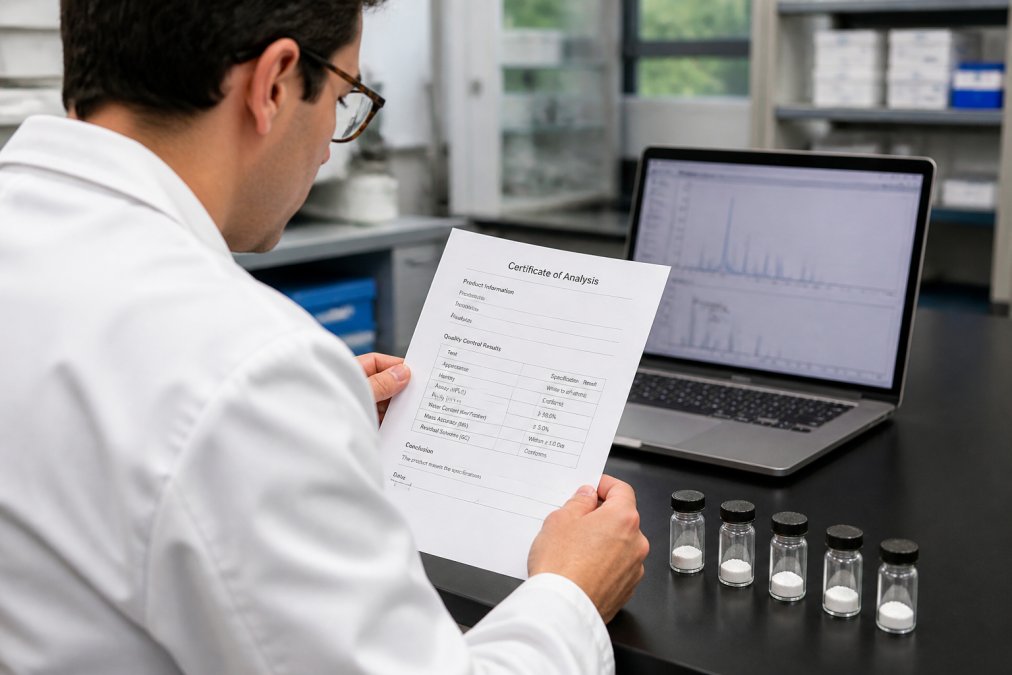
The COA is your first line of defense: it should confirm identity, purity, and the absence of contaminants. If any is missing, do not order.
HPLC Purity Data: What the Chromatogram Actually Tells You
High-performance liquid chromatography (HPLC) separates a sample's components by column interaction, producing a chromatogram of peaks.
Mass Spectrometry and Sequence Confirmation: Verifying Molecular Identity
Mass spectrometry (MS) measures the mass-to-charge ratio of ions, confirming the vial contains the molecule you ordered.
Impact of Peptide Purity on Research Outcomes
Purity directly shapes whether your results can be reproduced, and it is where most labs lose weeks unnoticed.
The Impurity Classes That Actually Move Your Data
Not all impurities are equal. Four classes most often corrupt results:
- Truncated sequences. Incomplete coupling during synthesis leaves shorter peptides. These are the most common impurity and the most likely to interact with your target.
- Deletion and insertion analogs. A missing or extra residue changes binding affinity, sometimes dramatically.
- Oxidation products. Methionine, cysteine, and tryptophan residues oxidize readily. An oxidized peptide may still register as "the peptide" on a mass spec but behave differently in solution.
- Residual TFA and counterions. These affect solubility, pH of your reconstituted stock, and, critically, the actual molar concentration you deliver to cells.
Endotoxin Levels and the Immune Response Problem
Endotoxin levels matter for any cell culture or in vivo work. Even small amounts of lipopolysaccharide (LPS) can activate toll-like receptor 4 (TLR4) signaling, trigger cytokine release, and produce readouts unrelated to your peptide.
Batch Consistency: The Reproducibility Trap
Batch consistency is the other half. If batch one and batch two differ in purity or impurity profile, your results will not line up, batch-to-batch variation, a common cause of "my experiment worked last month and now it doesn't."
For research integrity, demand:
- Full HPLC chromatogram, not just a percentage
- Mass spectrometry data confirming identity
- Endotoxin testing results where relevant
- Net peptide content, not just gross weight
- A lot number that ties the vial to its specific documentation
Best Practices for Peptide Storage 2026: Aliquoting and Cold Chain Protocols
Proper storage is the difference between a stable compound and a degraded one, and most guides skip what happens before the peptide reaches your freezer.
The Cold Chain Gap: What Happens During Transit
Most storage guidance starts at the lab bench, too late. A peptide that spent three days in a hot truck or uncontrolled warehouse has already begun to degrade before you open the box.
What to check on arrival:
- Cold packs still cold? If the gel packs are fully melted and the vial is warm to the touch, flag the shipment.
- Cake appearance. A proper lyophilized cake is a uniform white plug. Cracking, shrinkage, or a melted appearance suggests moisture exposure.
- Vial integrity. Check the crimp seal and stopper. A loose seal means the vacuum is gone.
- Transit time. Overnight shipping is not a luxury for temperature-sensitive compounds. It is a control.
Freeze-Thaw Cycles, Enzymatic Degradation, and Shelf Life
Every freeze-thaw cycle damages a peptide: ice crystals concentrate solutes, shift pH locally, and can denature or aggregate it. Ten cycles meaningfully degrade your sample. The fix is aliquoting protocols, divide reconstituted peptide into single-use volumes before freezing.
A workable storage routine:
- Store lyophilized powder at the temperature the supplier specifies, often -20°C for short-term and -80°C for long-term
- Reconstitute with the recommended solvent, not whatever is closest. Sterile water, phosphate-buffered saline, and dilute acetic acid each behave differently, and the wrong choice can precipitate your peptide
- Aliquot into single-use volumes immediately
- Label each aliquot with compound, concentration, date, and lot number
- Avoid repeated freeze-thaw by using one aliquot per experiment
- Keep a working aliquot at 4°C for same-week use rather than thawing a frozen one repeatedly
Solvent Choice and pH: The Variables Most Labs Ignore
Two labs can store the same peptide at the same temperature and get different results because of solvent and pH. Acidic residues, basic residues, and disulfide bonds each respond differently to the reconstitution buffer, a peptide with a free cysteine oxidizes and forms dimers far faster in neutral aqueous buffer than in a slightly acidic one.
Third-Party Verification and Batch Consistency: What to Demand from Suppliers
Third-party verification means an outside lab, not the seller, confirms the analytical data, the single most important trust signal in peptide sourcing.
When you evaluate a supplier, ask for:
- Third-party verification from an accredited laboratory
- Full quality control documentation for each lot
- Analytical data you can match to your specific batch
- A clear policy for what happens if documentation does not match your requirements
Cost-Benefit Analysis: Verified vs. Unverified Peptides for Your Lab
Verified peptides cost more up front, the honest trade-off.
The question is not which vial is cheaper but which costs less in total. An unverified peptide that fails mid-study forces a repeat: new material, labor, instrument time, and weeks of delay. A verified peptide that works the first time avoids all of that.
Run the math on your own work:
- Cost of one failed experiment (materials + labor + instrument time)
- Probability the unverified batch fails
- Cost difference between verified and unverified material
| Factor | Verified Peptides | Unverified Peptides |
|---|---|---|
| Upfront cost | Higher | Lower |
| Documentation | Full COA, third-party tested | Often vague or missing |
| Risk of failed study | Low | Higher |
| Repeat experiment cost | Rare | Common |
| Reproducibility | Strong | Uncertain |
SOP Template: Building a Standardized Peptide Intake and QC Workflow
A written SOP removes guesswork and protects your data if anyone questions your methods later.
Peptide Intake and QC Standard Operating Procedure
- Receipt inspection. Confirm the lot number on the vial matches the COA. Photograph the vial and packing slip.
- Documentation review. Check that the COA includes HPLC purity, mass spectrometry data, and endotoxin results where required. Flag any missing field.
- Identity check. Confirm observed molecular weight matches theoretical weight. Do not proceed if it does not.
- Storage logging. Record receipt date, storage temperature, and location. Store lyophilized powder per supplier guidance.
- Aliquoting. Reconstitute per supplier instructions. Divide into single-use aliquots immediately. Label each with compound, concentration, date, and lot number.
- Freeze-down. Store aliquots at the specified temperature. Log the location.
- Usage tracking. Record which aliquot was used for which experiment. Never refreeze a thawed aliquot.
- Deviation reporting. If any step fails, document it and quarantine the batch before use.
Conclusion
Experimental delays rarely come from one dramatic failure. They come from small procurement and handling decisions that compound: unverified material, vague documentation, and sloppy storage each add risk, and the risk shows up as lost time.
Frequently Asked Questions
How reliable are verified peptides compared to unverified alternatives?
Verified peptides come with third-party analytical documentation confirming identity, purity, and absence of contaminants. Unverified alternatives lack this transparency, so you cannot confirm molecular weight, sequence accuracy, or endotoxin levels before use. In practice, unverified material often fails initial QC screening, forcing repeat orders and pushing experiments back by days or weeks. Verified peptides from suppliers that provide full COA documentation eliminate that uncertainty and protect your study timeline.
What are the most common causes of peptide degradation in the lab?
Repeated freeze-thaw cycles top the list, followed by improper reconstitution solvents, exposure to moisture during weighing, and storage at incorrect temperatures. Lyophilized peptides are stable when kept cold and dry, but once reconstituted they degrade faster, especially if left at room temperature or exposed to light. Enzymatic degradation from bacterial contamination is another frequent culprit. Following aliquoting protocols and using sterile technique prevents most of these issues.
How does a Certificate of Analysis prevent experimental delays?
A COA lets you verify purity by HPLC, confirm molecular weight by mass spectrometry, and check batch-specific data before your experiment begins. If the documentation reveals a purity shortfall or a sequence mismatch, you catch it before wasting reagents, instrument time, and labor on a compromised run. Suppliers that include full COA documentation with every batch, like those providing verified peptides, give you the data needed to accept or reject material immediately rather than discovering problems mid-experiment.
What environmental factors most commonly destroy peptide integrity during shipping?
Temperature fluctuations during transit are the biggest risk. Lyophilized peptides tolerate short excursions better than reconstituted ones, but prolonged heat exposure accelerates chemical modification and aggregation. Humidity can also compromise the powder if vials are not properly sealed. Cold chain logistics with insulated packaging and temperature monitoring reduce these risks. When evaluating a supplier, ask how they handle transit time and whether they ship with desiccant and phase-change materials to maintain stability.