 how-to
Identifying Heavy Metal Contamination in Peptides: 2026 Guide
Table of Contents
- Why Heavy Metal Contamination in Peptides Is a Real Risk
- How ICP-MS Peptide Analysis Detects Trace Metals
- USP <232> Elemental Impurities: What the Standard Requires
- Certificate of Analysis Interpretation: Reading Between the Lines
- Batch-to-Batch Variability and Why One Good COA Is Not Enough
- Common Mistakes When Identifying Heavy Metal Contamination in Peptides
- Frequently Asked Questions
Last Updated: September 19, 2026
Why Heavy Metal Contamination in Peptides Is a Real Risk
Heavy metal contamination in peptides is the presence of toxic elements like lead, arsenic, cadmium, or mercury in a peptide product, usually at trace levels that still matter for research. Most suppliers advertise purity percentages. Far fewer can prove what is not in the vial.
That gap is where the risk lives. A peptide can test at 99% purity by HPLC and still carry elemental impurities that never show up on that test. HPLC separates and measures the peptide itself. It says nothing about metals.
Below, we break down where contamination comes from, how labs actually detect it, and how to read the paperwork that proves a batch is clean.
Common Sources During Peptide Synthesis and Raw Material Sourcing
Contamination rarely happens by accident at one point. It builds across the whole process.
- Synthesis reagents: Coupling agents, solvents, and catalysts can carry metal traces.
- Raw material sourcing: Lower-grade starting materials often arrive with unknown impurity profiles.
- Equipment contact: Reactor vessels, tubing, and metal fittings can leach ions over time.
- Purification steps: Poorly controlled chromatography can leave metal residue behind.
- Packaging and handling: Vials, stoppers, and transfer tools add another contact point.
The lesson is simple. Contamination is a process problem, not a single-step mistake. Suppliers who map every contact point catch it early. Suppliers who don't, ship it.
Health Risks and Bioaccumulation Concerns for Research Models
Trace metals don't always clear the body quickly. Some accumulate in tissue over repeated exposure, a process called bioaccumulation. For research models, that matters because it can skew results in ways that have nothing to do with the compound under study.
Lead and cadmium are the usual concerns. Both are linked to organ stress and cellular damage in published toxicology literature. Arsenic and mercury add their own risks. Even small amounts, delivered consistently, can shift study outcomes.
For a clean study, you need a clean input. That's the whole argument.
How ICP-MS Peptide Analysis Detects Trace Metals
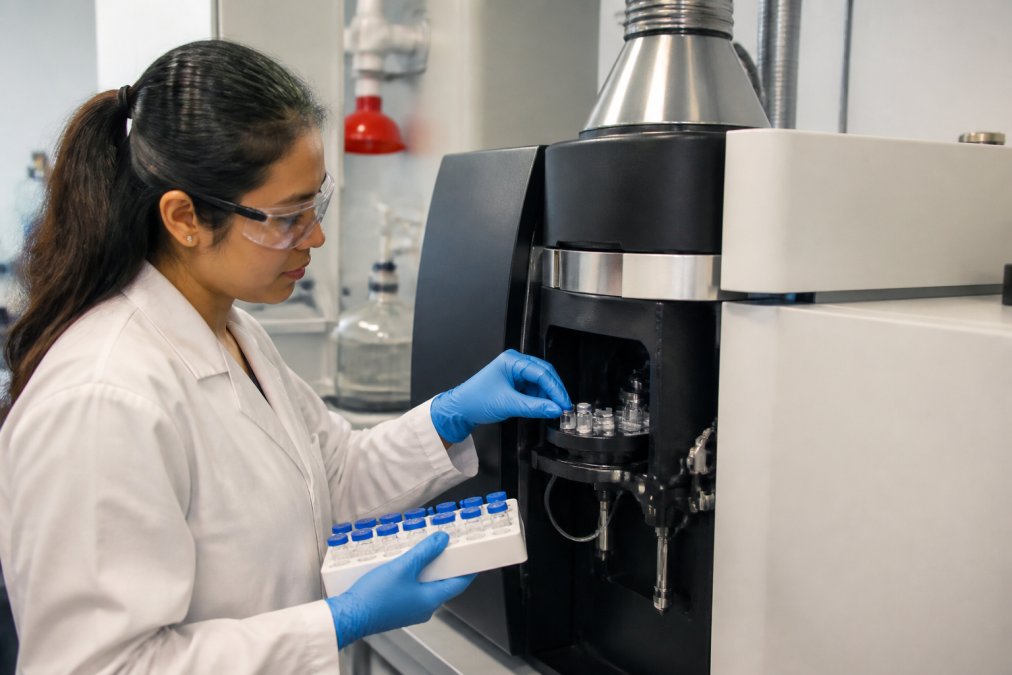
ICP-MS peptide analysis is the standard method for finding trace metals in peptide samples. It works by ionizing a sample in a high-temperature plasma, then measuring the charged particles by mass. Each metal has a unique mass signature, so the instrument can identify and count individual elements at very low levels.
This is the method regulators and quality labs rely on. It's also the method most at-home kits cannot replicate.
What ICP-MS Measures and Why It Beats Older Methods
ICP-MS measures individual elements, not groups. That means it can report lead, arsenic, cadmium, mercury, nickel, vanadium, and cobalt separately, with detection limits low enough to catch trace amounts.
Older methods like flame atomic absorption struggled here. They were slower, less sensitive, and often couldn't separate elements that overlapped. ICP-MS solves all three problems.
The FDA's elemental impurities guidance recognizes modern spectroscopic methods as the standard for this kind of testing. That's not marketing language. It's the analytical baseline.
Limitations of DIY Verification and At-Home Test Kits
At-home kits cannot detect trace metals at the levels that matter. Most consumer kits test for bulk presence, not parts-per-billion detection. They also can't separate one metal from another.
What most guides miss is this: a negative home test does not mean the sample is clean. It means the kit couldn't see what was there. Real verification requires a lab, a validated method, and a documented result.
USP <232> Elemental Impurities: What the Standard Requires
USP <232> elemental impurities is the United States Pharmacopeia standard that sets limits for elemental impurities in drug products and their components. It defines which elements must be controlled and at what permitted daily exposure levels.
The standard groups elements by toxicity and risk. Class 1 elements (cadmium, lead, arsenic, mercury) get the tightest limits. Class 2 and Class 3 elements are handled based on route of exposure and likelihood of presence.
For research peptides, USP <232> is the reference point.
Certificate of Analysis Interpretation: Reading Between the Lines
Certificate of Analysis interpretation is the skill of reading a COA for what it actually proves, not just what it claims. Most guides tell you a COA should have a batch number and a lab name. That's the easy part. The hard part, and the part almost nobody explains, is reading the heavy metals section itself.
The Anatomy of a Heavy Metals Section
A properly reported elemental impurities result is not a single number. It's a table. Each element gets its own row, and each row should contain four things:
| Field | What It Shows | Why It Matters |
|---|---|---|
| Element | The specific metal (Pb, Cd, As, Hg, etc.) | Grouped results hide individual failures |
| Result | The measured concentration | The actual number, not a pass/fail |
| Unit | Typically µg/g or ppm | Unit mismatches are a common red flag |
| Limit | The applicable USP <232> threshold | Lets you check the result against the standard yourself |
Reading the Numbers Against USP <232> Limits
USP <232> sets permitted daily exposure (PDE) limits for each element, expressed in micrograms per day for a drug product at its maximum daily dose. The oral PDE limits for the four Class 1 elements are commonly cited as:
- Cadmium: 5 µg/day
- Lead: 5 µg/day
- Arsenic: 15 µg/day
- Mercury: 3 µg/day
Red Flags That Suggest a Fabricated or Recycled Report
Beyond missing fields, watch for these patterns:
- Identical results across batches. Real analytical chemistry produces variation. If three different batch COAs show the exact same numbers to the same decimal place, the reports were likely copied.
- Suspiciously round numbers. Results like "<0.1 ppm" for every element, every time, suggest a detection limit was reported as a result.
- No instrument or method detail. A real ICP-MS report names the instrument, the calibration standard, and the digestion method. A summary page often omits all three.
- Lab contact information that doesn't resolve. Look up the lab. If the accreditation body has no record of them, the report is worthless.
- Batch numbers that don't match your order. This sounds obvious, but it's one of the most common issues.
- Test dates older than the batch. A COA dated before the batch was manufactured cannot describe that batch.
How to Verify Lab Testing Results Independently
You can verify a COA without trusting the supplier's word.
- Confirm the lab is accredited and independent, check the accreditation body's public directory
- Cross-check the batch number against your order and the manufacturing date
- Request the raw instrument report, not just the summary COA
- Send a sample to your own lab for confirmatory ICP-MS testing
- Compare results across multiple batches from the same supplier
Batch-to-Batch Variability and Why One Good COA Is Not Enough
Batch-to-batch variability means the quality of a peptide can shift from one production run to the next, even from the same supplier. Raw material sources change. Equipment wears. Reagents age.
Common Mistakes When Identifying Heavy Metal Contamination in Peptides
The biggest mistake is treating HPLC purity as a proxy for elemental safety. It isn't. HPLC measures the peptide. ICP-MS measures the metals. You need both.
Other common errors:
- Accepting a COA without a batch number
- Trusting a supplier's in-house test as independent
- Skipping verification on repeat orders
- Ignoring detection limits
- Assuming one clean batch means all batches are clean
Frequently Asked Questions
How can I test for heavy metals in peptides?
The most reliable method is ICP-MS (Inductively Coupled Plasma Mass Spectrometry), which detects trace elements like arsenic, cadmium, lead, mercury, nickel, vanadium, and cobalt at parts-per-billion levels. Request a batch-specific Certificate of Analysis from your supplier and confirm it includes ICP-MS results against USP <232> limits. At-home test kits cannot detect metals at the concentrations that matter for research-grade peptides, so rely on accredited third-party lab documentation rather than DIY methods.
What are the standard regulatory limits for heavy metals in research peptides?
USP <232> sets elemental impurity limits based on daily exposure thresholds. For example, the oral permitted daily exposure for lead is 5 micrograms per day, cadmium is 5 micrograms per day, arsenic is 15 micrograms per day, and mercury is 3 micrograms per day. These limits apply to the final drug product, but research-grade peptide suppliers often reference them as a benchmark. Always check whether a COA reports results against USP <232> or another standard.
How do I interpret a Certificate of Analysis regarding heavy metal content?
Look for the testing method (ICP-MS is preferred), the specific metals tested, the measured values, and the acceptance criteria. A complete COA lists each element with a result and a pass/fail against a defined limit. Red flags include missing method details, vague statements like 'metals: pass' without numbers, or results that reference a different batch number than the product you received. Cross-check the lot number on the vial with the COA.
Why is heavy metal contamination a risk in peptide synthesis?
Peptide synthesis involves reagents, solvents, and catalysts that can introduce trace metals. Raw material sourcing plays a major role: lower-grade amino acids or resins may carry cadmium, lead, or nickel. Metal ion scavenging and purification steps like HPLC reduce contamination, but skipping or cutting corners on quality control leaves impurities behind. Batch-to-batch variability means one clean batch does not guarantee the next will be clean.