 how-to
How to Verify Peptide Purity: A Step-by-Step Guide
Table of Contents
- Why Verifying Peptide Purity Matters for Your Research
- How to Read a Peptide Certificate of Analysis
- HPLC vs Mass Spectrometry for Peptides
- Peptide Quality Control Methods and Standards
- Step-by-Step Process for Verifying Peptide Purity
- Common Mistakes to Avoid When Verifying Purity
- Regulatory Standards and Traceability
- Frequently Asked Questions
Last Updated: September 3, 2026
Why Verifying Peptide Purity Matters for Your Research
The difference between successful research and failure often comes down to one variable: the quality of your starting materials. When working with peptides, purity isn't just a specification, it's the foundation of reproducible science.
Contaminated or impure peptides introduce unexpected variables. Your binding assays show anomalous results. Your pharmacokinetic data doesn't match literature values. Your receptor studies produce noise instead of signal. Weeks of work collapse because the compound wasn't what you thought it was.
Learning how to verify peptide purity before you start, not after your experiment fails, is the difference between moving forward and starting over.
How to Read a Peptide Certificate of Analysis
A Certificate of Analysis is your proof of identity and purity. Without it, you have no way to know what you actually received. Every legitimate supplier provides a COA for every batch.
Key sections of a COA
Batch identification and traceability. The COA begins with the peptide name, sequence, molecular weight, lot number, and synthesis date. This lets you trace exactly which batch you received and match it to your purchase order.
Purity data and main peak area. The purity percentage is expressed as a single number, typically by HPLC analysis. A peptide with 99% purity means 99% of the material is the target compound; the remaining 1% is impurities and contaminants.
Analytical method description. The COA specifies which testing methods were used. For peptides, HPLC (High-Performance Liquid Chromatography) is the standard. The method description includes column type, mobile phase composition, detection wavelength, and flow rate.
Retention time and chromatogram reference. The COA includes the retention time, the point at which your peptide elutes from the HPLC column. This serves as a fingerprint. A chromatogram image shows where the main peak appears relative to other peaks.
Molecular weight confirmation. Mass spectrometry data confirms the molecular weight of your peptide, verifying that the sequence is correct and no unexpected modifications occurred during synthesis.
Understanding purity percentages and main peak area
A 99% purity reading means the main peak accounts for 99% of the total peak area in the chromatogram. The remaining 1% is everything else: truncated sequences, synthesis byproducts, residual solvents, or degradation products.
When HPLC separates your sample, it produces multiple peaks. The largest peak is assumed to be your target peptide. The purity percentage is calculated by dividing the area under the main peak by the total area under all peaks, then multiplying by 100.
This method works well for most peptides, but it has limits. If impurities co-elute with your target peptide (meaning they come out of the column at the same time), they'll be counted as part of the main peak, inflating apparent purity. A rigorous COA addresses these edge cases by specifying detection limits and flagging any unusual chromatogram features.
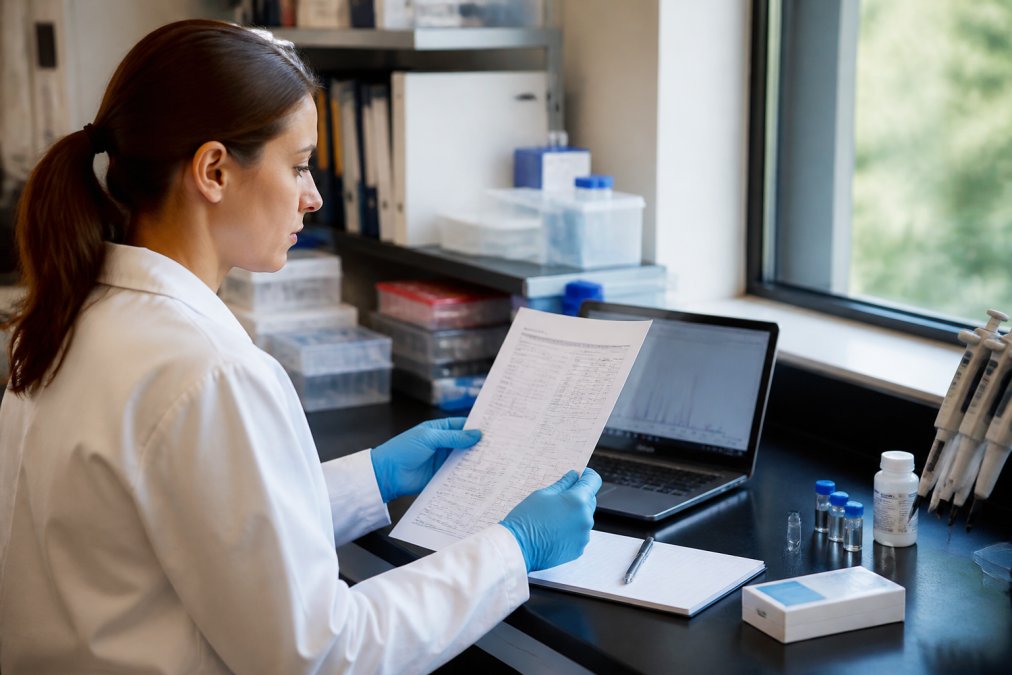
HPLC vs Mass Spectrometry for Peptides
HPLC and mass spectrometry are the two primary methods for verifying peptide purity. They answer different questions and complement each other.
HPLC separates your sample into individual components based on their interaction with the column. It tells you how many distinct compounds are present and what percentage each represents. HPLC is fast, relatively inexpensive, and gives a clear picture of purity.
Mass spectrometry ionizes your sample and measures the mass-to-charge ratio of each ion. It tells you the exact molecular weight of each compound present. MS is more expensive and requires more expertise to interpret, but it provides unambiguous molecular identity.
When to use HPLC for purity verification
HPLC is the standard method for routine purity assessment. Use HPLC when you need a quick, cost-effective purity check and you're confident about your peptide's identity. HPLC works best for straightforward linear sequences without modifications. It's also ideal for batch-to-batch consistency checks.
The limitation of HPLC is that it measures separation, not identity. Two different compounds could theoretically have the same retention time, though this is rare for peptides.
When to use mass spectrometry
Use mass spectrometry when you need absolute confirmation of molecular weight or when working with a novel or unusual peptide structure. MS is essential if your peptide contains modifications like phosphorylation or glycosylation, because these alter molecular weight and can't be reliably detected by HPLC alone.
MS is the gold standard for peptide identity verification. For most researchers, HPLC purity data is sufficient. But if your work depends on absolute certainty about your peptide's identity, request both HPLC and MS data.
Peptide Quality Control Methods and Standards
Quality control in peptide synthesis is a process, not a single test. Rigorous suppliers implement multiple checks at different stages.
Third-party laboratory testing
Third-party testing means an independent laboratory, not the peptide supplier itself, performs the analytical work. This creates objective verification that protects you.
When you order from a supplier using third-party testing, the lab has no financial incentive to report inflated purity numbers. They test the sample as received and report results honestly. This is the standard practice for research-grade peptides.
Verify that the testing laboratory is accredited. Look for certifications like ISO 17025, which means the lab meets international standards for competence and impartiality (iso.org). Ask your supplier which laboratory performs their testing and request their accreditation status.
Some suppliers perform in-house testing only. In-house testing is cheaper and faster, but it introduces bias. The same organization that profits from selling you a high-purity peptide also reports the purity number. This doesn't mean in-house data is fraudulent, but it's less reliable than third-party verification.
Batch-to-batch consistency verification
If you order the same peptide multiple times, you should expect consistent results. Batch-to-batch consistency is a sign of reliable manufacturing and quality control.
When you receive a new batch, compare its COA to previous batches. The purity percentage, retention time, and molecular weight should be similar. Batch-to-batch variation is normal, you might see purity ranging from 97% to 99.5% across different batches. But dramatic swings indicate inconsistent manufacturing or poor quality control.
Suppliers committed to consistency maintain detailed batch records and can explain variations when they occur.
Step-by-Step Process for Verifying Peptide Purity
Verification starts before your peptide arrives and continues after you receive it.
Step 1: Request the Certificate of Analysis before purchase
Request the COA before you place your order. A reputable supplier will send it immediately or make it available in their online portal.
Review the COA carefully before committing to purchase. Check that it includes batch identification, purity data, analytical methods, retention time, and molecular weight. If critical information is missing, ask the supplier to provide it or choose a different source.
Step 2: Verify third-party testing credentials
Confirm that testing was performed by an independent laboratory. Ask the supplier which lab performed the analysis and look up that laboratory's accreditation status.
If the supplier performed in-house testing, ask whether they can provide third-party verification as an option. Third-party testing costs more, but it's worth the investment for critical research.
Step 3: Examine the chromatogram and retention time data
The chromatogram is the visual representation of your HPLC analysis. The main peak (your target peptide) should be clearly the largest peak.
Check the retention time, the time at which your peptide elutes from the column. Write down this number. If you run your own analysis later, your retention time should closely match the COA value.
If the chromatogram shows multiple peaks of similar size, or if the main peak is only slightly larger than other peaks, the purity may be lower than stated.
Step 4: Assess impurity profiles and contaminants
The COA should identify what the impurities are, not just their percentage. Common impurities include truncated sequences (peptides missing amino acids), oxidized variants, and residual solvents.
Truncated sequences are the most common impurity. A good COA will identify these and report their percentage separately. Understanding what impurities are present helps you decide whether the batch is suitable for your work.
Step 5: Confirm molecular weight and peptide sequence
Mass spectrometry data confirms the exact molecular weight of your peptide. Compare this value to the theoretical molecular weight calculated from your peptide sequence. The measured molecular weight should match the theoretical value within a few Daltons.
Also verify that the peptide sequence listed on the COA matches your order. A simple error during synthesis could result in the wrong peptide being shipped.
Common Mistakes to Avoid When Verifying Purity
Accepting incomplete COAs. A COA listing only a purity percentage without supporting data is incomplete. You need chromatogram images, retention time, molecular weight, and method descriptions.
Confusing purity with identity. A peptide can be 99% pure but still be the wrong compound. Purity measures how much of the sample is a single substance. Always verify the sequence and molecular weight, not just the purity percentage.
Ignoring batch variation. If a new batch shows significantly different purity than previous batches, investigate before using it. Large swings suggest quality control issues.
Relying on visual inspection alone. You cannot determine purity by looking at a powder or solution. Always demand analytical data.
Assuming in-house testing is equivalent to third-party testing. For critical research, third-party testing is worth the extra cost.
Overlooking the detection limit. The COA should specify the detection limit, the smallest amount of impurity the method can reliably detect. A purity of 98% with a 2% detection limit is actually less certain than a purity of 95% with a 0.1% detection limit.
Regulatory Standards and Traceability
Peptide purity standards vary depending on your intended use. For research applications, the industry standard is ≥95% purity for most applications, with ≥99% purity preferred for sensitive work like receptor binding studies or pharmacokinetic profiling (usp.org).
The United States Pharmacopeia (USP) provides monographs for some peptides, specifying acceptable purity levels and testing methods (usp.org). If a USP monograph exists for your peptide, your supplier should meet those standards.
Traceability is the ability to track your peptide from synthesis through testing to delivery. A complete chain of custody includes lot numbers, synthesis dates, testing dates, and the names of personnel involved.
Globo Research Peptides maintains full traceability for every batch. Each peptide includes a unique lot number, complete synthesis history, and third-party testing documentation. When you order from a supplier, ask about their traceability system. Can they tell you exactly when your peptide was synthesized? Who performed the testing? If a supplier can't answer these questions, their quality control is incomplete.
Verifying peptide purity before you begin your research prevents failed experiments and wasted time. The process is straightforward: request complete documentation, confirm third-party testing, examine the analytical data carefully, and assess whether the batch meets your specifications.
At Globo Research Peptides, every batch comes with verified ≥99% HPLC purity and full Certificate of Analysis documentation from accredited third-party laboratories. We understand that your research depends on materials you can trust. When you order from Globo Research Peptides, you're ordering compounds backed by rigorous testing, transparent documentation, and complete traceability. Get started with a peptide that meets your exact specifications and move your research forward with confidence.
Frequently Asked Questions
What is a Certificate of Analysis (COA) for peptides, and why is it essential?
A Certificate of Analysis is a detailed report from an accredited third-party laboratory documenting the purity, identity, and quality of a peptide batch. It includes HPLC chromatograms, molecular weight verification, impurity profiles, and retention time data. A COA is essential because it provides independent verification that the peptide meets your specifications, ensures batch-to-batch consistency, and creates a permanent record for regulatory compliance and research reproducibility.
How do I know if a peptide's purity claim of 99% is actually legitimate?
Verify legitimacy by requesting the full Certificate of Analysis from the supplier before purchase. Check that testing was performed by an accredited third-party laboratory, not the manufacturer alone. Review the main peak area percentage in the HPLC chromatogram, which should support the stated purity. Look for detailed impurity profiles listing detected contaminants by name and quantity. Confirm the COA includes retention time data, molecular weight verification via mass spectrometry, and the laboratory's credentials and accreditation number.
Can I test peptide purity at home, or do I need to send samples to a lab?
Home testing of peptide purity is not practical for most researchers. While visual inspection can reveal obvious issues like discoloration or crystallization, accurate purity verification requires specialized equipment like HPLC systems and mass spectrometers, which are expensive and require trained operators. Most researchers rely on third-party laboratory testing provided by their peptide supplier. However, you can perform basic stability and solubility checks in your own lab, then request comprehensive analytical testing from your supplier's accredited partner laboratory.
Why is HPLC testing considered the gold standard for peptide purity verification?
HPLC is the gold standard because it separates peptide components by molecular size and charge, allowing precise quantification of the main peptide peak and detection of impurities at very low levels. It provides a chromatogram showing retention time, which serves as a molecular fingerprint for your specific peptide. HPLC is fast, reproducible, and sensitive enough to detect contaminants down to 0.1% or lower. Combined with mass spectrometry for molecular weight confirmation, HPLC gives researchers the confidence that their peptide matches specifications and is suitable for critical research applications.
This article was written using GrandRanker
Frequently Asked Questions
What is a Certificate of Analysis (COA) for peptides, and why is it essential?
A Certificate of Analysis is a detailed report from an accredited third-party laboratory documenting the purity, identity, and quality of a peptide batch. It includes HPLC chromatograms, molecular weight verification, impurity profiles, and retention time data. A COA is essential because it provides independent verification that the peptide meets your specifications, ensures batch-to-batch consistency, and creates a permanent record for regulatory compliance and research reproducibility.
How do I know if a peptide's purity claim of 99% is actually legitimate?
Verify legitimacy by requesting the full Certificate of Analysis from the supplier before purchase. Check that testing was performed by an accredited third-party laboratory, not the manufacturer alone. Review the main peak area percentage in the HPLC chromatogram, which should support the stated purity. Look for detailed impurity profiles listing detected contaminants by name and quantity. Confirm the COA includes retention time data, molecular weight verification via mass spectrometry, and the laboratory's credentials and accreditation number.
Can I test peptide purity at home, or do I need to send samples to a lab?
Home testing of peptide purity is not practical for most researchers. While visual inspection can reveal obvious issues like discoloration or crystallization, accurate purity verification requires specialized equipment like HPLC systems and mass spectrometers, which are expensive and require trained operators. Most researchers rely on third-party laboratory testing provided by their peptide supplier. However, you can perform basic stability and solubility checks in your own lab, then request comprehensive analytical testing from your supplier's accredited partner laboratory.
Why is HPLC testing considered the gold standard for peptide purity verification?
HPLC is the gold standard because it separates peptide components by molecular size and charge, allowing precise quantification of the main peptide peak and detection of impurities at very low levels. It provides a chromatogram showing retention time, which serves as a molecular fingerprint for your specific peptide. HPLC is fast, reproducible, and sensitive enough to detect contaminants down to 0.1% or lower. Combined with mass spectrometry for molecular weight confirmation, HPLC gives researchers the confidence that their peptide matches specifications and is suitable for critical research applications.