 how-to
Evaluating Peptide Purity Claims Before Purchase
Table of Contents
- Why Peptide Purity Claims Deserve Scrutiny
- How to Read a Peptide Certificate of Analysis
- HPLC and Mass Spectrometry for Peptides
- Independent Third-Party Peptide Testing and Batch Traceability
- Red Flags in Peptide Marketing and Vendor Transparency
- Cold-Chain Integrity and Storage Stability After Delivery
- The Regulatory Landscape and Legal Risks of Sourcing Peptides
- A Practical Checklist for Evaluating Peptide Purity Claims
- Frequently Asked Questions
Last Updated: September 14, 2026
Why Peptide Purity Claims Deserve Scrutiny
A vendor's label is a marketing document until an analytical lab confirms it. When evaluating peptide purity claims before purchase, the Certificate of Analysis is the only artifact separating a verified compound from a hopeful guess, and too many buyers treat it as a formality. At Globo Research Peptides, we treat that document as the product itself.
The stakes are practical. A mislabeled batch can invalidate months of receptor binding work or pharmacokinetic profiling, and the contamination may not surface until your data fails to replicate. Below: how to read a Certificate of Analysis line by line, how to spot recycled or forged documentation, and which vendor behaviors should end a conversation immediately.
How to Read a Peptide Certificate of Analysis
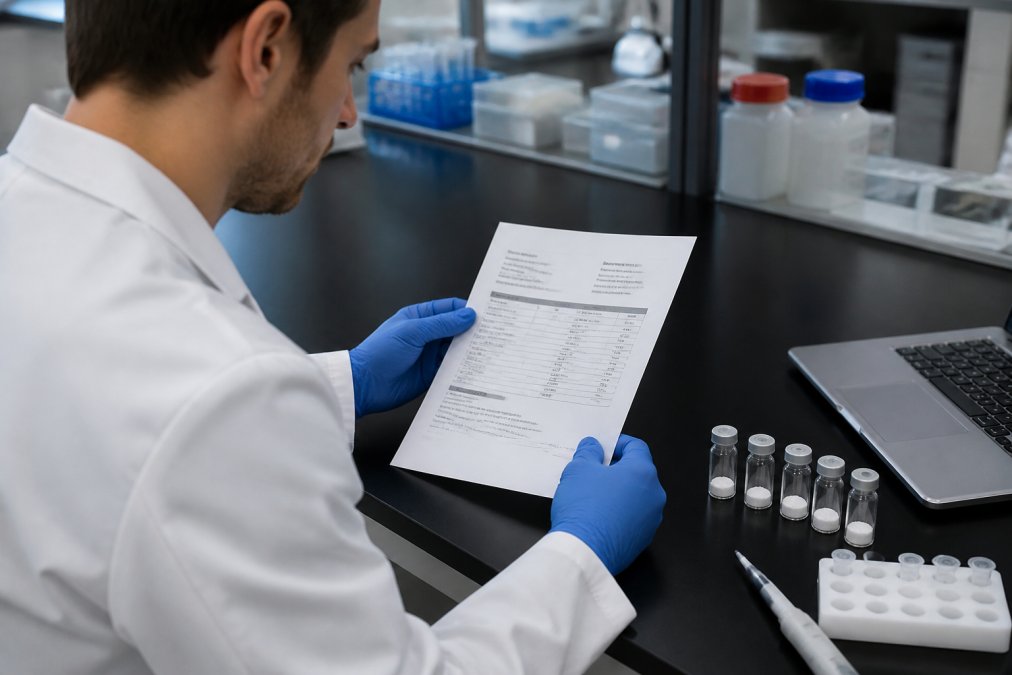
A complete Certificate of Analysis is a batch-specific record tying a unique lot number to the analytical methods used, the results obtained, and the testing laboratory's identity. If any of those four elements is missing, you are reading a summary, not a COA.
What a Complete COA Must Contain
Every legitimate document should include the following:
- Batch or lot number matching the vial label exactly
- Peptide name, sequence, and molecular weight
- HPLC purity percentage with the chromatogram attached
- Mass spectrometry confirmation of identity
- Testing laboratory name and, ideally, its accreditation
- Date of analysis and storage recommendations
Spotting Counterfeit or Reused Documentation
Most guides assume the COA in front of you is real and only ask whether it is complete. That is the wrong starting assumption. A forged or recycled report is more dangerous than a missing one, because it manufactures false confidence. Treat every COA as a document to be authenticated, not just read.
Document-level tells. Counterfeit COAs fail on details that are hard to fake consistently:
- Metadata mismatch. Check the PDF's creation date, author field, and software. A report generated by a scanner or image editor, or with an author name that does not match the testing lab, is a warning sign. A genuine instrument export carries the lab's software signature.
- Font and layout drift. Recycled reports often show mismatched fonts, misaligned tables, or a purity figure pasted over an older value. Zoom to 400% and look for pixelation around the number or a background shade that does not match the row.
- Reused chromatograms. The same chromatogram image on multiple product pages, or axis labels that do not match the stated method, means the image was lifted rather than generated for that batch.
- Lot number logic. A real lot number follows a consistent internal pattern across a vendor's catalog. Random lot numbers, sequential numbers across unrelated compounds, or numbers that change on refresh mean the traceability chain is fictional.
Verification steps that actually work.
- Cross-check the lot number against the vial label, the invoice, and any batch lookup tool on the vendor's site. All three must agree.
- Contact the named testing laboratory directly using contact information you find independently, not the number printed on the COA. Ask whether they performed the analysis and can confirm the report number. A legitimate lab will confirm or deny; a fabricated lab will not exist.
- Request the raw instrument data. A genuine HPLC run produces a data file with a timestamp, method parameters, and integration events. Vendors who can only produce a PDF image, never the underlying data file, are showing you a picture of a result rather than a result.
- Compare retention time to published values. If the stated retention time is implausible for the compound and column chemistry described, the chromatogram was not run on that peptide.
If a vendor cannot produce a batch-matched report on request, or cannot survive a direct call to the named lab, treat the purity claim as unverified regardless of how professional the document looks.
HPLC and Mass Spectrometry for Peptides
High-Performance Liquid Chromatography separates a sample's components and reports how much of the total signal belongs to your target compound. Mass spectrometry then confirms the dominant peak is the peptide you ordered by measuring its molecular weight.
Reading a Chromatogram and Retention Time
The chromatogram plots detector response against time. The main peak is your peptide; smaller peaks are impurities, synthesis byproducts, or degradation fragments. The retention time, when the main peak elutes, should match published data for that compound. The purity percentage describes how much of the total area that main peak accounts for.
Purity Percentage vs. Potency: What the Number Actually Means
This distinction trips up even experienced buyers. Purity describes how much of the material is the correct molecule; potency describes how much biological activity it delivers. A peptide can be 99% pure by HPLC and still underperform if it degraded, absorbed moisture, or was mishandled in transit. HPLC sees chemical composition, not biological activity.
Independent Third-Party Peptide Testing and Batch Traceability
Independent third-party peptide testing means the analysis is performed by a laboratory with no financial relationship to the seller. In-house testing is not inherently dishonest, but it removes the check third-party verification provides and gives the vendor full control over the report.
Traceability is the other half. You should be able to take a lot number from a vial and follow it back to a synthesis record, a test date, and a specific report. Vendors who rotate lot numbers without documentation, or ship labels matching no COA on file, break that chain.
When evaluating a supplier, ask two questions: who performed the analysis, and can you see the report for your exact lot? Globo Research Peptides publishes full Certificate of Analysis documentation for every batch, with testing performed by accredited third-party laboratories, so the answer is on the record rather than on request.
Red Flags in Peptide Marketing and Vendor Transparency
Marketing language is where weak vendors reveal themselves. Watch for:
- Universal "99% purity" claims across every product with no supporting data
- No lot numbers on vials or reports
- COAs that cannot be downloaded without contacting sales
- Pressure tactics such as limited-time pricing on research compounds
- No named testing laboratory anywhere on the site
- Reluctance to answer method questions directly
Vendor transparency is not a marketing position; it is an operational practice. A supplier that tests rigorously and documents honestly will answer a method question in one email.
Cold-Chain Integrity and Storage Stability After Delivery
A perfect COA describes the product at testing, not when it reaches your bench. Lyophilized powder is comparatively stable but not indestructible. Heat exposure during shipping, repeated freeze-thaw cycles, and improper reconstitution degrade material in ways no certificate can predict.
Ask how the vendor ships, whether temperature-sensitive compounds travel with cold packs, and what storage conditions the COA recommends. Follow those recommendations precisely and log the reconstitution date, if results look off months later, that log rules out handling as the cause.
The Regulatory Landscape and Legal Risks of Sourcing Peptides
Research-grade peptides occupy a narrow legal lane, and "for research use only" does more work than most buyers realize. It is not a marketing label but a liability shield for the seller, and understanding what it does and does not do for you is part of evaluating any purity claim.
What "Research Use Only" Actually Means
When a vendor labels a compound "for research use only" or "not for human or veterinary use," they signal that the product has not been evaluated or approved by the Food and Drug Administration for any therapeutic use (the FDA). That disclaimer shifts the intended-use burden onto the buyer. It does not make the compound legal to possess for personal use, and it gives you no consumer protection if the product is mislabeled or contaminated.
The practical consequence: a research-use-only disclaimer is not a quality guarantee or a legal safe harbor. It is a statement about intended use. A vendor can print it on every page and still ship a mislabeled vial.
Who Regulates What
Several agencies can intersect with peptide sourcing, depending on the compound and the context:
- FDA oversees drug approval, labeling, and the marketing of unapproved new drugs. Compounds marketed with implied human-use claims, dosing guidance, or before-and-after testimonials fall into enforcement territory.
- DEA controls scheduled substances under the Controlled Substances Act (dea.gov). Some peptide-related compounds and growth hormone secretagogues have been subject to scheduling or analog enforcement. If a vendor sells a scheduled compound without a registration framework, that is a legal risk to you, not just to them.
- FTC polices deceptive advertising (the FTC). A vendor claiming "99% purity" with no substantiation, or making health claims for a research chemical, can draw FTC attention. This matters to buyers because FTC action against a vendor is a public record you can search.
- State pharmacy boards and state-level controlled substance laws can be stricter than federal rules. A compound that is legal to source in one state may be restricted in another.
What This Means for Your Sourcing Decision
For a working lab, the risk is twofold: sourcing material of unknown provenance, and documenting that it was acquired for legitimate research purposes.
Concrete steps that reduce legal exposure:
- Keep the paper trail. Retain the COA, the invoice, the lot number, and the shipping documentation for every order. If a question ever arises about provenance, that file is your defense.
- Match the vendor's framing to your use. If you are doing in vitro receptor work, buy from vendors whose entire catalog is framed for laboratory research. If a supplier's site reads like a wellness store, complete with human dosing suggestions, that is a legal and scientific warning sign in equal measure.
- Avoid compounds with human-use marketing. A vendor that markets a peptide for weight loss, recovery, or anti-aging is signaling that its customer base is not laboratories. That is a compliance risk you inherit.
- Check for scheduling before you buy. Confirm the compound's status under the Controlled Substances Act and your state's parallel statutes. Do not rely on the vendor's characterization.
- Do not treat the disclaimer as protection. The research-use-only label protects the seller. Your protection comes from batch documentation, third-party testing, and your own recordkeeping.
Buy from vendors who state clearly that their products are for research use only, who maintain compliance documentation, and who do not market compounds with human-use claims. A supplier who is transparent about the legal lane they operate in is also more likely to be transparent about the analytical lane.
A Practical Checklist for Evaluating Peptide Purity Claims
Use this checklist before you place any order. If a vendor fails more than one item, look elsewhere.
| Check | What to Verify | Why It Matters |
|---|---|---|
| Batch match | Lot number on COA matches vial | Confirms the report describes your product |
| Identity confirmation | Mass spectrometry data present | Confirms the molecule is what you ordered |
| Purity method | HPLC with attached chromatogram | Shows how the purity figure was derived |
| Testing lab | Named, ideally accredited | Separates independent analysis from marketing |
| Purity vs. potency | Both addressed, not conflated | Prevents over-trusting a single number |
| Shipping | Cold-chain method disclosed | Protects stability in transit |
| Legal framing | Explicit research-use-only language | Keeps your sourcing defensible |
For labs that need verified purity of ≥99%, full batch documentation, and a fulfillment process built around research timelines, Globo Research Peptides offers in-stock inventory ready for immediate dispatch alongside a special-order fulfillment program for unique products.
The gap between a purity claim and a verified purity result is where studies fail. Close it by demanding batch-specific documentation, independent third-party testing, and a vendor who answers method questions without hesitation. Globo Research Peptides provides verified ≥99% HPLC purity, full Certificate of Analysis documentation for every batch, and rigorous third-party testing, so your materials arrive with evidence attached. Get started with Globo Research Peptides and source research compounds you can document, defend, and build on.
Frequently Asked Questions
Is there a way to test peptide purity myself?
You can send a sample to an independent analytical lab for High-Performance Liquid Chromatography and mass spectrometry, but this costs money and time. A practical first step is to request the batch-specific Certificate of Analysis and confirm the testing lab is accredited and independent. If the COA shows a purity percentage, retention time, and molecular weight that match the compound, that data should be verifiable. For critical studies, a small confirmatory test on arrival can catch shipping damage or mix-ups.
What is an acceptable purity for research peptides?
For most in vitro and receptor binding studies, a purity of 95% or higher is the baseline, and 98% to 99% is preferred for sensitive work. Lower purity means more impurities, which can skew results or introduce confounding effects. Purity percentage should always be tied to a specific analytical method, usually HPLC, and reported for the exact batch you receive. A generic purity claim without a matching batch-specific COA is not sufficient evidence.
How do I check peptide authenticity beyond the COA?
Cross-check the COA against the physical batch number on the vial label, verify the testing lab exists and is accredited, and look for a chromatogram and mass spectrum rather than just a summary number. You can also request the raw analytical data or a verification code. If a vendor reuses the same COA across multiple batches or cannot explain the testing method, treat that as a warning sign. Independent third-party peptide testing adds another layer of confidence.
Why is HPLC testing critical for peptide research?
HPLC separates the target peptide from impurities, deletion sequences, and truncated fragments, then quantifies how much of the sample is the intended compound. Without it, a purity claim is just a number. Mass spectrometry confirms the molecular weight matches the expected structure. Together, HPLC and mass spectrometry give you identity verification and an impurity profile, which are the two data points that determine whether a peptide is suitable for your study.
What should I do if the COA does not match the batch I received?
Document the discrepancy with photos of the vial label and the COA, then contact the vendor immediately and ask for the correct batch documentation. A transparent supplier should be able to provide the matching COA or explain the issue. If they cannot, or if the response is vague, do not use the material in critical work. Keep the correspondence on file, and consider sourcing from a vendor that provides full traceability and batch-specific documentation as standard practice.