 blog
Aminovault vs Core Peptides: Supplier Comparison
Last Updated: November 1, 2026
Quick Summary
Aminovault vs Core Peptides depends mainly on documentation quality, batch-specific COAs, catalog breadth, and total cost of ownership rather than headline price. Verify each supplier's current testing methods and lot-level results before ordering, since the comparison relies on publicly visible information.
- Require a batch-specific Certificate of Analysis tied to a lot number and test date.
- Ask for the HPLC method details: column, gradient, wavelength, and integration approach.
- Confirm identity with mass spectrometry, since HPLC purity alone does not verify the sequence.
- Ask which compounds are stocked and what the realistic lead time is for special orders.
- Compare total landed cost, including shipping and documentation fees, not per-milligram price alone.
Table of Contents
- How We Compared Aminovault and Core Peptides
- Catalog Breadth and Access to Specialized Compounds
- Peptide Purity Testing: What the Claims Mean in Practice
- Batch-Specific Certificate of Analysis: What to Require
- Aminovault Reviews: What Established Buyers Report
- Pricing, Minimum Orders and Shipping for Small Labs
- Choosing a Research Peptide Supplier for Your Lab's Next Order
- Frequently Asked Questions
Choosing a research peptide supplier is a decision that shapes the reliability of your entire study timeline. Labs weighing the aminovault vs core peptides decision are usually weighing the same things: documentation quality, verified purity, catalog breadth, and total cost of ownership. At Globo Research Peptides, we built this comparison around the criteria that matter most to academic, biotechnology, and contract research buyers, and we are transparent about where the evidence is limited.
How We Compared Aminovault and Core Peptides
This comparison is based on publicly visible supplier information, including product listings, stated testing practices, and documentation policies. For a different supplier comparison framework, see LicensedPeptides vs BloomPeptides. We did not run side-by-side purchases, so claims about batch results are noted as supplier claims rather than verified findings. Our criteria were documentation transparency, batch-specific Certificate of Analysis (COA) availability, testing methods, catalog scope, pricing structure, and shipping terms. A peptide supplier is a vendor relationship, not a single product, so we weighted reliability and documentation above headline price. Readers should verify current terms directly with each supplier before ordering.
Catalog Breadth and Access to Specialized Compounds
Catalog breadth matters most for labs studying less common targets, such as specific neuropeptide receptors. A supplier with a wide standard catalog can cover routine work, but niche compounds often require a special-order pathway. Buyers should ask each supplier which compounds are stocked, which require synthesis, and what the realistic lead time is for each category. Lead time, not list price, is often what delays a study.
Peptide Purity Testing: What the Claims Mean in Practice
A purity percentage is not a property of a peptide; it is the output of a specific analytical method run on a specific sample under specific conditions. The section below explains what the number means, which method parameters change it, and how to read a report critically, the analytical-method transparency angle most vendor-ranking pages skip entirely.
What HPLC purity actually measures
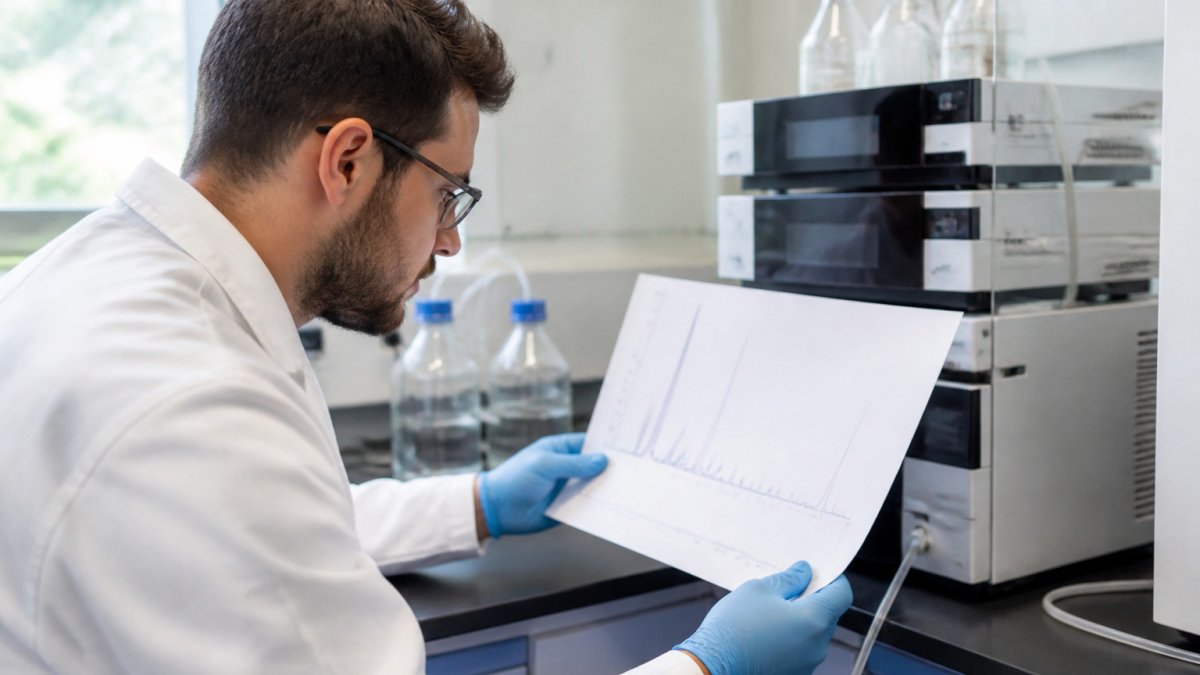
Reversed-phase high-performance liquid chromatography (RP-HPLC) separates components of a sample by hydrophobicity as they pass through a column. The detector, typically a UV absorbance detector set near 214 nm for the peptide bond, produces a chromatogram. Purity is usually reported as the area of the main peak divided by total peak area, expressed as a percentage. That definition matters because it is a relative measure: it tells you how much of the UV-absorbing material eluted as the target peak, not how much peptide mass is in the vial, and not whether the target peak is the correct sequence.
Three consequences follow:
- Purity is not identity. A truncated or sequence-scrambled peptide that co-elutes with the target can inflate the main-peak percentage. Identity needs a separate method, typically mass spectrometry (MS), often electrospray ionization (ESI-MS) or MALDI-TOF, comparing observed mass to the theoretical mass of the intended sequence.
- Purity is not quantity. Net peptide content (the mass of peptide versus counterion, water, and residual solvents in the vial) is a separate measurement, usually by elemental analysis, nitrogen determination, or quantitative amino acid analysis (Comparison of assays for determination of peptide content for lyophilized thymalfasin). A 98%-pure-by-HPLC vial can still be well below 98% peptide by mass.
- Purity is method-dependent. Change the column chemistry, gradient, flow rate, or detection wavelength and the same sample can report a different percentage. A number without those parameters is not reproducible.
The method parameters that change the number
When you evaluate a purity claim, the report should let a competent analytical chemist reproduce the run. The parameters that matter most:
| Parameter | Why it changes the result |
|---|---|
| Column chemistry and dimensions (e.g., C18, particle size, length × internal diameter) | Different selectivity resolves different impurities; a short column can merge a impurity into the main peak |
| Mobile phase and gradient | Shallower gradients usually resolve more closely eluting impurities and can lower the reported purity |
| Flow rate and column temperature | Affect retention and peak shape |
| Detection wavelength | 214 nm captures the peptide backbone; 280 nm captures aromatic residues only and will miss many impurities |
| Integration parameters | How peak boundaries are drawn materially changes area percentages |
A report that states "purity: 99%" with no method section is a marketing statement. A report that states the column, gradient, wavelength, and integration approach is a measurement you can audit.
How to read a purity claim critically
A practical checklist for research buyers:
- Is the method named and parameterized? HPLC alone is not enough; ask for column, mobile phase, gradient, flow rate, wavelength, and run time.
- Is identity confirmed independently? Look for an MS result with observed versus theoretical mass, not just an HPLC percentage.
- Is the result batch-specific? A purity figure tied to a lot number and a test date is auditable; a catalog-page figure is not.
- Is the acceptance criterion stated? "≥98% by RP-HPLC" is a specification; "high purity" is not.
- Is the testing lab identified? An in-house result and an independent third-party result carry different evidentiary weight, and the report should say which it is.
Where Globo Research Peptides fits
Globo Research Peptides reports verified purity of ≥99% and provides a full Certificate of Analysis for every batch, so buyers can review the supporting documentation. For labs that need to defend a supplier choice in a publication, a grant file, or an internal audit,
Batch-Specific Certificate of Analysis: What to Require
A useful COA identifies the exact lot, lists the analytical methods, and reports results with their acceptance criteria. For a full guide to certificate of analysis documentation, see the importance of certificate of analysis documentation. Globo Research Peptides provides a full COA for every batch. Watch for generic documents that describe a product line rather than a single lot, and for missing mass spectrometry confirmation of identity. If a COA does not match your specifications, request a corrected document before the material enters your study.
Aminovault Reviews: What Established Buyers Report
That is a legitimate reason to stay put, and it is worth weighing against any documentation gaps you have experienced. We recommend reviewing the most recent COAs from your current supplier against the criteria above before deciding whether a switch is justified.
Pricing, Minimum Orders and Shipping for Small Labs
Pricing depends on quantity, compound complexity, delivery location, and order timing, so no fixed price can be quoted here. Small labs should ask whether minimum order quantities apply and whether small milligram quantities are available without surcharges. Current pricing and a quote are available through the Globo Research Peptides website. Compare total landed cost, including shipping and any documentation fees, rather than per-milligram price alone.
Choosing a Research Peptide Supplier for Your Lab's Next Order
Start with the compounds your study needs, then check each supplier's stock status, COA format, and testing method. Request a sample COA before placing a first order, and confirm lead times for any special-order item. If you are comparing Aminovault with Globo Research Peptides, our recommendation is to match documentation requirements to your regulatory and publication needs first, and to treat price as the final factor. You can also explore AminoVault alternatives for research labs and how to check COAs before you buy. Globo Research Peptides supplies in-stock, research-grade peptides with a full COA for every batch, and you can explore current inventory and place your order at our website.
Frequently Asked Questions
How do Aminovault and Core Peptides compare?
Both are suppliers of research-use-only peptides, so the comparison comes down to documentation, catalog breadth, ordering terms and fit with your procurement process. Globo Research Peptides publishes its own criteria: verified purity of 99% or higher, a full Certificate of Analysis for every batch, and third-party testing. Verify each supplier's current COA format, lot-level data and pricing directly before deciding, since public product details change and this comparison cannot confirm live catalog or price information for competitors.
Which research peptide supplier provides batch-specific Certificates of Analysis?
A batch-specific Certificate of Analysis should list the lot number of the vial you receive, not a generic sample result. Globo Research Peptides states that it provides a full COA for every batch. When evaluating any supplier, request a sample COA before ordering and confirm that the lot number, HPLC purity result, method and testing date match the product you will be using in your study.
How can researchers verify peptide purity and identity?
Purity is usually reported as a percentage from high-performance liquid chromatography (HPLC), while identity is typically confirmed by mass spectrometry, which checks that the molecular weight matches the expected peptide. A credible COA reports both. Ask whether the testing was performed by an independent accredited laboratory, and check that the method is described well enough to reproduce or compare against your own in-house analysis.
What should researchers check before choosing a peptide supplier?
Start with documentation: a batch-specific COA, the analytical methods used and whether testing is third-party. Then check intended-use statements, since research-use-only products are not approved for human consumption. Confirm lead times for in-stock and special-order items, minimum order quantities for small amounts, and whether the supplier offers technical support. Compare these items across suppliers in writing rather than relying on marketing claims.