 ultimate-guide
Sourcing Custom Peptides for Academic Studies: 2026 Guide
Table of Contents
- What Academic Labs Need to Know Before Sourcing Custom Peptides
- Comparing Synthesis Technologies: Solid-Phase vs. Solution-Phase
- Peptide Purity Verification Methods: HPLC, Mass Spectrometry, and Beyond
- How to Read a Certificate of Analysis for Peptides
- Best Practices for Peptide Storage 2026: Temperature, Lyophilization, and Stability
- Academic Budgeting and Grant Compliance for Custom Peptide Procurement
- Custom Peptide Design, Modification, and Special-Order Fulfillment
- Frequently Asked Questions
Last Updated: September 11, 2026
What Academic Labs Need to Know Before Sourcing Custom Peptides
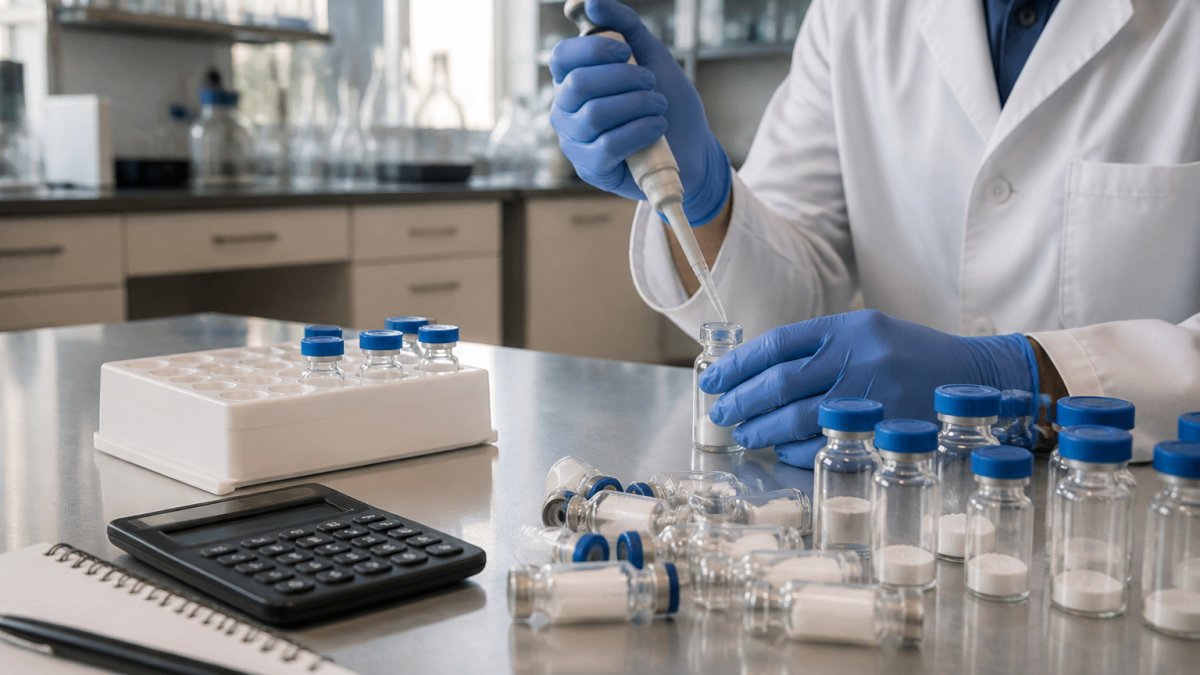
Sourcing custom peptides for academic studies starts with a decision most labs make too late: choosing a supplier whose documentation will survive grant review, not just one whose price looks good on a purchase order. A synthetic peptide is a short chain of amino acids assembled to match a specific sequence.
Reagents that fail analytical validation can invalidate months of downstream work, and re-running a study costs far more than the peptide itself.
Below, we break down synthesis technologies, purity verification, COA review, storage, and budgeting.
Documentation Requirements for Grant-Funded Research
Federal grant recipients must justify reagent purchases and demonstrate that materials meet the standards in the funded proposal, retaining the certificate of analysis, the supplier's purity claim, and the analytical method used to verify it for every batch (ecfr.gov).
A common mistake is treating the COA as a receipt. It's the evidence chain that connects your published result back to a characterized material.
Three documents belong in your lab records for each lot:
- Certificate of analysis with lot number and analytical method
- Purity value stated as a percentage from a named method
- Storage and handling conditions as shipped
Comparing Synthesis Technologies: Solid-Phase vs. Solution-Phase
Solid-phase peptide synthesis remains the default for research-scale work because it builds the chain on an insoluble resin, allowing excess reagents to be washed away between coupling steps. Solution-phase synthesis performs the same chemistry in liquid, suiting short sequences and large-scale production but demanding more purification at each stage.
The practical difference is sequence length and scale: solid-phase handles longer sequences and small quantities efficiently, while solution-phase becomes competitive for bulk material of a short peptide.
| Attribute | Solid-Phase | Solution-Phase |
|---|---|---|
| Typical scale | Milligrams to grams | Grams to kilograms |
| Best sequence length | Longer chains | Short chains |
| Purification burden | End-stage | Intermediate stages |
| Cost efficiency | Research quantities | Bulk quantities |
For most academic orders, solid-phase is the correct choice. What most guides miss is that the resin and coupling chemistry matter less than the purification step that follows.
Peptide Purity Verification Methods: HPLC, Mass Spectrometry, and Beyond
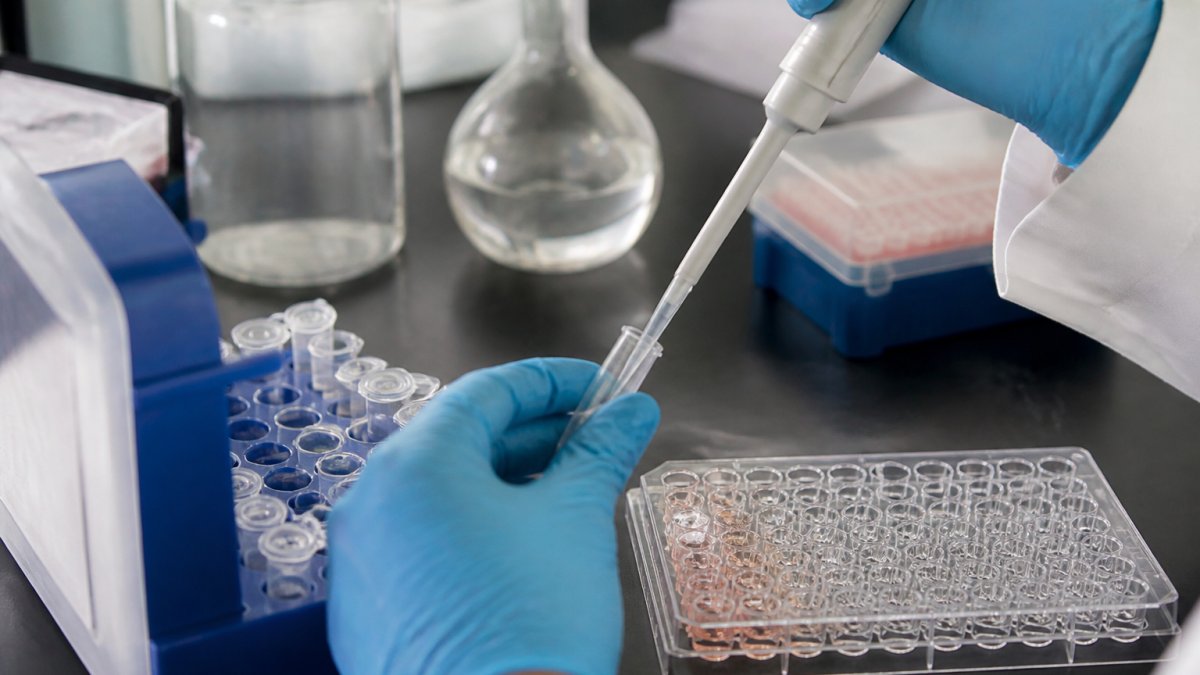
Peptide purity verification methods combine separation and identification: HPLC quantifies how much of the sample is the target sequence, while mass spectrometry confirms the molecular weight matches the expected structure. Neither alone is sufficient.
HPLC separates components by their interaction with a column and mobile phase; purity is the area percentage of the main peak.
Mass spectrometry answers a different question. It confirms the molecule is what it claims to be. A sample can be 98% pure by HPLC and still be the wrong sequence.
- HPLC: quantifies purity percentage
- Mass spectrometry: confirms molecular identity
- Solubility testing: verifies the peptide dissolves for your assay
- Analytical validation: ties the results to a documented method
For epitope mapping or antibody production, request both HPLC and mass spectrometry data. Identity confirmation is not optional when the sequence itself is the variable.
How to Read a Certificate of Analysis for Peptides
Reading a certificate of analysis for peptides means checking four things in order: lot number, analytical method, purity value, and storage conditions. If any is missing or vague, the document cannot support your study.
Start with the lot number. It must match the vial in your hand. A COA without a lot number is a marketing sheet.
Next, confirm the method. A purity figure without a stated technique tells you nothing about how it was measured.
Then check the numbers. A purity level of ≥99% should be stated alongside the method that produced it (PubMed).
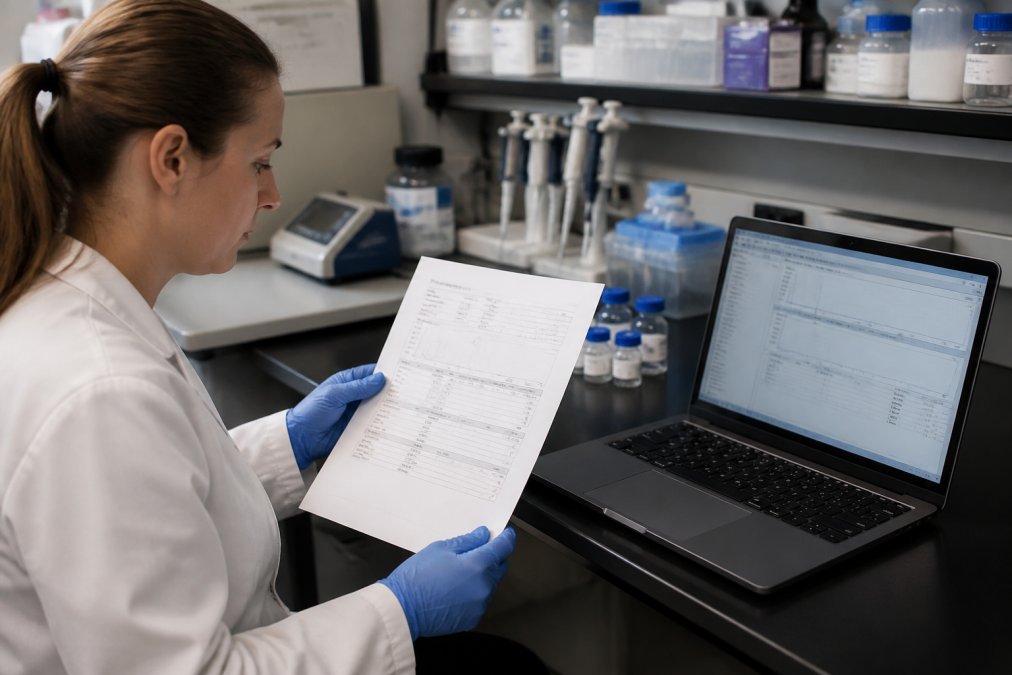
Red Flags in Incomplete or Vague COAs
The clearest warning sign is a COA that reports purity without naming the analytical method. A close second is a document with no lot number, making batch traceability impossible.
Other red flags include:
- Purity stated as a range rather than a measured value
- No storage or handling instructions
- Missing molecular weight confirmation
- No testing laboratory identified
Any one of these should trigger a request for a corrected document before you use the material. A supplier that cannot produce a complete COA on request will not produce one when your result is questioned.
Best Practices for Peptide Storage 2026: Temperature, Lyophilization, and Stability
Storage advice for peptides is easy to state and hard to apply, because the right conditions depend on the sequence: a hydrophobic 20-mer and a hydrophilic 8-mer do not degrade the same way. This section covers the mechanisms behind peptide instability, then gives decision rules for a specific sequence.
Why Peptides Degrade: The Four Pathways
Peptide instability is not one problem. It is four, and each has a different fix:
- Hydrolysis. Water attacks the peptide backbone, cleaving it. This is the dominant pathway in solution and the reason lyophilized powder is more stable than a reconstituted stock.
- Oxidation. Methionine, cysteine, tryptophan, and histidine are oxidation-prone. A peptide containing methionine will oxidize faster than one that does not, and the fix is different (see below).
- Deamidation. Asparagine and glutamine residues can deamidate, especially at neutral to basic pH. This changes the peptide's charge and can shift its behavior in an assay.
- Aggregation. Hydrophobic sequences self-associate in aqueous solution. Aggregation is often mistaken for "the peptide stopped working" when the peptide is fine and the buffer is wrong.
Knowing which pathway applies tells you what to control: a methionine-containing peptide needs antioxidant handling, a hydrophobic peptide needs a solvent strategy, and a long hydrophilic peptide mostly needs cold, dry storage.
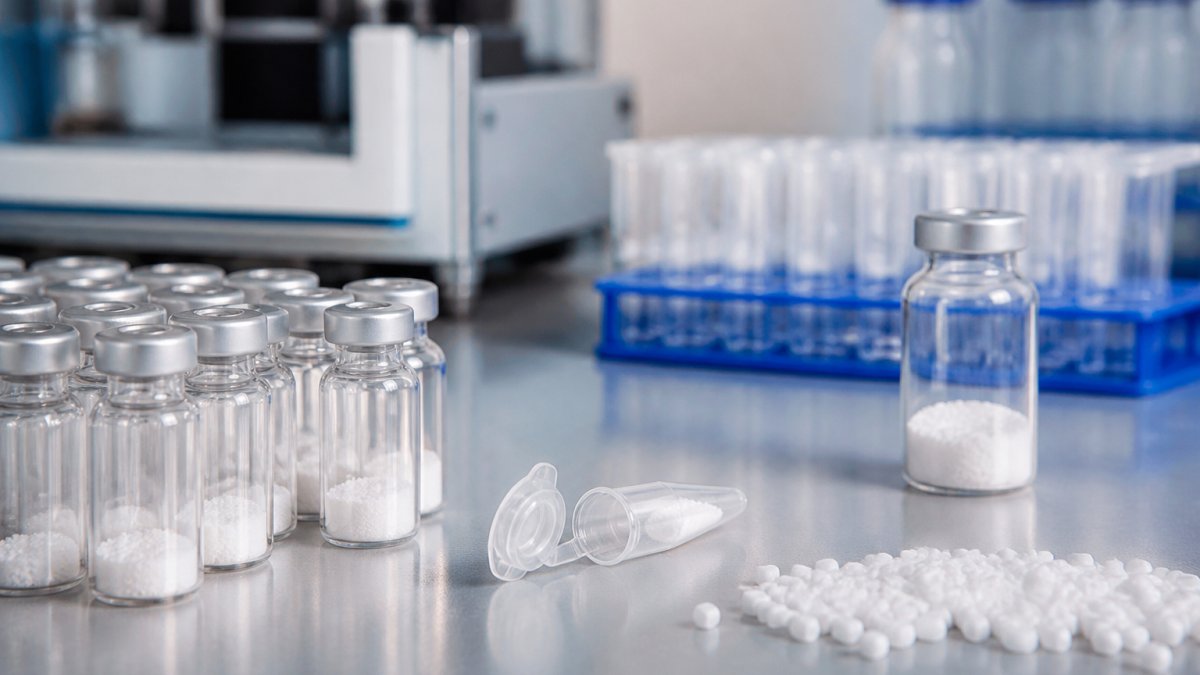
Lyophilized Storage: Temperature, Moisture, and Desiccation
Lyophilized peptide is stable because water has been removed. Its two enemies are heat and moisture, and moisture is the one labs underestimate.
- Temperature. Long-term storage is typically well below freezing (peer-reviewed research). Short-term working stocks can often sit at refrigerator temperature, but confirm with the supplier's specification rather than assuming.
- Desiccation. A vial opened in a humid room pulls moisture from the air. Keep desiccant in the storage container and let vials equilibrate to room temperature before opening, so condensation does not form inside the vial.
- Seal integrity. A vial that has been punctured repeatedly is no longer a sealed container. If you need many small aliquots, weigh out powder aliquots rather than repeatedly opening one vial.
Reconstitution: A Workflow, Not a Step
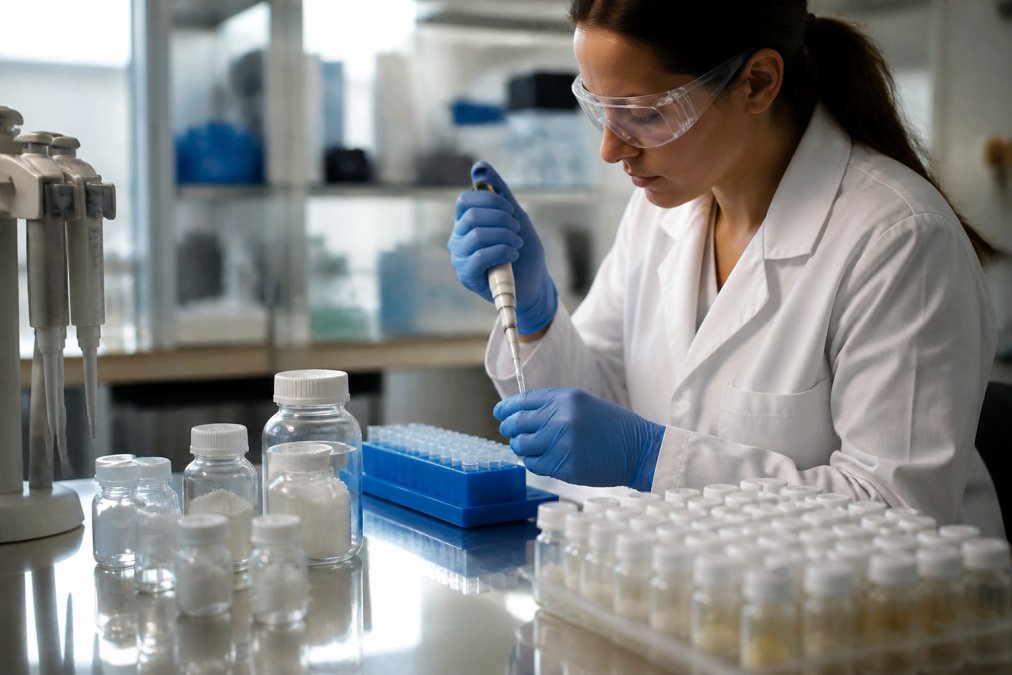
Reconstitution is where most peptide handling errors happen. A defensible workflow:
- Equilibrate the vial to room temperature before opening. Opening a cold vial in a warm room condenses moisture onto the powder.
- Choose the solvent based on sequence, not habit. Hydrophilic peptides often dissolve in water or buffer. Hydrophobic peptides may need a small amount of organic solvent (such as acetonitrile or DMSO) first, then dilution into aqueous buffer.
- Add solvent to the vial, not powder to solvent. This reduces losses on the vial wall.
- Dissolve gently. Swirl or pipette; avoid vigorous vortexing, which can shear and aggregate.
- Check pH. If the peptide is basic or acidic, adjust pH away from its isoelectric point to improve solubility.
- Aliquot before freezing. Single-use aliquots prevent repeated freeze-thaw cycles, which are a leading cause of activity loss.
- Log the mass. Weigh the vial before and after reconstitution. If the mass does not match the labeled quantity, you have a documentation problem before you have a solubility problem.
Troubleshooting Solubility by Sequence Type
When a peptide will not dissolve, the sequence usually tells you why:
- Hydrophobic sequences (rich in leucine, isoleucine, valine, phenylalanine, tryptophan) resist aqueous buffers. Start with a small amount of organic solvent, then dilute into aqueous buffer. If the peptide precipitates on dilution, the organic fraction was too low.
- Basic sequences (rich in arginine, lysine, histidine) dissolve better at acidic pH. Adjust downward.
- Acidic sequences (rich in aspartate, glutamate) dissolve better at basic pH. Adjust upward.
- Cysteine-containing sequences can form disulfides and appear insoluble when they are actually aggregating. Consider whether the peptide needs reducing conditions.
- Methionine-containing sequences oxidize over time. Handle with reduced exposure to air and consider whether the assay tolerates the oxidized form.
Degradation After Storage: What to Check First
If a peptide that worked previously loses activity, check the storage log first, not the synthesis. The usual causes, in order of frequency:
- Repeated freeze-thaw cycles. Each cycle stresses the peptide. Single-use aliquots eliminate this.
- Storage at the wrong temperature. A working stock left at room temperature over a weekend is a common and avoidable loss.
- pH drift in solution. A reconstituted stock stored at the wrong pH can deamidate or aggregate over weeks.
- Oxidation of sensitive residues. Methionine and cysteine are the usual suspects.
- Microbial contamination. A non-sterile aqueous stock can grow organisms that degrade the peptide and confound the assay.
A Practical Storage Decision Rule
For most academic work, the decision rule is:
- Lyophilized powder: store cold and desiccated; equilibrate before opening; use the supplier's specified temperature.
- Reconstituted stock: aliquot immediately into single-use portions; freeze; avoid repeated thawing.
- Working solution: keep at the temperature the assay requires; discard on a defined schedule rather than keeping it indefinitely.
The sequence determines the solvent and the pH. The workflow determines whether the peptide is still good when you need it.
Academic Budgeting and Grant Compliance for Custom Peptide Procurement
Most competitors treat peptide procurement as a commercial transaction. For an academic lab, it is a compliance event: every dollar spent on a custom peptide must be traceable to a funded aim, an allowable cost category, and a documented material. That framing changes what you should ask a supplier before you order, not after.
What Drives the Price of a Custom Peptide
Custom peptide pricing is a function of five variables, and understanding them lets you write a defensible budget line instead of a guess:
- Sequence length. Each additional residue adds coupling and deprotection cycles. A 10-mer and a 30-mer are not the same product at different sizes; they are different synthesis campaigns.
- Purity level. Crude, desalted, ≥95%, and ≥98% HPLC are distinct products. Moving from ≥95% to ≥98% typically requires an additional preparative HPLC pass, which is where most of the cost delta lives.
- Modifications. Fluorescent tags, biotin, phosphorylation, amidation, and cyclization each add synthesis steps and often require a different resin or protecting-group strategy.
- Scale. Milligram-scale research quantities and gram-scale orders sit on different cost curves. Below a supplier's minimum resin load, you are paying for the run, not the material.
- Turnaround. Standard and expedited timelines are priced differently because expedited work displaces other runs on the synthesizer.
For budgeting, request a quote that itemizes these variables rather than a single number. An itemized quote is also the document a program officer is most likely to accept as justification.
Grant Compliance: The Cost-Principle Frame
Federal grant recipients operate under cost principles requiring purchases to be allowable, allocable, and reasonable. For a peptide order, that means three things:
- Allowable. The peptide must be a material the funded project actually needs. A reagent bought "just in case" is harder to defend than one tied to a specific aim.
- Allocable. If the peptide supports more than one project, the cost has to be split or charged to the project it primarily serves. Charging a shared reagent entirely to one grant is a common audit finding.
- Reasonable. The price has to be comparable to what a prudent buyer would pay. A single quote is weak evidence; two or three quotes for a large order is stronger.
This is why the documentation file matters more than the receipt. Keep the quote, certificate of analysis, and invoice together, keyed to the project and aim the peptide supports. When a program officer or auditor asks how a reagent connects to the funded work, that file answers in one place.
Invoicing and Procurement Mechanics
Academic procurement runs through systems commercial suppliers often do not accommodate well. Before you commit, confirm:
- Purchase order acceptance. Many institutions require a PO number on the invoice. A supplier that only takes credit cards creates a reimbursement problem.
- Institutional billing address and tax status. University purchasing is often tax-exempt; the invoice has to reflect that or your department absorbs the difference.
- W-9 and vendor registration. New vendors frequently need to be set up in the institution's system before a PO can be issued. Start this before you need the peptide, not the week the experiment starts.
- Itemized invoicing. A single line item labeled "peptides" is harder to reconcile against a grant budget than an invoice that lists sequence, scale, purity, and modification.
Cost-Saving Strategies That Do Not Compromise the Science
- Order the purity you need, not the highest purity available. If your assay tolerates ≥95%, paying for ≥98% is waste. If your assay is sequence-sensitive, the opposite is true.
- Batch multiple sequences into one order. Suppliers often price per-run rather than per-peptide, so combining sequences can lower the per-peptide cost.
- Ask about milligram-scale minimums. Some suppliers accommodate small academic orders; others do not. Knowing the floor before you design the experiment prevents a redesign later.
- Reuse characterized lots across related aims. A peptide that supports two funded aims can be purchased once and allocated, provided the allocation is documented.
- Plan around standard turnaround. Expedited synthesis is a real cost multiplier. If the study schedule allows, standard turnaround is the cheaper and equally valid choice.
Custom Peptide Design, Modification, and Special-Order Fulfillment
Custom peptide design begins with the amino acid sequence, then adds modifications that change how the peptide behaves in your assay. Common modifications include fluorescent labeling, biotinylation, and phosphorylation, each altering the molecule's properties and synthesis cost.
Design software helps with sequence optimization, but the final check is always analytical. A sequence that looks clean in software may aggregate in solution.
Special-order fulfillment matters when a compound isn't in stock. Turnaround depends on sequence length, modification complexity, and purification requirements, so confirm the timeline before committing a study schedule.
Globo Research Peptides stocks a research-grade catalog with verified ≥99% HPLC purity and a full certificate of analysis for every batch, covering most routine work without a custom order. For unique sequences, the special-order program handles design through delivery, and third-party testing by accredited laboratories backs every result.
Frequently Asked Questions
What documentation should accompany custom synthesized peptides for academic research?
Every batch of custom peptides should arrive with a Certificate of Analysis that includes the peptide sequence, molecular weight confirmation via mass spectrometry, HPLC purity percentage, and the analytical method used. For grant-funded studies, you may also need batch-specific testing dates and laboratory accreditation details. Globo Research Peptides provides full COA documentation for every batch, which supports audit trails and reproducibility requirements in academic settings.
How do you verify the purity of custom peptides for research?
Peptide purity verification methods typically combine reverse-phase high-performance liquid chromatography (HPLC) with mass spectrometry. HPLC separates peptide variants and calculates a purity percentage based on peak area, while mass spectrometry confirms molecular identity. For sensitive assays like receptor binding studies, request purity of 95% or higher. Globo Research Peptides verifies ≥99% HPLC purity and includes third-party testing documentation with each order.
What are the common challenges when sourcing custom peptides for academic studies?
Academic labs frequently encounter incomplete Certificates of Analysis, long turnaround times for obscure sequences, minimum order requirements that strain tight budgets, and storage-related degradation before studies conclude. Solubility issues with hydrophobic peptides can also derail experiments. To avoid these problems, confirm COA completeness before ordering, ask about special-order fulfillment for non-standard compounds, and follow best practices for peptide storage 2026 guidelines, including lyophilization and -20°C storage.
Are there specific storage requirements for research-grade peptides?
Lyophilized peptides should be stored at -20°C or lower, protected from light and moisture. Once reconstituted, aliquot samples to avoid repeated freeze-thaw cycles and store at -80°C for long-term stability. Use sterile buffers and avoid alkaline conditions that accelerate degradation. Peptides containing cysteine or methionine are especially prone to oxidation, so consider adding antioxidants or working under inert gas. Following best practices for peptide storage 2026 preserves peptide integrity and extends usable shelf life.
Peptide procurement is where good studies quietly go wrong. The fix isn't a better price, it's a supplier whose documentation holds up when your data is challenged. Globo Research Peptides provides verified ≥99% HPLC purity, full COA documentation for every batch, third-party testing by accredited laboratories, and a special-order program for sequences that aren't in stock. Order now and give your next study materials you can defend.