 ultimate-guide
Research Grade Peptide Purity Standards Explained
Table of Contents
- What Are Research Grade Peptide Purity Standards?
- Why Purity Level Determines Experimental Validity
- Peptide Purity HPLC Analysis: How It Works
- How to Read a Peptide Certificate of Analysis
- Research Grade vs Pharmaceutical Grade Peptides
- Purity Thresholds and Impurity Profiles You Can Accept
- Counterfeit Detection and Stability: What COAs Miss
- Frequently Asked Questions
Last Updated: September 7, 2026
What Are Research Grade Peptide Purity Standards?
Research grade peptide purity standards are the analytical benchmarks defining the minimum acceptable level of target peptide content in lyophilized powder for laboratory investigation. They refer to the verified percentage of the correct, full-length peptide sequence in a vial, with the remainder being synthesis byproducts, truncated sequences, and residual solvents. The difference between 95% and 99% purity is the difference between trustworthy data and experimental noise (peer-reviewed research).
The standard most laboratories rely on is high-performance liquid chromatography (HPLC) purity, which separates and quantifies the components of a peptide sample. A product labeled as ≥99% pure means that chromatographic analysis detected the target peptide at that level, leaving less than 1% of total impurities. This single metric determines whether your receptor binding assay measures the peptide you intended or a cocktail of failed synthesis products. Below, we will walk through how purity is verified, how to read the documentation, and what thresholds you can reasonably accept for different study types.
Why Purity Level Determines Experimental Validity
Purity level is the primary determinant of experimental validity because impurities compete, bind, and degrade alongside your target compound. A peptide at 95% purity introduces truncated sequences that may act as partial agonists or antagonists at the same receptor, producing a dose-response curve that reflects five different molecules rather than one.
The consequences scale with assay stringency. In immunology studies, minor impurities can trigger off-target cytokine responses; in pharmacokinetic profiling, an impure standard corrupts your calibration curve. Selecting a peptide based solely on price per milligram often reflects a less rigorous purification protocol, and repeating a failed experiment costs far more than the savings from a cheaper product.
Peptide Purity HPLC Analysis: How It Works
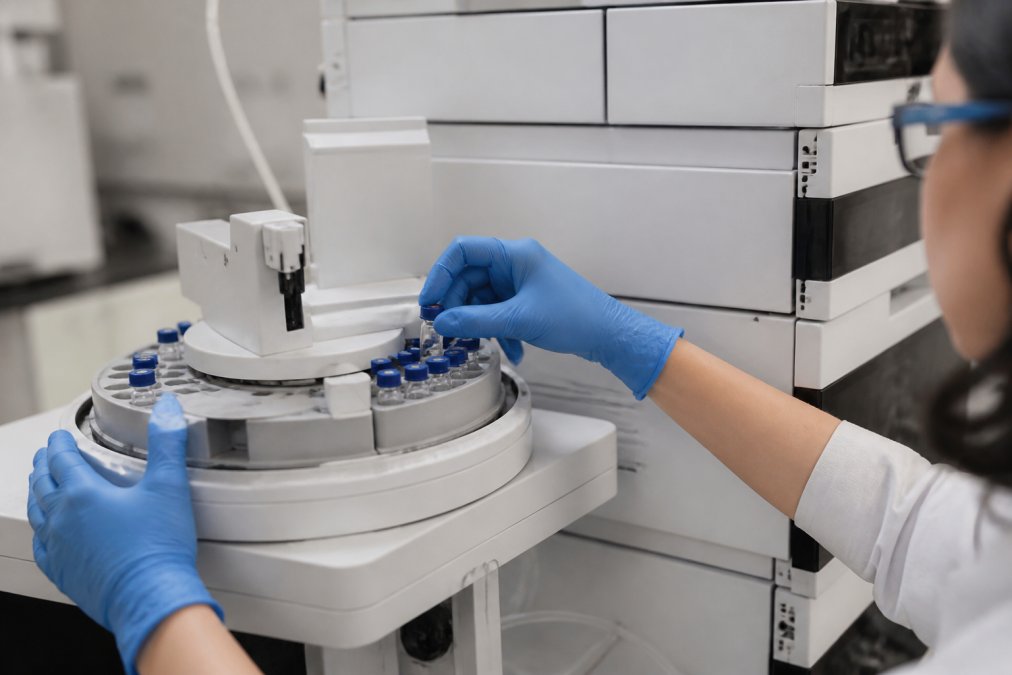
Peptide purity HPLC analysis is the process of passing a dissolved peptide sample through a chromatographic column to separate its components based on chemical properties, producing a chromatogram where each peak represents a distinct molecular species. The area under the target peak, compared to the total area of all peaks, yields the purity percentage. This method detects the presence of deletion sequences, oxidation products, and other synthesis byproducts that accumulate during solid-phase synthesis.
What the Chromatogram Actually Tells You
The purity percentage on a Certificate of Analysis derives from a single analytical run under specific conditions. The most common methods are reverse-phase HPLC with a C18 column and a mobile phase gradient of acetonitrile and water with 0.1% TFA. Detection is by UV absorbance at 214 nm, where the peptide bond absorbs, rather than 280 nm, which only detects aromatic residues (PubMed).
Gradient slope, column temperature, and flow rate influence peak resolution; closely related impurities may co-elute under one set of conditions but separate under another. A ≥99% purity claim is only meaningful if the method was optimized to resolve the expected impurity family, so the COA should list method parameters. If the method section is vague, the purity number is unverifiable.
What HPLC Does and Does Not Reveal
HPLC quantifies the impurity profile but cannot confirm the main peak is the correct sequence; peptides with identical molecular weights but different arrangements produce overlapping peaks. A responsible supplier pairs HPLC with mass spectrometry to confirm molecular weight and amino acid analysis to validate sequence composition. A COA listing only HPLC purity tells half the story.
Chromatographic purity differs from absolute peptide content. HPLC purity of 99% means 99% of UV-absorbing material elutes as the target peak, not that the vial contains 99% peptide by weight. The remaining mass includes water, residual solvents, and the counter-ion salt, a TFA salt often contributes 5-15% by weight depending on basic residues. Suppliers report peptide content separately, so a 1 mg vial of 99% pure peptide may contain only 0.85 mg of actual peptide.
Orthogonal Verification Methods
HPLC alone is never sufficient for full characterization of a research-grade peptide. The standard orthogonal methods are:
- Electrospray Ionization Mass Spectrometry (ESI-MS): Confirms the intact molecular weight. The observed mass should match the theoretical monoisotopic mass within 0.5 Da. A mass shift of +16 Da indicates oxidation of a methionine or tryptophan residue; a shift of −18 Da suggests dehydration, often from aspartimide formation during synthesis.
- Amino Acid Analysis (AAA): Hydrolyzes the peptide into individual amino acids and quantifies each residue. This confirms the sequence composition and detects deletion sequences that may co-elute with the main peak on HPLC.
- Capillary Electrophoresis (CE): An alternative separation method that resolves peptides by charge-to-size ratio rather than hydrophobicity. CE can detect impurities that HPLC misses because the separation mechanism is orthogonal.
A COA listing only HPLC purity, without MS data, AAA results, or method parameters, provides insufficient evidence of product identity. For quantitative studies, the minimum defensible documentation is HPLC plus ESI-MS; for complex sequences or multiple disulfide bonds, AAA should be required.
How to Read a Peptide Certificate of Analysis
A peptide certificate of analysis (COA) translates raw analytical data into a usable quality statement. It should list the peptide name, batch number, date of analysis, and quantitative results. Critical fields are HPLC purity, mass spectrometry molecular weight verification, and amino acid analysis results.
Check that the reported molecular weight matches the theoretical value within tolerance; a discrepancy indicates a sequence error. The impurity profile matters as much as the headline purity number, look for major impurities, particularly TFA content, which can interfere with cell-based assays at high levels. A complete COA includes solubility notes and storage recommendations. Globo Research Peptides provides full COA documentation for every batch.
Research Grade vs Pharmaceutical Grade Peptides
Research grade vs pharmaceutical grade peptides differ primarily in intended use, manufacturing controls, and regulatory oversight, not necessarily purity. Pharmaceutical grade peptides are produced under cGMP for human clinical trials, requiring stringent endotoxin testing and full regulatory documentation. Research grade peptides are for in vitro studies, animal models, and assay development, where the same sterility requirements do not apply.
The purity of a research grade peptide can match or exceed that of a pharmaceutical grade product, but the manufacturing environment and documentation burden differ. For laboratory use, research grade peptides at ≥99% purity are appropriate and cost-effective. The FDA guidance on peptide drug products outlines the regulatory expectations for pharmaceutical manufacturing, which are more extensive than what research applications require. Understanding this distinction prevents you from overpaying for cGMP documentation you do not need while ensuring you do not compromise on the purity that your experiments do require.
Purity Thresholds and Impurity Profiles You Can Accept
Acceptable purity thresholds depend on your application. For routine screening where the peptide is a tool, 95% to 98% purity may suffice. For receptor binding, enzyme kinetics, or quantitative analysis where concentration is a variable, ≥99% is the defensible standard.
| Application Type | Recommended Purity | Key Impurity Concern | Verification Required |
|---|---|---|---|
| Routine screening | 95-98% | Truncated sequences | HPLC only |
| Receptor binding assays | ≥99% | Competing analogs | HPLC + mass spectrometry |
| Quantitative pharmacokinetics | ≥99% | Degradation products | HPLC + MS + amino acid analysis |
| Cell-based immunology studies | ≥99% | TFA counter-ion, endotoxins | Full COA review |
The impurity profile matters as much as the purity percentage. A 99.5% pure peptide with a dominant antagonist impurity is riskier than a 99.0% peptide with a benign salt impurity. Evaluate impurity identity, not just quantity; degradation products accumulate over time, making stability testing and proper storage non-negotiable.
TFA vs. Acetate Salt Content: The Overlooked Variable
One of the most underappreciated factors in peptide quality is the counter-ion salt form. Most synthetic peptides are purified by reverse-phase HPLC with 0.1% TFA, which forms a salt with basic residues (arginine, lysine, histidine). After lyophilization, the product is a peptide-TFA salt, TFA is a stoichiometric component, not a trivial impurity.
TFA has two practical consequences. First, it contributes to total mass, a peptide with multiple basic residues may contain 10-15% TFA by weight, so a 5 mg label may contain only 4.3-4.5 mg of actual peptide. For quantitative assays, correct for peptide content. Second, TFA can interfere with cell-based assays above approximately 5 mM, affecting cell viability. For most in vitro assays at micromolar concentrations, TFA is negligible, but for high-concentration stocks or sensitive primary cells, it becomes problematic.
The alternative is the acetate salt, where TFA is exchanged during a final purification step. Acetate is better tolerated in cell-based assays and does not absorb at 214 nm, simplifying UV concentration measurements. However, the exchange process adds a manufacturing step and reduces yield, commanding a higher price. For cell-based immunology studies with primary cells at high concentrations, request the acetate salt form.
Net Peptide Content vs. Gross Weight
Gross weight is what you measure on the balance; net peptide content is the actual amount of full-length peptide, excluding water, solvents, and counter-ion. A reputable COA reports both, with peptide content determined by amino acid analysis. For a TFA salt, peptide content may be 80-90% of gross weight; for acetate, 85-95%. Without peptide content on the COA, you cannot accurately prepare molar solutions.
Degradation Products and Stability Thresholds
The impurity profile of a peptide changes over time, even under proper storage. Common degradation pathways include:
- Oxidation: Methionine, cysteine, and tryptophan residues are susceptible to oxidation. Methionine oxidation adds +16 Da to the molecular weight and can alter receptor binding affinity. The oxidation rate increases with exposure to air and light.
- Deamidation: Asparagine and glutamine residues can deamidate to aspartic acid and glutamic acid, respectively, introducing a negative charge and changing the isoelectric point. This reaction is accelerated at alkaline pH and elevated temperature.
- Aspartimide Formation: Aspartic acid residues, particularly in Asp-Gly sequences, can cyclize to form aspartimide, which then racemizes or rearranges. This degradation pathway is common during storage at neutral pH.
- Hydrolysis: Peptide bonds can hydrolyze, particularly at Asp-Pro linkages, generating truncated fragments.
A COA documents the impurity profile at release, not at time of use. For critical studies, establish a stability protocol: reconstitute a fresh vial, run HPLC, and compare to the COA. If new peaks appear or the main peak decreases by more than 2%, the peptide has degraded beyond acceptable limits.
Counterfeit Detection and Stability: What COAs Miss
A COA verifies the batch at time of testing but cannot guarantee the vial you receive is that batch. Counterfeit detection is a real concern in the peptide supply market. Source from a supplier with transparent chain of custody, which conducts third-party testing and provides documentation matching the batch number on your vial.
Stability is the second gap COAs leave open. A peptide 99% pure at release may degrade during improper shipping or storage. Lyophilized peptides are stable at controlled room temperature short-term, but long-term storage requires desiccation and refrigeration. Once reconstituted, most should be used within days at 2-8°C or aliquoted and frozen; repeated freeze-thaw cycles accelerate degradation. Your SOP should verify purity after reconstitution, not just at purchase.
Research grade peptide purity standards are the foundation of reproducible science; treating them as a checkbox compromises experimental integrity. The difference between verified ≥99% purity and an unverified claim is the difference between publishable results and retractions. Globo Research Peptides supports your work with rigorously tested compounds, full COA documentation for every batch, and a special-order fulfillment program. Get started with Globo Research Peptides and ensure your next experiment rests on materials you can defend.
Frequently Asked Questions
Is 98% purity good for peptides?
For most in vitro research applications, 98% purity is considered acceptable, but it depends on your assay's sensitivity. At 98%, you have roughly 2% impurity, which may include truncated sequences or deletion peptides. These impurities can confound dose-response curves or receptor binding studies. For sensitive assays like cell-based functional screens or in vivo work, 99% or higher purity is the safer standard. Always check the Certificate of Analysis for the specific impurity profile, not just the overall percentage, to ensure the remaining 2% will not interfere with your experimental readout.
What is the difference between research grade and pharmaceutical grade peptides?
Research grade peptides are produced for laboratory investigation and are not intended for human use. They typically meet a purity of 95% to over 99% verified by HPLC, with documentation like a Certificate of Analysis. Pharmaceutical grade peptides require compliance with Good Manufacturing Practice (GMP), full regulatory oversight by the FDA, and stricter controls on endotoxin levels, sterility, and manufacturing consistency. For basic science, research grade purity is appropriate. The higher regulatory burden of pharmaceutical grade drives up cost without adding scientific value for in vitro studies.
What are the current FDA guidelines for peptide impurity thresholds?
The FDA does not set a single universal purity threshold for research grade peptides, because these compounds are not regulated as drugs when used solely in laboratory settings. For pharmaceutical peptides, the FDA requires impurity characterization per ICH guidelines, with thresholds often below 0.5% for individual unknown impurities. For research use, the practical threshold depends on your application. Laboratories should define their own acceptance criteria based on assay sensitivity. Always verify that your supplier's HPLC data and COA match your internal quality requirements before starting a study.
How do I verify that a peptide's purity claim is accurate?
Start by requesting the Certificate of Analysis (COA) for your specific batch number. Verify that the COA includes an HPLC chromatogram with a single main peak and that the purity percentage matches the product listing. Check that the COA lists the method (e.g., reverse-phase HPLC), the detection wavelength, and the column specifications. For high-stakes studies, consider sending a sample to an independent lab for mass spectrometry verification. This confirms the molecular weight matches the expected sequence, catching mislabeled or counterfeit products that a simple HPLC reading might miss.