 ultimate-guide
Peptide Quality Control in Laboratory Settings: A 2026 Guide
Table of Contents
- Why Peptide Quality Control Matters in Research
- Core Analytical Techniques for Peptide Quality Control
- Testing Protocols Every Lab Should Implement
- Is 98% Purity Good for Peptides? Understanding Purity Standards
- How to Read a Peptide Certificate of Analysis
- In-House vs. Outsourced QC: A Cost-Benefit Analysis
- Troubleshooting Failed QC Results
- Building Your QC Standard Operating Procedures (SOP)
- Frequently Asked Questions
Last Updated: September 21, 2026
Why Peptide Quality Control Matters in Research
Peptide quality control is the foundation of reproducible, publishable science. Even small variations in composition can invalidate months of work, a batch that's 98% pure might contain 2% contamination that masks real biological effects or introduces noise.
In receptor binding studies, pharmacokinetic profiling, and mechanism-of-action research, unexpected impurities or degradation products create uncertainty about whether results reflect the peptide's actual behavior or contaminant behavior, forcing experiment repetition and publication delays.
At Globo Research Peptides, quality control documentation is as important as the peptide itself. Your Certificate of Analysis should report analytical methods, limits of detection, and specific impurities identified, not just a purity number.
Core Analytical Techniques for Peptide Quality Control
Peptide quality control rests on three pillars: purity verification, identity confirmation, and contaminant profiling. Understanding what each technique measures is essential for interpreting your Certificate of Analysis and troubleshooting unexpected results.
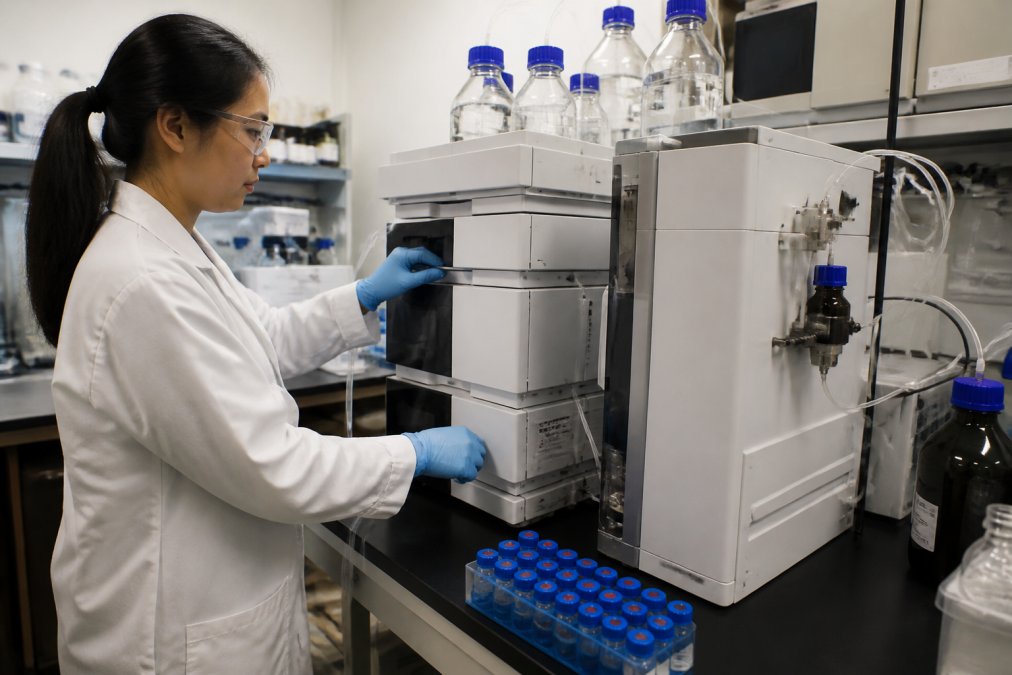
High-Performance Liquid Chromatography (HPLC) for Purity Verification
HPLC is the gold standard for peptide purity assessment, separating molecules by physical and chemical properties to reveal your target compound's percentage relative to all other substances. A 99% HPLC purity result means your peptide comprises 99% of the total peak area at a specific retention time and wavelength.
HPLC's strength is simplicity and reproducibility, the same batch produces nearly identical chromatograms, making it the standard reference for comparing batches and validating supplier quality.
HPLC's limitation is that it measures what separates from your target peptide, not what it actually is. Purity percentages must always be paired with identity confirmation methods.
Mass Spectrometry (MS) for Identity Confirmation
Mass spectrometry measures molecular weight with extraordinary precision. When MS reports a mass-to-charge ratio matching your peptide's theoretical molecular weight, you have direct evidence of your target compound, the only technique that definitively confirms identity.
LC-MS combines HPLC's separation power with MS's identification capability, separating peptides by retention time and measuring the mass of each peak. Matching mass and retention time confirm both purity and identity.
MS reveals unexpected modifications, oxidized methionine, truncated sequences, and structural variants produce distinct mass shifts that MS detects immediately, invaluable for troubleshooting synthesis failures.
HPLC vs LC-MS for Peptide Testing
HPLC is faster and cheaper, sufficient for routine quality control of well-characterized peptides. Many labs use HPLC as their primary screening tool and reserve LC-MS for new compounds or batches that fail HPLC expectations.
LC-MS provides both separation and identity confirmation in a single run, making it the better choice for novel peptides, custom syntheses, or high-stakes research. The trade-off is cost and equipment sophistication.
For established compounds from trusted suppliers like Globo Research Peptides, HPLC purity paired with single LC-MS confirmation is often sufficient. For new peptides or custom syntheses, LC-MS should be standard for every batch.
Testing Protocols Every Lab Should Implement
Comprehensive peptide quality control includes endotoxin testing, sterility confirmation, amino acid composition verification, and heavy metal screening, addressing biological contamination, elemental impurities, and compositional accuracy.
Endotoxin and Sterility Testing Protocols
Endotoxins are lipopolysaccharide fragments from gram-negative bacteria that trigger strong immune responses at nanogram concentrations. The Limulus Amebocyte Lysate (LAL) test detects endotoxins by measuring their ability to trigger coagulation in horseshoe crab blood cell lysate.
Research-grade peptides typically have endotoxin limits of less than 1 EU/mg, conservative enough to prevent immune activation while achievable through standard manufacturing controls. Your Certificate should specify the limit tested and actual result.
Sterility testing confirms the absence of viable bacteria and fungi by culturing your peptide sample in growth media for 14 days. A negative result means no viable organisms were detected.
Amino Acid Analysis (AAA) Standards
Amino acid analysis measures molar ratios of amino acids in your peptide. Deviations from expected ratios indicate incomplete synthesis, degradation, or contamination.
AAA is particularly valuable for detecting truncated peptides, shorter sequences from premature synthesis termination, which appear as compositional imbalance.
AAA hydrolyzes your peptide into individual amino acids, then separates and quantifies them via HPLC. Comparing results to theoretical composition confirms whether your peptide matches its intended sequence.
Heavy Metal Analysis in Peptide Synthesis
Heavy metals like cadmium, lead, and mercury can contaminate peptides during synthesis. Even trace amounts interfere with biological assays, particularly receptor binding studies where metal ions affect protein conformation.
Heavy metal analysis uses inductively coupled plasma mass spectrometry (ICP-MS) to ionize elements and measure their mass-to-charge ratios.
Is 98% Purity Good for Peptides? Understanding Purity Standards
The answer depends entirely on your application. A 98% pure peptide is acceptable for some research contexts and inadequate for others. Understanding what that percentage actually means, and what it doesn't, is essential for making informed decisions about your materials.
How to Read a Peptide Certificate of Analysis
Your Certificate of Analysis is a technical document that summarizes every quality control test performed on your peptide batch. Learning to read it critically, understanding what each section means and what questions to ask, transforms it from a checkbox into a genuine quality assurance tool.
Interpreting Analytical Certificates of Analysis (CoA)
The batch identification section lists your peptide's name, sequence, molecular weight, lot number, and synthesis date. Verify the sequence matches your order, this is where transcription errors are caught.
Common Contaminants in Peptide Production
Understanding what contaminants appear in peptides helps you interpret your Certificate and troubleshoot unexpected results.
In-House vs. Outsourced QC: A Cost-Benefit Analysis
The decision to perform quality control in-house or outsource it to an analytical laboratory depends on your research volume, budget, equipment availability, and expertise. Both approaches have legitimate advantages and real constraints.
Troubleshooting Failed QC Results
When a peptide batch fails quality control, purity below specification, unexpected impurities, or identity mismatch, the investigation process is systematic but requires understanding what each failed test means.
Building Your QC Standard Operating Procedures (SOP)
A documented Standard Operating Procedure for peptide quality control ensures consistency across your lab and provides a reference for troubleshooting. Your SOP should specify which tests are performed, under what conditions, and how results are interpreted and documented.
Frequently Asked Questions
What is the standard purity level required for peptide quality control in research?
Most research-grade peptides require ≥95% purity for standard studies, though advanced applications like receptor binding and pharmacokinetic profiling often demand ≥99% purity. The specific threshold depends on your research objectives. Higher purity reduces the risk of contaminants interfering with results. Always verify the purity requirement in your study protocol and request a Certificate of Analysis from your supplier to confirm the batch meets your specification before beginning experiments.
Is 98% purity good for peptides used in laboratory research?
98% purity is acceptable for many routine research applications, including cell-based assays and preliminary binding studies. However, it falls short for sensitive applications such as in vitro receptor binding studies, pharmacokinetic profiling, or regulatory preclinical work, which typically require ≥99% purity. The remaining 2% impurities, including degradation products, synthesis byproducts, or residual solvents, can skew results in high-sensitivity assays. Evaluate your specific research needs before accepting this purity level.
How do I read and interpret a peptide Certificate of Analysis?
A Certificate of Analysis (CoA) documents the analytical results for a specific batch. Key sections include: molecular weight (verify against your peptide sequence), HPLC purity (reported as percentage at a specific wavelength), mass spectrometry confirmation (m/z ratio matching your expected molecular ion), water content, and any detected contaminants. Check that the retention time and peak integration method match your analytical standards. Cross-reference the testing date, expiration, and batch number. If any value falls outside your acceptable range, contact your supplier before using the material.
What is the difference between HPLC and LC-MS for peptide testing?
HPLC (High-Performance Liquid Chromatography) measures purity by separating compounds and detecting them by UV absorbance, giving you a percentage purity but not definitive identity confirmation. LC-MS (Liquid Chromatography-Mass Spectrometry) combines chromatographic separation with mass detection, providing both purity data and molecular weight confirmation via mass-to-charge ratio. For peptide quality control, HPLC is the standard for purity verification, while LC-MS is essential for confirming structural identity and detecting unexpected impurities. Many labs use both methods: HPLC for routine purity screening and LC-MS for batch verification and identity confirmation.
What happens if my peptide batch fails quality control testing?
If a batch fails QC, first verify that the testing method and acceptance criteria match your protocol specifications. Common failure causes include instrument calibration drift, incorrect sample preparation, or genuine batch defects. Contact your supplier immediately with your CoA data and test results. Reputable suppliers will investigate the batch, re-test if warranted, or issue a replacement. Document the failure in your lab records and do not use the failed batch in your research. Implement a re-testing protocol before accepting replacement material to prevent downstream study delays.
How often should I perform stability testing on stored peptide stocks?
Stability testing frequency depends on storage conditions and your research timeline. For peptides stored at -20°C or below, conduct stability testing at baseline (upon receipt), then at 6-month intervals during long-term storage. For room-temperature or 4°C storage, test more frequently (monthly or quarterly). Stability testing typically involves HPLC purity re-analysis to detect degradation products. Document all results and establish a maximum shelf-life for your peptide stocks. If purity drops below your acceptable threshold, retire the batch and order fresh material from your supplier.
Do I need third-party testing for my peptide batches, or can I rely on supplier CoAs?
Supplier CoAs are valuable for initial batch verification, but third-party testing adds an independent quality assurance layer, especially for critical research projects or when working with new suppliers. Third-party labs provide unbiased analytical results and can detect issues a supplier might miss. For regulatory preclinical work or high-stakes studies, third-party testing is strongly recommended. For routine research, supplier CoAs from accredited laboratories are usually sufficient, provided the supplier uses validated analytical methods and maintains proper quality standards.