 ultimate-guide
Common Peptide Impurities in Research: A 2026 Guide
Table of Contents
- Why Peptide Impurities Matter for Research Reproducibility
- How to Classify Common Peptide Impurities in Research
- Synthesis-Related Impurities: Deletion, Insertion, and Truncation Sequences
- Degradation Impurities: Oxidation, Diketopiperazine, and Pyroglutamate Formation
- How to Interpret Peptide HPLC Chromatograms for Impurity Detection
- Is 98% Purity Good for Peptides? Understanding Purity Thresholds
- Mitigation Strategies and Stability Testing Protocols
- Frequently Asked Questions
Last Updated: September 17, 2026
Why Peptide Impurities Matter for Research Reproducibility
A peptide that reads 98% pure on a certificate of analysis can still derail a study. The missing 2% is not inert filler; it is a mixture of deletion sequences, oxidized variants, and isomeric byproducts that can bind receptors, interfere with assays, or trigger immune responses you never intended to measure. This guide from Globo Research Peptides breaks down the common peptide impurities in research, where they originate, and how to catch them before they corrupt your data.
How to Classify Common Peptide Impurities in Research
Peptide impurities fall into two broad categories: process-related impurities introduced during synthesis and purification, and product-related impurities that form during synthesis, storage, or handling. Regulatory frameworks for synthetic peptide drugs, such as those outlined by the FDA guidance on peptide drug substances, treat this distinction as foundational because it determines which control strategy applies.
Process-Related vs. Product-Related Impurities
Process-related impurities are introduced by the synthetic route itself: residual solvents, cleavage reagents, protecting group removal byproducts, and truncated sequences from incomplete coupling. They are present the moment synthesis ends.
| Impurity Type | Origin | Typical Detection | Mitigation Focus |
|---|---|---|---|
| Deletion sequences | Incomplete coupling | Mass spectrometry | Synthesis monitoring |
| Insertion sequences | Excess activated amino acid | Mass spectrometry | Coupling stoichiometry |
| Oxidation | Methionine, cysteine residues | RP-HPLC | Storage, antioxidants |
| Diketopiperazine | N-terminal cyclization | RP-HPLC, MS | pH control, storage temp |
| Pyroglutamate | N-terminal Glu/Gln | RP-HPLC, MS | Formulation pH |
| Succinimide | Asp residues | RP-HPLC, MS | pH, buffer selection |
| Residual solvents | Purification | GC, NMR | Supplier QC |
Synthesis-Related Impurities: Deletion, Insertion, and Truncation Sequences
Solid-phase peptide synthesis (SPPS) is stepwise, and every step can fail. Deletion sequences occur when an amino acid fails to couple, leaving a gap that later couplings build on. Truncation sequences result when synthesis stops early. Insertion sequences appear when excess activated amino acid couples twice at the same position.
Degradation Impurities: Oxidation, Diketopiperazine, and Pyroglutamate Formation
Degradation impurities form after synthesis, driven by oxygen, moisture, light, and pH extremes. Unlike process-related impurities, which are locked in at the end of synthesis, product-related degradants accumulate over time and are strongly influenced by how you store, reconstitute, and handle the material. Knowing the chemistry behind each pathway lets you predict which impurities are likely in a given sequence, rather than discovering them on a chromatogram months later.
Oxidation: Methionine, Cysteine, and Tryptophan
Methionine is the most oxidation-prone residue in synthetic peptides. Its thioether side chain reacts with dissolved oxygen, peroxides, and trace metal ions, converting to methionine sulfoxide and, under harsher conditions, methionine sulfone. Sulfoxide formation adds 16 Da to the mass and typically shifts the peptide earlier on reversed-phase HPLC because the oxidized side chain is more polar.
Diketopiperazine and Pyroglutamate Formation
Diketopiperazine (DKP) formation occurs when the N-terminal amino acid cyclizes with the second residue, cleaving the peptide backbone and releasing a cyclic dipeptide. The reaction is base-catalyzed and temperature-dependent, and most aggressive for peptides with a small, unhindered N-terminal residue such as glycine or proline. DKP formation is a concern during cleavage and deprotection, when the peptide is exposed to piperidine or other basic reagents, and again during storage if the lyophilized powder picks up moisture.
Succinimide and Isomeric Impurities
Aspartate residues are prone to succinimide formation, a cyclic imide intermediate that can reopen as either aspartate (the original) or isoaspartate (the isomerized form). The reaction is pH-dependent, fastest under mildly acidic to neutral conditions, and accelerated by elevated temperature and by a small, flexible residue immediately C-terminal to the aspartate. The result is an isomeric impurity: same mass, different structure, different biological activity.
Cysteine Dimers and Disulfide Scrambling
For peptides with more than one cysteine, disulfide scrambling is a distinct and often overlooked degradation pathway. The correct disulfide connectivity can rearrange under basic pH, elevated temperature, or trace thiols, producing isoforms with the same mass but different bridging patterns. These scrambled isoforms often co-elute with the target on RP-HPLC and can only be resolved by selective reduction, alkylation, or enzymatic mapping.
What This Means for Research Use
The practical takeaway is that degradation is sequence-specific. A methionine-containing peptide needs antioxidant protection and oxygen exclusion; a cysteine-containing peptide needs reducing-agent control and pH management; an aspartate-containing peptide needs pH control and cold storage; an N-terminal glutamine peptide needs protection from heat and moisture. Generic "store cold and dark" advice is a starting point, not a strategy, the more you know about which pathway your sequence is vulnerable to, the more precisely you can design storage and handling to prevent it.
How to Interpret Peptide HPLC Chromatograms for Impurity Detection
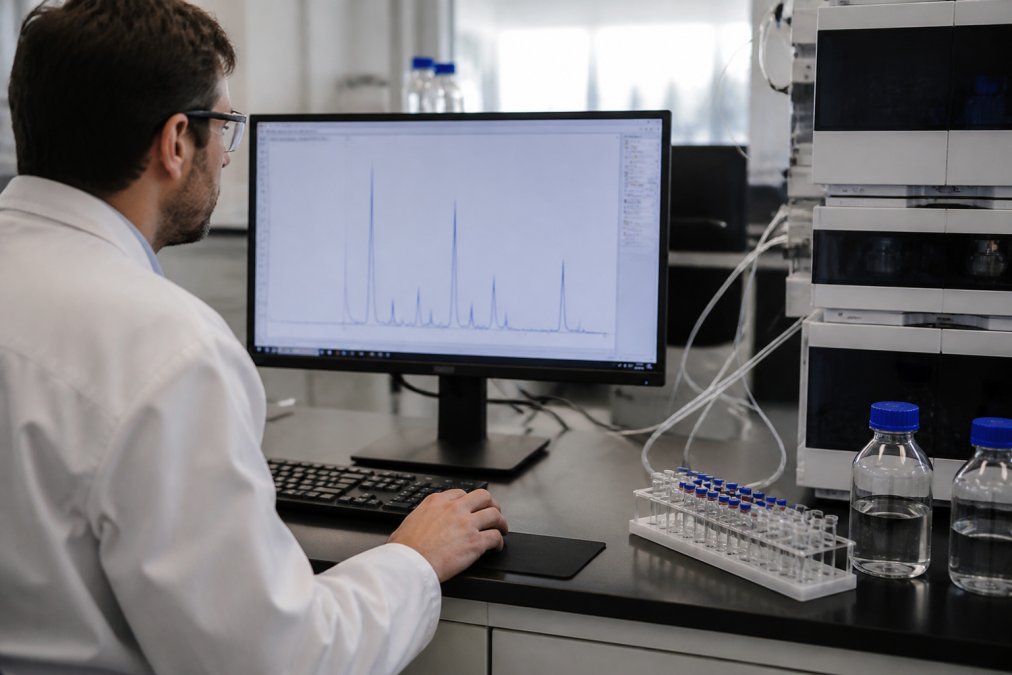
When you evaluate a chromatogram, check for:
- Early-eluting peaks (often polar degradants like pyroglutamate)
- Late-eluting peaks (often hydrophobic deletion or truncation sequences)
- Peak symmetry (tailing suggests column issues or impurity co-elution)
- Baseline drift (may indicate residual solvents or buffer problems)
Is 98% Purity Good for Peptides? Understanding Purity Thresholds
For most research applications, 98% purity is acceptable, but not universally sufficient. The answer depends on what the remaining 2% contains and what your assay can tolerate. For in vitro receptor binding studies where a contaminant might have its own activity, 98% can introduce confounding signal. For pharmacokinetic profiling, even trace impurities can alter clearance measurements.
The Impact of Peptide Impurities on Cell Assays
Impurities can influence cell assays in ways that are easy to miss. A deletion sequence may retain partial receptor affinity, producing a dose-response curve that looks real but reflects a mixture. Oxidized variants can act as antagonists or partial agonists. Residual cleavage reagents, even at trace levels, can be cytotoxic and skew viability readouts.
Mitigation Strategies and Stability Testing Protocols
Most guides on peptide impurities stop at identification, leaving you to figure out what to actually do about them. This section maps each common impurity class to concrete synthesis and handling adjustments, then lays out a stability-testing protocol you can run in a research lab without a dedicated analytical department.
Impurity-Specific Mitigation Tactics
Deletion and truncation sequences. These originate in incomplete coupling during SPPS. The strongest mitigation is upstream: work with suppliers who monitor coupling efficiency with a ninhydrin or Kaiser test after each cycle, use double coupling for sterically hindered residues, and cap unreacted amines with acetic anhydride between cycles. Capping converts a potential deletion sequence into a terminated fragment that is easier to separate during purification.
A Practical Stability Testing Protocol
A stability study does not need a full regulatory apparatus to be useful, the goal is to detect impurity growth before it affects your assay. A workable research-lab protocol:
- Establish a time-zero baseline. Run RP-HPLC and mass spectrometry on a freshly reconstituted aliquot before storage. Record the full chromatogram, not just the main-peak percentage.
- Define storage conditions to test. At minimum, compare -80°C, -20°C, and 4°C for reconstituted aliquots, and -20°C versus room temperature for lyophilized powder. For sensitive assays, add light-exposed and oxygen-exposed arms.
- Set timepoints. For most research peptides, 0, 1, 2, 4, and 8 weeks is enough to see a trend. For peptides with known labile residues (Met, Cys, Asp, N-terminal Gln), add 24-hour and 72-hour early timepoints.
- Run parallel HPLC and MS. Purity percentage alone can hide isomeric and co-eluting impurities. Compare extracted ion chromatograms for the expected mass plus common adducts (+16 oxidation, -17 DKP loss, -18 pyroglutamate cyclization) across timepoints.
- Document everything. Storage temperature, buffer composition, pH, freeze-thaw count, and analytical method should travel with the data. A stability result without those variables is not reproducible.
Freeze-Thaw and Aliquot Discipline
Repeated freeze-thaw cycles are one of the most common causes of unexplained impurity growth in research settings. Each thaw introduces moisture and oxygen and gives degradation pathways a window to act. The fix is simple but requires discipline: reconstitute once, aliquot into single-use volumes on day one, and freeze immediately. Never refreeze a thawed aliquot, for expensive or scarce peptides, this practice pays for itself in preserved material.
Matching Mitigation to Your Assay
The right mitigation strategy depends on what your assay can tolerate. A cell-viability readout may be insensitive to a 2% oxidized variant; a receptor-binding assay may not be. Before investing in elaborate storage controls, ask what impurity level your readout can actually detect, then design your handling around that threshold. The most rigorous protocol matches the sensitivity of the question you are asking.
Frequently Asked Questions
What are the most common impurities found in synthetic peptides?
Common peptide impurities in research include deletion sequences, truncation sequences, and amino acid insertions from the synthesis process. Product-related impurities often involve oxidation, diketopiperazine formation, and pyroglutamate conversion. Other impurities include residual solvents, cleavage reagents, and isomeric forms. Understanding these categories helps researchers evaluate Certificate of Analysis documentation and anticipate how impurities might affect experimental outcomes.
Is 98% purity good for peptides used in cell assays?
For many routine cell assays, 98% purity is acceptable, but it depends on the specific application. If your assay is sensitive to structural analogs or oxidized variants, even 2% impurity can skew results. For receptor binding studies or pharmacokinetic profiling, ≥99% purity with full analytical documentation is preferable. Always review the Certificate of Analysis to confirm which impurities are present and at what levels.
How do I interpret peptide HPLC chromatograms to identify impurities?
In a peptide HPLC chromatogram, the main peak represents your target peptide, while smaller peaks indicate impurities. Early-eluting peaks often correspond to deletion sequences or polar degradation products. Late-eluting peaks may indicate hydrophobic impurities like truncation sequences. The area percentage of each peak gives a rough purity estimate. For definitive identification, pair HPLC with mass spectrometry to confirm molecular weights and structural characterization.
Why is a Certificate of Analysis critical for peptide research?
A Certificate of Analysis (COA) documents the analytical testing performed on a peptide batch, including HPLC purity, mass spectrometry confirmation, and sometimes residual solvent levels. Without a COA, you cannot verify that the peptide meets your specifications or trace impurities that might affect experimental reproducibility. A detailed COA from a supplier like Globo Research Peptides provides transparency and supports compliance with institutional quality standards.